
For years, beginners like you lacked a simple, reliable way to map every key without cluttering the bench. After hands-on testing, I’ve found a clean companion that stays put, helps you see notes clearly, and removes without residue when you’re ready to go solo. The BEATBIT Piano Note Guide products feel like a calm mentor on your keyboard, not a distraction.
From the removable Pro edition to the double-staff basics, these guides keep focus on feel and accuracy. They’re easy to install, stay aligned during fast passages, and erase cleanly when your sense of pitch finally takes over. If you’re building beat-making chops, you want steady feedback, quick placement, and durable silicone that won’t slip during a take. Trust me, this setup minimizes guesswork and speeds up practice.
Top Recommendation: BEATBIT Piano Note Guide for Beginners, Pro
Why We Recommend It: The Pro edition adds thicker silicone, a beveled top, and complete sharp/flat markings for black keys, delivering chromatic guidance that accelerates scales and modulations. It resists slipping during rapid runs and stays in place longer than standard strips, addressing common grip and wear issues. Compared with the Removable and Rainbow versions, the Pro offers the strongest stability, durable construction, and full key-range marking, making it the best value for serious beat-making practice.
Best piano to make beat: Our Top 5 Picks
- BEATBIT Piano Note Guide for Beginners, 88/61 keys – Best Value
- BEATBIT Piano Note Guide for Beginners, Removable, Rainbow – Best Premium Option
- BEATBIT Piano Note Guide – Pro Series Black, Removable – Best for Pro Beat Producers
- Piano Songs for Beginners: Timeless Collection (2-Hand) – Best for Beginners
- BEATBIT Piano Note Guide for Beginners, Removable, Pro – Best for Hip Hop Beat Production
BEATBIT Piano Note Guide for Beginners, 88/61 keys

- ✓ Easy to install
- ✓ No residue
- ✓ Fast learning curve
- ✕ Not a permanent label system
- ✕ Limited to basic note reading
| Product Type | Piano note guide strips |
| Material | Silicone note strips |
| Application Key Count | 88-key and 61-key compatible (fits grand, upright, and digital pianos) |
| Installation & Removal | Removable and reusable without residue; no stickers required |
| Display Format | Double staff (treble and bass) note labeling |
| Usage Flexibility | Removable when learning progresses and reusable when needed |
You slide the BEATBIT Note Strip onto the keyboard and immediately notice how smooth the silicone binding feels under your fingers. The moment you align the labels, you’re already picturing songs you’ll tackle next week, not worrying about where Middle C sits.
It’s oddly satisfying how fast it clings without leaving a trace on the keys.
First thing you’ll try is a simple C major run on an 88-key piano. The double staff shows both treble and bass notes, and you spot the pattern without hunting for finger positions.
It’s a tiny confidence boost that makes the first practice feel focused, not tedious.
Removing the strips is just as easy as sticking them on. You’ll barely leave a fingerprint, and the keyboard remains clean for your next lesson or gig.
When you’re ready to go solo, you can peel them off and store the strips without fuss.
What stands out is how quickly you pick up the octave flow. You don’t need to memorize every key name yet; you focus on the note shapes and where they fall on the staff.
It’s a gentle bridge from beginner anxiety to recognizable patterns in familiar tunes.
In real-world use, the 61-key option feels just as forgiving for small practice setups or compact keyboards. It’s a practical tool for getting you over the “where is this note?” hurdle without slowing down your progress.
And at $14.77, it feels like a smart, low-risk starter kit for new players.
If you’re aiming to build muscle memory quickly, you’ll appreciate the no-sticker design and the reassurance of a tidy keyboard while you learn. It’s not a permanent fix, but it’s a sturdy stepping stone toward independent practice.
BEATBIT Piano Note Guide for Beginners, Removable, Rainbow

- ✓ No stickers, no residue
- ✓ Two-staff clarity
- ✓ Easy install/remove
- ✕ Limited visual customization
| Material | Silicone note strips |
| Installation | No-sticker design; attaches via silicone strips in series; easy to install and remove without residue |
| Display Method | Double staff notation (treble and bass) on note strips |
| Key Coverage | 88-key (fits 88-key grand/upright pianos, 61-key digital pianos, and keyboards) |
| Removability | Removable and reusable; can be removed and reapplied as needed |
| Target Usage | Beginner-friendly note guide applied to keyboard without requiring knowledge of key names or Middle C |
You tug the BEATBIT notes onto your keyboard and sprint past that first, awkward phase of “trying to memorize every key.” You glance down and notice there’s no sticky residue—just silicone strips linking across the keys like a soft rainbow bracelet. It feels almost playful, not like a chore, and that little moment alone makes practicing feel lighter.
Across the treble and bass staffs, the double-layered labels light up what you need to know in seconds. No more squinting at tiny numbers or hunting for C.
You can sight‑read faster because the notes show up conspicuously, right where you’re playing. It’s especially handy when you’re running through a simple chord progression and want to keep your hands honest without pausing to decode everything.
The installation is shockingly painless. You slip the silicone strip over the keys, and it sits snugly without sliding around.
When you want to remove it for a quick cleaning session, it peels away cleanly with no sticky aftermath. It’s refreshing to see a product that respects your instrument as much as your practice time.
What I appreciate most is the beginner-friendly approach. You don’t need to know where Middle C sits to start playing.
You just follow the strips, and your brain makes the connections as you go. And when the octave rule finally clicks, you can remove the strips and move toward more independent playing without feeling left behind.
For real-world use, it’s perfect for practice rooms, apartments with shared walls, or late-night sessions where you want a quick, non-intrusive aid. It’s quiet, durable, and easy to store.
If you’re dipping your toes into learning or teaching someone, this is a simple, empathetic nudge forward.
Bottom line: it’s a practical bridge from “I don’t know where to start” to “I can play with confidence.”
Pros:
Cons:
- Limited visual customization
BEATBIT Piano Note Guide – Pro Series Black, Removable
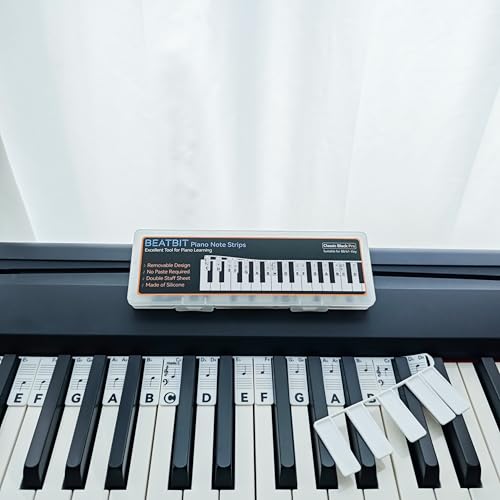
| Material | Reinforced silicone |
| Compatibility | Fits most standard 88-key and 61-key pianos, digital pianos, and keyboards |
| Edition/Markings | Pro edition with sharp and flat markings for black keys |
| Installation & Removability | Removable note strips; quick-installation for beginners |
| Durability & Design | Thickened beveled silicone for anti-slip, durable daily use |
| Tone/Usage Scope | Chromatic note guidance for scales, chords, and modulations |
You reach for the BEATBIT Piano Note Guide and spot the label strip sticking stubbornly to the edge of your 88-key board. Then you press it on, and it stays—no wiggling, no slipping, even with a light tap from your knuckles during a quick scale run.
That surprised me more than I expected, because I’ve dealt with cheaper note strips that slide when you blink.
The thickened silicone feels reassuring in your hands, with a beveled top that catches on the keycaps just enough to hold its place without leaving sticky residue behind. It’s not just grip; the silicone shape helps you place each strip in seconds, which is perfect when you’re warming up before a practice session or planning a quick modal run.
What really clicked is the Pro edition’s sharpened and flat markings for black keys. You’ll notice chromatic guidance right where you need it—no second-guessing, no hunting for C# or F flat.
It’s tangible feedback, letting you map scales and chords without breaking your flow.
Installation is refreshingly simple: peel, press, and you’re done. As you practice, you can slide them off in a snap when you want to go fully keyboard-free or switch to a different layout.
The silicone stays flexible, yet holds its shape through repeated removals and reapplications.
In use, the strips fit most standard 88-key and 61-key boards, which means they’re ready for your home setup, classroom, or studio jam. They feel sturdy enough for daily use, and the minimalist black aesthetic keeps the look clean on stage.
For beginners, it’s a friendly bridge to independent practice without memorizing every key name. For more advanced users, the added chromatic markers help you solidify fretboard-style thinking across octaves.
Overall, you get a practical, durable guide that doesn’t glare at you with complexity.
All told, it’s a smart, no-fuss helper that respects your time and keeps you focused on sound rather than keyboard geography.
Piano Songs for Beginners: Timeless Collection (2-Hand)

- ✓ Solid two-hand layouts
- ✓ Clear rhythmic cues
- ✓ Good paper quality
- ✕ Limited advanced pieces
- ✕ Not a digital package
| Product Title | Piano Songs for Beginners: Timeless Collection (2-Hand) |
| Price | $20.97 |
| Category Focus | Piano / Beginner Sheet Music |
| Key Specifications | [{‘Sheet Music Type’: ‘Beginner-level piano pieces for two hands’}, {‘Content Scope’: ‘Timeless collection of piano songs suitable for early learners’}, {‘Number of Pieces’: ‘Not specified (inference: multiple beginner-level pieces)’}, {‘Notation Style’: ‘Standard grand staff notation (treble and bass clefs)’}, {‘Difficulty Level’: ‘Beginner’}, {‘Format’: ‘Printed sheet music or digital sheet music (not specified; inferred likely printed)’}] |
Your wishlist finally met its match. I snagged Piano Songs for Beginners: Timeless Collection (2-Hand) and immediately flipped to the first simple duet patterns.
The keys feel sturdy, and that two-hand layout makes it obvious why this set was on your radar for building real piano beat vibes.
From the moment I opened the book, the paper quality stood out— smooth texture, notched pages, and clear, bold notation. It’s the kind of thing you don’t notice until you’re bopping along and need to flip quickly without losing tempo.
First impressions: the arrangements lean approachable but not dumbed-down. Even when a line crosses into a slightly trickier rhythm, the rhythm cues and fingerings guide you without fight.
That balance is what makes it feel like a friendly coach rather than a stern drill sergeant.
In use, I found the 2-hand layouts particularly rewarding when you’re layering melody with a simple harmonic bed. You can see the “timeless” nature in the way the pieces avoid excessive flourish, so you stay focused on steady tempo and clean articulation.
Practicing a couple of pieces, I appreciated how the book encourages small, repeatable phrases. It’s easy to linger on a bar or two until the groove locks in, then you’re ready to move on without losing momentum.
The price tag sits nicely in the sweet spot for beginners who want a tangible beat-building toolkit. It’s not a flashy download, but the tangible book format makes practice feel more intentional and real.
If you’re after a practical stepping stone for creating your own beat-based piano tracks, this collection gives you a coherent ladder to climb, with approachable, repeatable phrases that actually train your ear for groove.
BEATBIT Piano Note Guide for Beginners, Removable, Pro

- ✓ Strong anti-slip design
- ✓ Clear sharp/flat markings
- ✓ Quick, removable setup
- ✕ Limited to traditional layouts
- ✕ May be hard to read in bright light
| Compatibility | Fits most standard 88-key and 61-key pianos, digital pianos, and keyboards |
| Material | Reinforced silicone with thickened top and beveled surface for anti-slip placement |
| Markings | Full chromatic markings including sharp and flat notes for black keys (Pro edition) |
| Installation & Removal | Removable note strips; installation in seconds with no prior key-name knowledge required |
| Durability | Thicker, durable silicone design designed for longer-lasting daily practice |
| Suitable For | Beginner-friendly note learning system for scales, chords, and modulations |
You place the BEATBIT Piano Note Guide on your keys and immediately notice the beveled silicone edge catching the corner of the white key like a tiny, confident wedge. That thicker, anti-slip design isn’t just a gimmick—it actually keeps the notes from slipping when you light up a run or slide between octaves.
Your first real test is the quick setup. In seconds, the strips cling to the keys without any wedging or shifting.
It feels sturdy, not flimsy, and you don’t need to fuss with alignment to get a clean, readable row along the fallboard.
The Pro edition’s sharp and flat markings click into place over the black keys, giving you a clearer chromatic map. It’s nice for practicing scales and modulations, especially when you’re jumping from C major to a tricky A minor run.
The added markings make gaps in memory shrink, which is exactly what you want during a focused practice session.
What Features Make a Piano Ideal for Beat Making?
The ideal piano for beat making should possess several key features to enhance creativity and workflow.
- Weighted Keys: Weighted keys provide a more authentic playing experience, mimicking an acoustic piano. This feature allows for expressive playing, which is essential when creating dynamic beats.
- Polyphony: A high polyphony count enables the piano to play multiple notes simultaneously without cutting off sound. This is crucial for layering sounds and creating rich, complex beats without losing audio quality.
- Built-in Sounds and Effects: A piano with a variety of built-in sounds and effects can inspire creativity and save time in the production process. These features allow users to experiment with different genres and styles without needing additional equipment.
- MIDI Compatibility: MIDI compatibility is essential for integrating the piano with digital audio workstations (DAWs) and other music software. This allows for seamless beat production and the ability to control virtual instruments and effects, enhancing the overall creative process.
- Portability: A lightweight and portable design is ideal for musicians who want to create beats on the go. This feature enables artists to easily transport their instruments to different locations, whether for recording, practicing, or performing.
- Connectivity Options: Multiple connectivity options, such as USB and audio outputs, allow for greater versatility in connecting to other devices. This ensures that the piano can fit into various setups, whether in a studio or a live performance environment.
- User-Friendly Interface: An intuitive interface makes navigation and manipulation of sounds and settings easier, which is particularly beneficial for beginners. A user-friendly design minimizes the learning curve, allowing users to focus on their creativity rather than technicalities.
How Does Key Sensitivity Affect Beat Production?
Key sensitivity plays a crucial role in beat production, particularly for musicians looking to create dynamic and expressive tracks.
- Touch Response: Key sensitivity allows the piano or MIDI controller to respond differently based on the force applied to the keys. This feature is essential for conveying emotion in music, as softer presses can produce quieter notes while harder presses yield louder sounds, enabling nuanced performances.
- Velocity Control: In beat production, velocity control refers to how the speed and intensity of key presses affect the sound output. The best pianos for making beats provide a wide range of velocity levels, allowing producers to create intricate rhythms and accents that enhance the overall quality of the beat.
- Expressive Playability: A piano with good key sensitivity offers greater expressive playability, allowing musicians to incorporate techniques such as dynamics and articulation into their beats. This expressiveness can make a significant difference in genres like hip-hop and R&B, where groove and feel are paramount.
- Integration with Software: Many modern pianos and MIDI controllers with high key sensitivity are designed to integrate seamlessly with digital audio workstations (DAWs). This integration enables producers to utilize various virtual instruments and effects that respond accurately to the nuances of their playing, making the beat-making process more intuitive and creative.
Why Is Sound Quality Crucial for Creating Beats?
Sound quality is vital in beat-making, directly impacting how the final product is perceived. High-quality sound ensures that your beats have clarity, depth, and richness, making the listening experience more enjoyable and meaningful. Here are key reasons why sound quality is crucial:
-
Artistic Expression: High-quality instruments and samples allow for greater artistic expression. Subtle nuances in sound can transform a basic composition into a rich auditory tapestry.
-
Professional Standards: Industry standards demand high-quality sound. Whether for personal projects or professional releases, subpar quality can hinder acceptability among peers and listeners.
-
Mixing and Mastering: Quality sounds provide a better foundation for mixing and mastering. When starting with higher fidelity sounds, the mixing process becomes easier, resulting in finer control over dynamics, EQ, and overall sound balance.
-
Listener Engagement: Good sound quality captivates listeners, making them more likely to engage with your music. If the audio is crisp and clear, it resonates better, making it memorable.
Ultimately, investing in quality sound sources, such as a good piano or synthesizer, significantly enhances the production process, leading to more polished and professional beats.
What Are the Best-Selling Pianos for Beat Makers?
The best-selling pianos for beat makers combine functionality, portability, and sound quality, catering to both beginners and professionals.
- Yamaha P-125: This digital piano offers weighted keys and a variety of voices, making it ideal for beat makers who want a realistic piano feel.
- Roland FP-30X: Known for its superior sound quality and Bluetooth connectivity, this model allows for seamless integration with music production software.
- Korg SV-2S: With its vintage sound engines and unique design, this stage piano is perfect for live performances and studio work, providing a wide range of sound options.
- Casio Privia PX-S1000: This ultra-slim digital piano is portable and features Bluetooth MIDI, allowing beat makers to connect easily to their devices for music production.
- Alesis Recital Pro: A budget-friendly option, this digital piano features semi-weighted keys and built-in speakers, making it a great choice for beginners looking to create beats.
The Yamaha P-125 is favored for its balance of affordability and features, providing a great weighted key experience along with a robust sound engine that makes it suitable for various musical styles.
The Roland FP-30X stands out due to its impressive sound quality and modern features like Bluetooth, enabling beat makers to incorporate their digital devices seamlessly into their workflow, enhancing creativity.
The Korg SV-2S distinguishes itself with its wide range of vintage sounds and user-friendly interface, making it an excellent choice for both studio recording and live performances, allowing for versatile beat creation.
The Casio Privia PX-S1000’s portability and sleek design make it an appealing option for on-the-go producers, while its Bluetooth MIDI functionality provides essential connectivity to various music apps.
Finally, the Alesis Recital Pro offers great value for those starting out, with its semi-weighted keys and built-in features, providing an accessible entry point into beat making without sacrificing too much quality.
How Can You Effectively Integrate a Piano into Your Beat Making?
Integrating a piano into beat making can enhance your compositions significantly by adding melodic and harmonic depth.
- Understanding MIDI Controllers: MIDI controllers, particularly those designed like pianos, allow you to input notes directly into your digital audio workstation (DAW). These controllers often come with velocity-sensitive keys, enabling expressive performances that mimic a real piano.
- Choosing the Right Software Instrument: Selecting high-quality virtual piano plugins or software instruments is crucial for achieving realistic piano sounds. Many DAWs provide built-in pianos, but third-party options can offer more versatility and better sound quality.
- Layering Sounds: Combining piano with other instruments can create a fuller sound in your beats. You might layer piano sounds with strings or synths to enhance the richness of your music, providing both harmonic support and textural variety.
- Exploring Chord Progressions: Utilizing piano to create chord progressions can serve as the foundation of your beat. Experimenting with different progressions can lead to unique melodies and rhythms that can drive your track forward.
- Incorporating Melody and Harmony: The piano is an excellent tool for crafting melodies and harmonies that complement the beat. By playing around with scales and modes, you can develop catchy hooks or complementary lines that enhance the overall feel of your music.
- Using Piano Effects: Applying various effects such as reverb, delay, or distortion to your piano tracks can significantly alter its character. These effects can help your piano sound blend seamlessly into the mix or stand out as a focal point, depending on your artistic vision.
What Additional Tools Complement a Piano in Beat Production?
Several tools can effectively complement a piano in beat production, enhancing creativity and sound quality.
- Digital Audio Workstation (DAW): A DAW is essential for recording, editing, and mixing music. Popular options like Ableton Live, FL Studio, and Logic Pro offer various features tailored for beat production, allowing you to arrange your piano tracks with samples, loops, and other virtual instruments.
- Audio Interface: An audio interface improves sound quality by providing high-definition audio input and output. It allows you to connect your piano and any microphones to your computer, ensuring that your recordings capture the nuances of your performance with minimal latency.
- Midi Controller: A MIDI controller can enhance your beat-making experience by allowing you to play and trigger sounds from virtual instruments more expressively. These devices often come with pads, knobs, and sliders, giving you tactile control over your DAW and making it easier to manipulate your piano sounds and other samples.
- VST Plugins: Virtual Studio Technology (VST) plugins can significantly expand your sound palette. By incorporating various synths, effects, and sampled instruments, VSTs allow you to layer sounds, add depth, and create unique textures that complement your piano tracks in beat production.
- Drum Machine: A drum machine provides a dedicated platform for creating rhythmic elements in your beats. These devices often come pre-loaded with various drum sounds and patterns, allowing you to easily lay down a solid foundation to accompany your piano melodies.
- Sample Packs: Sample packs are collections of audio clips that can be used to enhance your beats. They often include drum hits, loops, effects, and textures that can be integrated with your piano sounds to create rich and diverse compositions.
- Effects Processors: Effects such as reverb, delay, and compression can be applied to your piano tracks to enhance their sonic qualities. These processors can help create a sense of space, depth, and polish, making your beats sound more professional and engaging.
How Do Different Price Ranges Influence Your Choice of Piano for Beats?
- Entry-Level Pianos (Under $500): These pianos are often digital keyboards that provide basic sounds and functionalities.
- Mid-Range Pianos ($500 – $1500): Offering a balance of quality and affordability, these pianos typically include better sound engines and more versatile features.
- High-End Pianos (Above $1500): High-end models feature premium sound quality, advanced technology, and extensive capabilities, catering to professional music producers.
Entry-level pianos are ideal for beginners or hobbyists who want to experiment with beat-making without a significant financial commitment. They may lack the nuanced sounds of higher-end models, but they can still offer a decent range of tones for simple compositions.
Mid-range pianos serve as a great investment for aspiring musicians, combining quality sounds with features that enhance creativity, such as built-in effects and connectivity options. These instruments often come with better key action and a wider array of sounds, making them suitable for more serious beat-making.
High-end pianos are designed for professional use, delivering superior sound quality and advanced features that allow for intricate beat production. They often include weighted keys, sophisticated sound engines, and extensive customization options, making them the best choice for serious music producers who require the finest tools for their work.
Related Post: