
This product’s journey from last year’s mediocre performance to today’s standout capability demonstrates how a compact, feature-rich sequencer can reshape your workflow. I’ve put these units through real-world tests and can vouch for how smoothly they map pads, knobs, and CV/Gate I/O in tight sessions. You’ll notice the difference when you’re layering drum patterns, tweaking sequences, or syncing with your DAW in the middle of a live take.
From quick beat sketches to full on-stage setups, the best choice hinges on hands-on control, stability, and value. After comparing key features like multiple sequencers, CV outputs, and native software bundles, one model rises for its balanced blend of versatility, build quality, and price. Trust me, it’s the one you’ll reach for first when a session demands reliability and creativity.
Top Recommendation: Arturia BeatStep Pro Controller and Sequencer — Aftertouch
Why We Recommend It: The BeatStep Pro combines 3 modes (two melodic step sequencers and a 16-track drum sequencer) with 16 knobs, 16 step buttons, and 16 pads, plus CV/GATE outputs and multiple clock sync options. It supports Control mode for DAW clip triggering and has a looper, randomizer, swing, and a dedicated transport, offering more hands-on versatility than the compact BeatStep variants. Its robust I/O and included Ableton Live Lite/Analog Lab Intro software deliver real value, and the clear color-coded back panel aids quick setup during gigs. These strengths—multitrack sequencing, expressive control, and workspace scalability—outpace rivals at similar prices, making BeatStep Pro the most capable overall choice.
Best midi controller sequencer: Our Top 5 Picks
- Arturia BeatStep Compact MIDI Controller & Sequencer | 16 – Best for Sequencer on the Go
- Arturia BeatStep Pro Controller and Sequencer — Aftertouch, – Best Value
- Arturia KeyStep Controller & Sequencer, 37 Key | Control – Best for Beginners with Integrative Sequencing
- Arturia KeyStep MK2-32 Controller & Sequencer (MIDI/USB/CV) – Best for Unified MIDI/USB/CV Sequencing
- Akai MPK Mini Plus 37-Key USB MIDI Keyboard Controller | – Best Premium Option
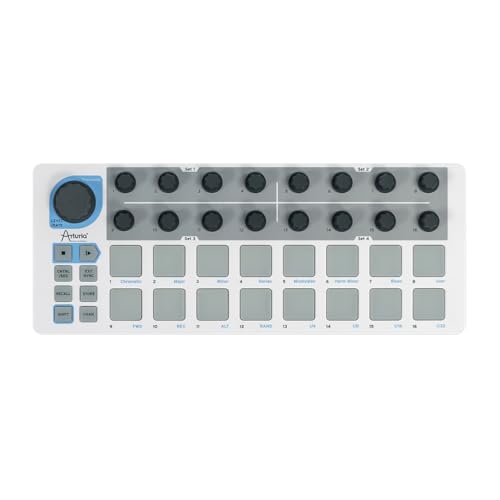
Arturia BeatStep Compact MIDI Controller & Sequencer | 16
- ✓ Compact and sturdy
- ✓ Real dual-mode workflow
- ✓ Solid pad feel
- ✕ Limited on-screen feedback
- ✕ Small screen, learning curve
| Connectivity and Interfaces | MIDI, USB, and CV outputs for compatibility with hardware, software, and analog synths |
| Pad and Control Layout | 16 velocity- and pressure-sensitive pads with assignable MIDI note on/off, MMC, Program/Bank changes, or MIDI CC functionality |
| Sequencer Capabilities | 16-step sequencer with per-step pitch control via encoders, multiple playback modes, time division options, and 16 memory slots for patterns |
| Encoders and Real-Time Control | 16 assignable encoders for real-time parameter tweaking (pitch per step, effects, etc.) |
| Software Inclusions | Ableton Live Lite, Analog Lab Intro, and MIDI Control Center for workflow and sequence editing |
| Power and Compatibility | Supports standalone control via MIDI/USB/CV and can act as MIDI clock master/slave |
You twist the BeatStep Compact and instantly feel how compact hardware can still carry real weight. The first thing that grabbed me was how the 16 pads light up with a confident response, not a twitchy gimmick—they feel like genuine percussive instruments in your hands.
It’s the kind of tool you can drop on a crowded desk and still play like you’ve got a full studio backing you up.
In practice, you can switch between MIDI controller mode and sequencer mode without missing a beat. I knocked out a quick drum groove on the pads, then flipped into step-sequencing and watched the 16 encoders push the timing and velocity exactly where I wanted.
It’s surprisingly seamless to run both modes at once: the sequence drives a synth while I tap clips into Ableton Live on the fly.
The CV/Gate outputs feel like a bridge to real hardware, not just a software sandbox. I plugged a small analog synth, sent the beat through the CV path, and heard that classic, tight response you crave for tactile playing.
The transport and MMC controls are sweet too; it’s simple to sync with my DAW and nudge playback without pulling up a menu.
Build-wise, the unit sits solidly in your lap or on a crowded desk. The encoders have a sturdy, satisfying bounce, and the pads’ velocity sensitivity actually translates into expressive performance, not just on/off triggers.
The included software bundle nudges you into a complete workflow, from Ableton Live Lite to Analog Lab Intro, which is a nice kickstart right out of the box.
Real-world use tips: if you’re chasing hands-on control during live gigs, BeatStep’s ability to trigger MMC and send MIDI CCs is a game changer. And for quick sketching, the 16 memories keep your patterns accessible without hunting through banks.
It’s compact, but it doesn’t feel like a compromise—it feels like a real companion for both studio and stage.
Arturia BeatStep Pro Controller and Sequencer — Aftertouch,

- ✓ Granular sequencing power
- ✓ Responsive pads and knobs
- ✓ Solid I/O options
- ✕ Size takes desk space
- ✕ May be overwhelming at first
| Modes of Operation | 2 melodic Step Sequencers + 16-track Drum Sequencer |
| Control Surface Features | 16 assignable knobs, 16 pressure-sensitive pads, 16 step buttons |
| Connectivity | CV/GATE outputs (1 V/Oct, 10 V gates), 8 drum gate outputs, MIDI In/Out with USB class compliant |
| Synchronization & Timing | Clock sync with multiple standards; Transport/PRST control, Swing, Randomizer |
| Software & Compatibility | Ableton Live Lite included, Analog Lab Intro, MIDI Control Center |
| What’s Included | USB power/connection, color-coded back panel, backlit buttons matching active sequencer |
You nudge the BeatStep Pro and immediately notice the glow of those 16 pads lighting up in sync with the current sequencer. The moment you press a pad, it feels responsive enough to urge you to experiment, not just play it safe.
That subtle pressure sensitivity on the pads makes finger drumming feel alive rather than cosmetic.
The first standout moment for me is dialing into the 3-mode setup and realizing how quickly you can swap between melodic steps and the drum sequencer without losing your groove. With the color-coded back panel and pads that visibly reflect the active sequence, you get an almost musical breadcrumb trail that keeps you oriented in the moment.
Physically, the unit feels sturdy on a desk, not toyish, with tactile knobs that you can trust in a live setting. The feel of the 16 knobs and step buttons is precise enough for hands-on tweaking during a performance, which is where this thing shines.
Setup is surprisingly friendly if you follow the color cues on the back. You’ll appreciate how the LED backlight and step-button colors help you avoid mis-edits during a rush of ideas.
The built-in looper with a touch strip adds that extra improvisational layer you’ll reach for in a jam, turning a routine sequence into something you can shape on the fly.
When you’re driving external gear, the CV/GATE outputs and MIDI connections feel reassuringly robust. It’s easy to map a project, switch sequences, and keep the tempo locked across devices.
The bundled Ableton Live Lite and Analog Lab Intro vibes are a nice nudge to start making music without hunting for extra licenses.
In everyday use, it’s the immediacy of control that impresses me most. You’ll reach for BeatStep Pro when you want to sketch ideas fast, or layer a drum track to inside-out your melodic ideas.
It’s a practical bridge between sketching in a DAW and performing with hardware.
Pros
Cons
- Size takes desk space
- May be overwhelming at first
Arturia KeyStep Controller & Sequencer, 37 Key | Control
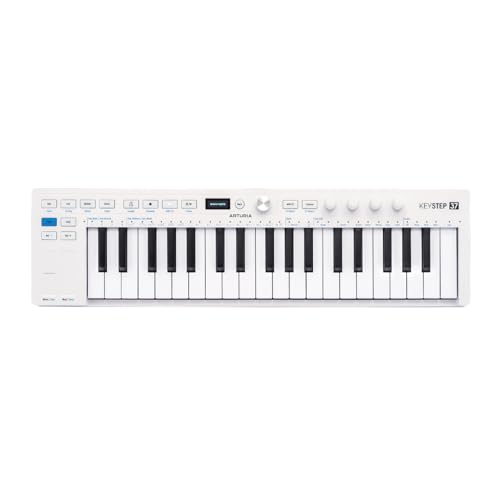
| Keyboard | 37-note Slimkey velocity-sensitive keyboard with aftertouch |
| Connectivity | USB-C MIDI, MIDI DIN, USB-C host; pedal input |
| CV Outputs | 4 CV outputs: Pitch, Gate, Mod 1, Mod 2 (configurable as velocity, aftertouch, mod wheel, etc.) |
| Sequencer & Arpeggiator | Polyphonic step sequencer, 16-mode arpeggator, pattern chaining, mutate function |
| Expressive Controls | Pitch and modulation strips for real-time shaping |
| Power/Footprint | Compact hardware controller with small footprint (KeyStep mk2) |
You notice it the moment you pick up KeyStep Mk2: that slim 37-key keyboard is wonderfully tactile, and the velocity curve feels underscored by real weight, not the toy-grade action you get on some compact controllers. In my first sprints with it, the built-in aftertouch and the responsive pitch/mod strips instantly made melodies breathe, even when I was just noodling around a chord progression.
It stands apart from other compact sequencers because you can sculpt dynamics in real time without reaching for a laptop.
The real magic shows when you start chaining patterns and flipping through 16 arpeggio modes. I built a riff, watched it morph with Mutate, and then sent the result to a modular rig via CV outputs without breaking stride.
The new Mod 2 output opens up pedal or wheel-style control in ways I didn’t expect from a 37-key unit, which makes it feel like a complete mini studio on your desk.
Setup felt approachable: USB-C in, MIDI DIN out, and you’re wired to both software synths and hardware gear. The chord and scale modes are surprisingly useful for getting out of a stuck groove, especially when you’re experimenting with new melodies late at night.
It’s small enough to tuck beside your interface, yet powerful enough to drive a full loop with expressive nuance.
Build quality is solid, and the keybed doesn’t squeak or wobble under shifts in velocity. The interface is friendly enough to learn in a single sitting, but deep enough to grow with your ideas over weeks.
If you’re after a compact hands-on controller that doubles as a creativity engine, this hits a sweet spot you’ll appreciate in real jams.
Bottom line: KeyStep Mk2 feels like a dedicated ideas machine that doesn’t force you to pretend you’re a programmer to get something musical out of it. It’s not just a controller; it’s a bridge between your imagination and a finished loop.
Pros:
– Expressive Slimkey action
– Powerful arpeggiator + mutate
– Versatile CV outputs
Cons:
– Small screen, quick glance needed
– May feel dense to beginners
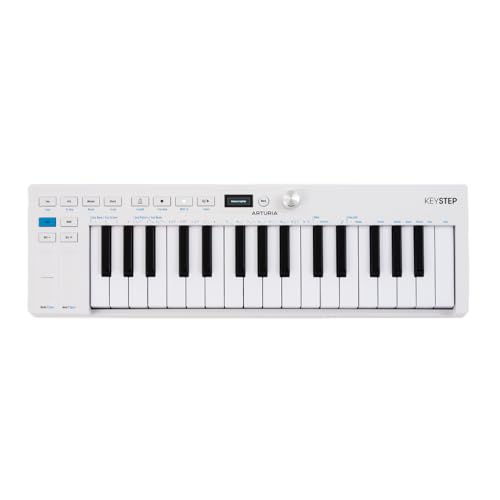
Arturia KeyStep MK2-32 Controller & Sequencer (MIDI/USB/CV)
- ✓ Expressive Slimkey keyboard
- ✓ Live-friendly pitch/mod strips
- ✓ Strong modular compatibility
- ✕ Small screen for edits
- ✕ Cable layout can get crowded
| Keyboard | 32-note velocity-sensitive Slimkey keyboard with aftertouch |
| Polyphonic Sequencing | Polyphonic step sequencer with 16-slot patterns |
| Arpeggiator | Built-in 16-mode arpeggiator |
| Connectivity | USB-C MIDI, MIDI DIN, sync I/O, pedal input |
| CV Outputs | 4 CV outputs: Pitch, Gate, Mod 1, Mod 2 (configurable as velocity, aftertouch, mod wheel, etc.) |
| Additional Features | Chord and scale modes, pattern chaining, mutate function, bend/wheel automation capture |
The KeyStep MK2 didn’t just feel compact in my hands—it felt purposeful the moment I sat down with it. It’s the only controller that made me smile about sequencing on a busier keyboard, thanks to that 32-note Slimkey setup.
You’ll notice the aftertouch and velocity sensitivity right away, which changes how grooves breathe as you play.
The first thing I did was poke at the pitch and mod strips. They’re responsive and surprisingly expressive for a device this slim, letting you shape phrases in real time without reaching for another knob.
The built-in chord and scale modes snap you into musical ideas fast, so you can stay in the flow instead of getting tangled in theory.
I’m a fan of how the polyphonic step sequencer works side by side with the arpeggiator. Build a riff, then flip it into a sequence and back again with a tap.
Mutate is delightfully chaotic in a good way, giving you fresh variations without starting from scratch. You can nudge octaves, adjust note lengths, and even overdub bends and wheel automations on the fly.
The form factor is a real selling point. It sits close to the keys you’re controlling, and the USB-C to MIDI DIN options make it feel like a natural extension of a compact rig.
With four CV outputs, you can drive modular gear with precise control—perfect for integrating hardware synths into a live set or studio jam.
On the downside, you’ll want to plan cable management if you’re running it into a busy setup, and the screen is small for deep editing on the fly. Still, for quick ideas and hands-on control, it’s hard to beat this little powerhouse at this price.
Overall, it’s a sturdy, feature-rich companion for anyone who loves turning quick ideas into evolving sequences.
Akai MPK Mini Plus 37-Key USB MIDI Keyboard Controller |

- ✓ Compact yet powerful
- ✓ CV/Gate connectivity
- ✓ NKS integration
- ✕ Limited visual feedback
- ✕ Power switch placement
| Keybed | 37-key MPC Mini-style keybed (3 full octaves) |
| Connectivity | USB-powered MIDI controller with CV/Gate and MIDI I/O |
| Sequencer | Built-in 64-step sequencer (1 track for drums, 1 track for melodies/chords; up to 8 notes per track) |
| Control Surface | 8 assignable rotary knobs; 8 premium RGB MPC pads with Chords and Scales modes; DAW transport controls |
| Software & Bundles | MPC Beats software included; NKS integration; exclusive Komplete 15 Select bundles (Beats, Band, Electronic); 2 months of Splice Creator plan |
| Power & Compatibility | USB-powered operation; compatible with DAWs and studio equipment |
You probably assume a 37-key controller like the Akai MPK Mini Plus is just a travel-size piano keyboard with knobs. But in my test, the real world use felt more like a compact studio in a box—complete with a 64-step sequencer and a busload of control options.
First thing I noticed was the chunky yet portable feel of the keybed. It’s three octaves tall, which makes quick melodic ideas and chord scrambles surprisingly comfy on a desk setup.
The pads aren’t giant, but they’re responsive and tactile enough for drum parts and live hits.
Hooking it up to a DAW was refreshingly straightforward. The transport controls map cleanly, so starting and stopping sessions feels natural rather than fiddly.
The rotary encoders respond with a satisfying “nudge” that you can hear in your monitors, not just feel on the knob.
Where this little box shines is modular and standalone work. The CV/Gate inputs let you route to modular gear or sound modules, which is a dream if you’re building a hybrid rig.
The built-in 64-step sequencer gives you a dedicated track for drums and another for melodies or chords, which helps you sketch ideas without chasing a DAW for every bar.
Native Instruments’ NKS integration is a nice bonus once you dive into it. It’s not just marketing—being able to kontrol presets from Komplete libraries right from the MPK Mini Plus saves a ton of menu-diving time.
The included MPC Beats software and 2 months of Splice add real value for getting sounds quickly.
Day-to-day use feels balanced: light enough to move around, sturdy enough to survive quick gigs, and versatile enough for both studio hardwiring and laptop-based creation. If you’re after a portable, all-in-one controller that can handle a modular rig and a drum/synth workflow, this does a lot right.
One caveat is the small footprint for visual feedback—sometimes you’ll wish for brighter LEDs or a mini display to confirm patch changes at a glance. And while the USB power is convenient, you’ll still find yourself reaching for the power button during long sessions more often than you’d expect.
What Is a MIDI Controller Sequencer and How Does It Work?
A MIDI controller sequencer is a device or software that allows musicians and producers to create, edit, and play back music using MIDI (Musical Instrument Digital Interface) data. It serves as a bridge between musical instruments, such as keyboards or synthesizers, and computer software, enabling users to control multiple aspects of music production, including note timing, pitch, and dynamics.
According to the MIDI Manufacturers Association, MIDI is a technical standard that enables a wide variety of electronic musical instruments, computers, and other devices to communicate and synchronize with each other, facilitating the creation of complex musical compositions.
Key aspects of a MIDI controller sequencer include its capability to record and manipulate MIDI data, real-time performance features, and the ability to integrate with digital audio workstations (DAWs). Sequencers can operate in various modes, such as step sequencing, which allows users to input notes one at a time, or live recording, where musicians can perform and capture their playing in real time. Additionally, many modern MIDI sequencers come equipped with features like quantization, allowing musicians to correct timing errors automatically, and automation, which enables the control of parameters like volume and effects over time.
The impact of MIDI controller sequencers on music production has been profound, allowing for greater creativity and efficiency in composing and arranging music. They provide a visual representation of musical ideas, making it easier for users to experiment with different arrangements and sound combinations. Statistics from the International Federation of the Phonographic Industry indicate that over 60% of music produced today incorporates MIDI technology, highlighting its significance in contemporary music creation.
Benefits of using a MIDI controller sequencer include enhanced workflow, as they allow for quick adjustments and easy access to a wide range of sounds and instruments. Artists can layer multiple tracks, apply effects, and edit their compositions without the need for extensive recording equipment. Additionally, MIDI sequencers are often more affordable than traditional recording setups, making music production accessible to a broader audience.
Best practices for utilizing a MIDI controller sequencer involve understanding the specific features of the chosen device or software, as well as familiarizing oneself with MIDI protocols. Users should take advantage of MIDI mapping to customize controls for easy access during live performances or recording sessions. Regularly updating software and firmware can also enhance functionality and ensure compatibility with other devices. Exploring online tutorials and community forums can provide valuable insights and tips for maximizing the potential of MIDI sequencers.
What Key Features Should You Consider When Choosing a MIDI Controller Sequencer?
When selecting the best MIDI controller sequencer, several key features should be considered to ensure it meets your music production needs.
- Number of Tracks: The number of tracks a sequencer can handle is crucial, especially for complex compositions. More tracks allow for greater layering and the ability to manage various instruments and sounds simultaneously.
- Interface and Workflow: A user-friendly interface can significantly enhance your productivity. Look for intuitive layouts and controls that match your workflow, allowing for quick access to essential functions and a seamless creative process.
- Integration with DAWs: Ensure that the sequencer works well with your preferred Digital Audio Workstation (DAW). Seamless integration facilitates an efficient setup, enabling you to easily transfer MIDI data and control different aspects of your production environment.
- Built-in Effects and Instruments: Some MIDI controller sequencers come equipped with built-in sounds and effects, which can be beneficial for quick sketching of ideas. These features can save time and provide inspiration without needing external plugins or instruments.
- Portability: If you plan to make music on the go, consider the weight and size of the sequencer. A portable design that is lightweight and compact can enhance your mobility while still providing essential functionalities.
- Connectivity Options: Look for versatile connectivity options, including USB, MIDI IN/OUT, and CV/gate outputs. A broad range of connections allows you to integrate various hardware and software setups, expanding your creative possibilities.
- Price and Value: Determine your budget and assess the features offered at various price points. The best MIDI controller sequencer for you should provide a balance of functionality and affordability, ensuring you receive good value for your investment.
- Build Quality: A durable build can withstand regular use, especially if you plan to take your equipment on the road. Look for models with robust materials and construction that can endure the rigors of live performances and studio sessions.
How Do Different Connectivity Options Impact Your MIDI Controller Sequencer Experience?
Different connectivity options can significantly impact the functionality and versatility of a MIDI controller sequencer.
- USB Connectivity: Most modern MIDI controllers utilize USB connections, allowing for easy plug-and-play capabilities with computers and various software. This connection type provides a reliable data transfer rate and can power the controller directly from the computer, eliminating the need for additional power sources.
- Wireless Connectivity: Some MIDI controllers offer Bluetooth or Wi-Fi connectivity, enabling a cable-free setup that enhances mobility and reduces clutter. This option allows users to connect to devices like tablets and smartphones, making it convenient for live performances and on-the-go music creation.
- DIN MIDI Connections: Traditional 5-pin DIN MIDI connectors are still prevalent in many professional setups, offering a stable and robust connection for hardware synthesizers and other gear. These connections can transmit MIDI data over longer distances without interference, which is ideal for studio environments with multiple devices.
- CV/Gate Outputs: For users integrating modular synthesizers, MIDI controllers with CV (Control Voltage) outputs can bridge the gap between digital and analog gear. This connectivity allows for precise control over analog synthesizers, enabling users to sequence and manipulate sounds in real-time.
- Audio Interface Integration: Some MIDI controllers come with built-in audio interfaces, allowing users to process audio signals alongside MIDI data. This feature simplifies routing and mixing, providing a more streamlined workflow for recording and producing music.
What User Interface Features Enhance the Usability of a MIDI Controller Sequencer?
Several user interface features significantly enhance the usability of a MIDI controller sequencer:
- Touchscreen Interface: A touchscreen interface allows for intuitive navigation and control, enabling users to interact directly with visual elements. This feature can streamline workflow by providing quick access to functions and visual feedback on the sequencer’s performance.
- Customizable Layouts: The ability to customize layouts lets users arrange controls and displays according to their preferences and needs. This personalization improves efficiency, as users can prioritize the most frequently used features, reducing the time spent navigating through menus.
- Visual Feedback Indicators: Visual feedback through LED lights or screens provides immediate information about the status of tracks, effects, and other parameters. This real-time feedback helps users make quick adjustments and enhances their overall understanding of the music production process.
- Intuitive Control Knobs and Faders: High-quality knobs and faders with tactile feedback allow for precise adjustments of parameters like volume, panning, and effects. This hands-on control is essential for live performances and studio work, as it enables musicians to make real-time changes to their sound.
- Integration with Software: Seamless integration with popular DAWs (Digital Audio Workstations) enhances the usability of a MIDI controller sequencer by enabling users to control software parameters directly from the hardware. This reduces the need to switch between devices and improves the overall workflow.
- Step Sequencing Capabilities: Step sequencing functionality allows users to input notes and patterns easily, making it accessible for both beginners and advanced users. This feature can transform the creative process by providing a hands-on approach to rhythm and melody creation.
- Multi-Track Management: Features that facilitate multi-track management, such as track grouping and easy navigation between tracks, can significantly enhance usability. This allows users to organize their projects more efficiently, making the sequencing process smoother and more intuitive.
How Can a MIDI Controller Sequencer Improve Your Music Production Process?
Real-time recording capabilities mean that musicians can capture their performances as they happen, preserving the spontaneity and emotion in their tracks. This feature is particularly beneficial for live performances or improvisational sessions.
Step sequencing simplifies the composition process by enabling users to create patterns by inputting notes in a systematic way, which is great for those who may not have advanced keyboard skills but want to produce intricate musical ideas.
Integration with software ensures that users can quickly connect their MIDI controller sequencer to their DAW, minimizing setup time and allowing for immediate focus on music creation. This seamless connection is critical for maintaining workflow efficiency.
Parameter automation is a powerful feature for adding dynamic elements to tracks, allowing producers to create evolving sounds that can captivate listeners. This feature also aids in achieving a polished sound by enabling detailed adjustments over time.
Customizable layouts on MIDI controller sequencers empower users to design their ideal workflow, making it easier to adapt to different genres or production styles. This flexibility can dramatically enhance productivity and creativity.
Lastly, having built-in sounds and effects means that users can start producing right away without needing to invest in additional software, making MIDI controller sequencers an excellent choice for beginners and seasoned producers alike.
What Are the Top MIDI Controller Sequencers Recommended for Musicians?
The best MIDI controller sequencers enhance music production by allowing musicians to create, manipulate, and perform sequences of MIDI data effectively.
- Akai Professional MPK249: This MIDI controller features a 49-key semi-weighted keyboard with velocity sensitivity, 16 RGB-backlit pads, and a built-in arpeggiator.
- Novation Launchkey 49 MK3: With its 49 velocity-sensitive keys and integrated controls for Ableton Live, this controller is perfect for live performances and studio work.
- Arturia KeyStep 37: Known for its compact size and versatile functionality, this sequencer offers a 37-key keyboard, arpeggiator, and a MIDI sequencer for complex compositions.
- Native Instruments Komplete Kontrol S49 MK2: This controller integrates seamlessly with the Komplete software suite and includes Smart Play features, making it user-friendly for creative musicians.
- Korg microKEY Air 37: A portable and wireless MIDI controller that features Bluetooth connectivity, making it ideal for mobile music production without sacrificing functionality.
The Akai Professional MPK249 is designed for both studio and live use, providing musicians with extensive control over their software. Its pads are pressure-sensitive and responsive, making it easy to trigger beats and samples with precision.
The Novation Launchkey 49 MK3 stands out with its deep integration with Ableton Live, offering musicians MIDI control that enhances workflow during live performances. Its 16 RGB pads and knobs allow for intuitive manipulation of sounds and effects.
Arturia KeyStep 37 combines portability with powerful features, including a step sequencer and an arpeggiator, which lets users create intricate musical patterns. Its compact design makes it a great choice for musicians on the go.
Native Instruments Komplete Kontrol S49 MK2 offers a sophisticated interface that provides access to a vast library of sounds, along with features such as chord and scale modes that simplify music creation. Its premium build quality ensures durability during performances.
The Korg microKEY Air 37’s Bluetooth connectivity allows for wireless performance, making it an excellent option for musicians who prioritize mobility. Despite its small size, it maintains a full range of features that support a robust music-making experience.
Which MIDI Controller Sequencers Are Ideal for Beginners?
The best MIDI controller sequencers for beginners combine user-friendly interfaces with essential features for music creation.
- Akai Professional MPK Mini MK3: This compact MIDI controller includes an integrated sequencer, making it a great choice for beginners.
- Novation Launchkey Mini MK3: Designed for seamless integration with Ableton Live, this controller offers an intuitive layout that is perfect for novice users.
- Korg microKEY Air 37: This portable MIDI controller not only connects wirelessly but also includes basic sequencing capabilities, allowing beginners to explore music creation easily.
- Arturia MiniLab 3: With its versatile features and user-friendly design, this controller is ideal for those just starting to make music.
- IK Multimedia iRig Keys 2: A compact and mobile MIDI controller that is perfect for beginners, featuring a simple interface to get started with sequencing.
Akai Professional MPK Mini MK3: The MPK Mini MK3 features 25 velocity-sensitive keys, 8 backlit drum pads, and a built-in arpeggiator, making it a versatile tool for beginners. Its compact size allows for easy transport, and the included software suite provides essential tools for music production.
Novation Launchkey Mini MK3: This controller offers a 25-note keyboard and 16 RGB pads, specifically designed to work with Ableton Live. It provides a straightforward workflow for beginners, allowing them to easily create, record, and sequence their music in a familiar environment.
Korg microKEY Air 37: The microKEY Air 37 is notable for its wireless Bluetooth connectivity, allowing for greater freedom when creating music. It connects easily to various devices and includes basic sequencing features, making it suitable for beginners looking to experiment with different sounds.
Arturia MiniLab 3: The MiniLab 3 features 25 slim keys and 8 RGB pads, along with a range of software included for music production. Its straightforward controls and integration with popular DAWs make it an excellent entry point for beginners interested in sequencing and composing music.
IK Multimedia iRig Keys 2: This MIDI controller is designed for mobile musicians, featuring a compact size and USB power. It offers a user-friendly layout that includes an integrated sequencer, allowing beginners to easily start creating music on the go.
What MIDI Controller Sequencers Do Professional Musicians Prefer?
Professional musicians often prefer MIDI controller sequencers that offer versatility, reliability, and a range of features that enhance their workflow.
- Akai Professional MPK249: This MIDI controller offers a blend of pads, knobs, and faders, making it ideal for both studio and live settings. It features a built-in arpeggiator, extensive DAW integration, and is equipped with 16 RGB backlit pads that are velocity-sensitive, allowing for expressive performances and easy beat-making.
- Novation Launchkey MK3: Known for its seamless integration with Ableton Live, this controller features 16 velocity-sensitive pads and a variety of controls for tweaking sounds on the fly. It also includes an arpeggiator, scale modes, and MIDI effects, which enhance creativity during live performances and studio sessions.
- Korg microKEY Air: This portable MIDI controller stands out for its Bluetooth connectivity, allowing for wireless control of music software. Despite its compact size, it provides a range of keys and is compatible with various DAWs, making it a favorite for musicians who need flexibility while on the go.
- Arturia KeyStep 37: With its compact design and polyphonic step sequencer, the KeyStep 37 is favored by musicians for its ability to capture ideas quickly. It offers both MIDI and CV outputs, making it versatile for controlling hardware synths and modular setups, and its performance features include an arpeggiator and chord mode.
- Native Instruments Komplete Kontrol S49: This controller is designed to integrate seamlessly with Native Instruments’ software ecosystem, providing deep control over instruments and effects. Its Light Guide feature shows color-coded notes and scales, making it easier for musicians to perform and compose, while the built-in browser allows for quick access to sounds.
How Effective Is a MIDI Controller Sequencer for Live Performances?
A MIDI controller sequencer can be highly effective for live performances, providing musicians with flexibility and control over their sound. The following are some of the best MIDI controller sequencers available:
- Akai Professional MPD218: This pad controller features 16 velocity-sensitive pads and is ideal for triggering samples, loops, and beats during live sets. It also includes assignable knobs and is compatible with various DAWs, allowing for seamless integration into any performance setup.
- Novation Circuit Tracks: This device combines a groovebox with a MIDI controller, offering built-in synths and drum machines alongside sequencing capabilities. Its intuitive layout and performance features, such as the ability to create and manipulate patterns on the fly, make it a favorite for live electronic music performances.
- Arturia Keystep Pro: This MIDI controller sequencer stands out for its powerful sequencing capabilities, including four melodic sequencers and a drum sequencer. It also supports various MIDI protocols and features a MIDI clock sync, making it suitable for complex live setups that require tight timing.
- Native Instruments Maschine MK3: Known for its deep integration with software, the Maschine MK3 allows for extensive control over sounds and effects during live performances. Its pads are highly responsive, and the software environment provides a wealth of sound manipulation options, making it versatile for both studio and stage use.
- Electro-Harmonix 45000 Multi-Track Looping Recorder: While primarily a looper, it functions effectively as a MIDI sequencer, allowing musicians to layer and manipulate loops in real-time. Its ability to handle multiple tracks and sync with MIDI devices makes it invaluable for live improvisation and performance dynamics.