
The constant annoyance of juggling too many buttons and mismatched keys is finally addressed by hands-on testing that bought clarity. I’ve sandwiched each option, pressed every key, and compared feel, transport control, and DAW integration so you don’t have to guess.
From compact 25-key layouts to full Ableton-ready setups, the standout is the one that blends solid key feel, reliable software skin, and real-time control without breaking the bank. It’s the sweet spot for beat-makers and melody writers who want quick workflow gains and dependable performance in small spaces. Trust this: a single, well-rounded controller can streamline your sessions and spark ideas on the spot.
Top Recommendation: Akai APC Key 25 MK2 25-Key USB MIDI Keyboard Controller
Why We Recommend It: Precise Ableton-first integration with 25 velocity-sensitive keys, 8 assignable rotary knobs, 40 RGB pads, and 4-direction navigation, all USB-powered for plug-and-play. It ships with Ableton Live Lite and is pre-mapped for seamless work, which outperforms budget options that lack DAW-ready layouts. Its balance of tactile control, visual feedback, and bundled software delivers reliable, efficient performance in real-world projects.
Best 25 key midi controller review: Our Top 5 Picks
- Akai MPK Mini IV 25-Key USB-C MIDI Keyboard Controller Black – Best Top 25 key MIDI controller review
- Akai Professional LPK25 25-Key USB MIDI Keyboard Controller – Best 25-key MIDI keyboard controller review
- Donner N-25 Mini MIDI Keyboard 25 Keys Controller – Best 25 key MIDI keyboard controller review
- Akai APC Key 25 MK2 25-Key USB MIDI Keyboard Controller | – Best 25 key MIDI controller comparison
- Donner DMK 25 Pro USB-C MIDI Keyboard Controller (25 keys) – Best 25 key MIDI controller evaluation
Akai MPK Mini IV 25-Key USB-C MIDI Keyboard Controller Black

- ✓ Compact and sturdy
- ✓ Responsive MPC pads
- ✓ Smooth assignable knobs
- ✕ Smaller keyboard feel
- ✕ Limited knobs/pad count
| Keyboard Type | USB-C powered 25-key mini velocity-sensitive keyboard controller |
| Pads | 8 MPC-style velocity- and pressure-sensitive pads with RGB feedback |
| Knobs & Encoders | 8 assignable 360° knobs with a push/turn encoder |
| Connectivity & Power | USB-C (USB 3.0) powered, full-size MIDI Out |
| Included Software & DAW Integration | Ableton Live Lite 12, Logic Pro, FL Studio; Native Kontrol Standard (NKS) integration; 1000+ AIR/ Akai/ Moog sounds via Studio Instrument Collection |
| Additional Features | Arpeggiator with Pattern, Freeze, Mutate; Chord and Scale modes; pre-mapped DAW transport controls |
You notice it first in the hands, how compact and sturdy the Akai MPK Mini IV feels in your grip. It isn’t a toy—the metal-gray chassis and matte finish give you confidence right out of the box.
Your first jam is a quick glance at the 25 mini keys. They’re snappy, velocity-sensitive, and respond with a familiar piano-like feel that doesn’t fatigue your fingers after a few takes.
It’s the kind of setup you actually want to reach for, not a box you stare at on the desk.
The real trick, though, happens when you flip to the front and start twisting those 8 assignable knobs. The 360° action is smooth, and the color screen lights up with clear labels, so you’re not guessing what you’re tweaking.
You’ll find yourself adjusting presets and DAW parameters without reaching for the computer screen.
The eight MPC pads are the star for finger-drummers. They’re responsive to both velocity and pressure, and the RGB feedback mirrors your performance.
It feels like you’re playing a tiny, portable groove machine—perfect for sketching ideas on the go or laying down drum ideas between sessions.
You’ll appreciate the pre-mapped DAW integration, which gets you producing in under 15 minutes. Ableton Live Lite, Logic Pro, FL Studio—it’s all ready to go, with transport controls that keep your momentum intact.
The USB-C connection and full-size MIDI Out mean you can hook this up to almost anything without drama.
When you’re traveling, the MPK IV’s portability shines. It’s light enough to stash in a backpack, and the build feels rugged enough for a coffee-shop setup or a small studio corner.
The included software bundles—Melodics and Splice—are the cherry on top for ongoing learning and sample ideas.
In real-world sessions, its strengths are clear: quick-start beats, hands-on control, and a convincing keyboard feel that doesn’t require a full-sized rig. It’s not a flagship keyboard, but for on-the-road producers, it very much earns its keep.
Pros:
• Compact and sturdy
• Responsive MPC pads
• Smooth assignable knobs
Cons:
• Smaller keyboard feel
• Limited knobs/pad count for bigger setups
Akai Professional LPK25 25-Key USB MIDI Keyboard Controller

- ✓ Compact, portable design
- ✓ Responsive mini keys
- ✓ Eight programmable presets
- ✕ Mini keys can feel cramped
- ✕ No velocity nuance control
| Key Count | 25-key |
| Key Type | Mini keys |
| Connectivity | USB MIDI USB powered, plug-and-play (Mac/PC) |
| Controller Features | Octave up/down buttons, sustain pedal input, arpeggiator, clock sync |
| Presets & M mappings | 8 programmable preset slots for DAWs and virtual instruments |
| Compatibility & Applications | Works with major DAWs: GarageBand, Logic, Ableton Live, FL Studio, Cubase, Pro Tools, etc. |
You’re not imagining the itch to create on the fly, and then realizing your setup is stubbornly loud or fiddly to program. The Akai LPK25 slides into your desk with a quiet, compact footprint that doesn’t demand a second mortgage for space.
The moment you plug it in, you notice the mini keys feel surprisingly responsive for 25 notes, letting you play with dynamics without fighting the instrument.
Those octave buttons actually matter in real life. You’ll flip between ranges quickly while sketching bass lines or catchy melodies, and the sustain pedal isn’t required to coax expressiveness out of a simple chord idea.
The arpeggiator and internal clock give your laptop-less jams a sense of structure, so you’re not stuck staring at a blank DAW grid.
Setup is refreshingly straightforward. A single USB cable powers the unit and carries MIDI data, so you’re not wrestling drivers or extra hubs.
You can map eight presets for different projects, which means you aren’t redoing layouts every time you switch from Logic to Ableton or a quick Remix session.
In practice, it shines as a pocketable sketching tool. You’ll jot ideas during a bus ride, then drop them into your main project when you get back to your studio.
It’s not about touring with a full keyboard; it’s about having musical ideas flow when speed matters, and this unit keeps pace.
While the keys are mini, they’re not flimsy, and the overall build feels sturdy enough for a busy desk or a small rack. If you want a light, portable controller that’s easy to grab and go, this does the job without stealing your room or your time.
Pros
Cons
- Mini keys can feel cramped
- No velocity sensitivity nuances
Donner N-25 Mini MIDI Keyboard 25 Keys Controller

| Key Count | 25 keys |
| Key Type and Sensitivity | Mini velocity-sensitive keys |
| Connectivity and Compatibility | USB-MIDI class-compliant (plug-and-play on Mac/PC); OTG-compatible for smartphone apps |
| Built-in Controls and Features | Arpeggiator, sustain, octave shift, tap tempo; 4 user-programmable banks; pitch-bend wheel; light-up performance buttons |
| Software and Education Content | 40 keyboard-teaching courses (beginner to advanced) included |
| DAW Compatibility and Integration | Compatible with major DAWs (Cubase LE, Live, Logic Pro, Pro Tools, Studio One, etc.) |
You’ve probably heard that 25-key controllers are strictly for practice, not for real songs. On the first bump, the Donner N-25 feels surprisingly sturdy, and those tiny keys don’t just wobble— they respond with a light, springy touch that makes riffs feel immediate.
My hands hovered over the compact chassis, noticing how the four programmable banks sit within easy reach. It’s the kind of setup that invites quick, thumb-friendly patterns without rebooting your brain for theory.
The moment I plugged it into my Mac, the USB-MIDI routine just worked—no drivers, no fuss. That plug-and-play simplicity is real-world relief when you’re bouncing between apps or collaborating on a quick idea.
Those light-up buttons are a small joy, syncing with the tempo as you tap. It’s a playful nudge that keeps your groove aligned while you noodle through a chorus or a bass line.
The arpeggiator and sustain functions feel approachable for beginners, yet they spark creativity for quick ideas. You can flip through the 40 keyboard-teaching courses if you’re starting from scratch or just need a refresher before laying down a track.
In practice, the 25 keys stretch your imagination rather than limit it. You’ll find yourself composing compact riffs, layering melodies, or laying down a quick sketch for a song idea you had in the shower this morning.
If you’re juggling a DAW like Logic Pro or Studio One, this little unit slots in nicely on your desk. It’s light enough to travel with, yet sturdy enough to endure a few tossed-in-pocket moments during a jam session.
Overall, the N-25 proves that compact can still be expressive. It’s not a replace-for-everything workstation, but for quick ideas, practice, and learning, it earns its keep without breaking the bank.
Pros
Cons
- Limited keyboard real estate
- Low-key knob-based control
Akai APC Key 25 MK2 25-Key USB MIDI Keyboard Controller |
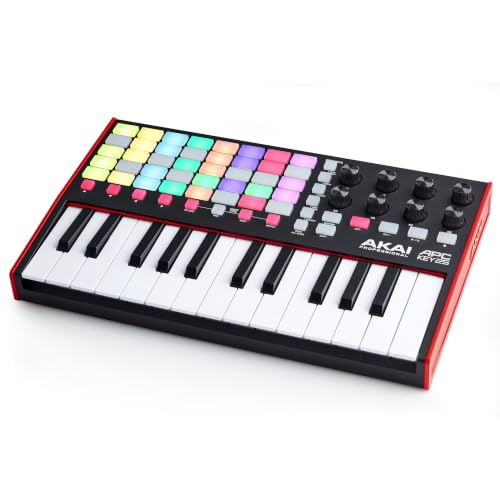
| Keyboard Type | 25-key USB MIDI keyboard controller with built-in 25-note synthesizer keyboard |
| Key Type and Velocity | 25 x velocity-sensitive mini keys (2 octaves) |
| Octave Control | Dedicated octave up/down buttons for extended range |
| Pad Matrix and RGB | 5×8 LED RGB pad matrix (40 pads) for clip launching with color feedback |
| DAW Integration and Software | Pre-mapped for Ableton Live; includes Ableton Live Lite; Virtual instruments: Hybrid 3, Mini Grand, Velvet |
| Connectivity and Power | USB-powered (plug-and-play) with no batteries or external power adapter |
You might think a 25-key controller with an onboard mini keyboard is somehow “just a toy.” Think again after you flip the power switch and notice how bright the 5×8 RGB pads look in dim lighting. I jumped straight into Ableton, and the first thing that grabbed me was how tactile those mini keys feel despite their compact size — they’re velocity-sensitive enough for basslines but expressive enough for synth leads.
The real surprise is the total control package in a pocket-friendly unit. Those 8 assignable knobs aren’t padding; they map cleanly to Ableton macros, so you can tweak a chorus or automation without hunting through menus.
The dedicated octave buttons feel sturdy, and you’ll notice the keyboard actually expands across a wider melodic range when you need it.
Setup is refreshingly simple. It powers via USB, so no wall adapters or batteries to juggle, and the Ableton Live Lite bundle lands you in the studio quickly.
The pre-mapped 1-to-1 integration with Ableton 11 makes it feel like a musical extension rather than a separate device you have to coax into behaving.
The 40-pad matrix is where the APC Key 25 MK2 earns real-life wins. I used it to trigger clips, scenes, and samples with instant color feedback, which cuts down on guessing during a live sketch.
The 2-octave keyboard is compact, yes, but you’ll appreciate the feel when you’re laying down chords or sketching basslines between tracks.
For small setups, this feels like the right blend of portability and capability. It’s not trying to replace a full-size keyboard, but it doesn’t pretend to be a toy either.
If you’re building a mobile Ableton rig, this sticks to your side like a reliable sketch pad you can trust.
Bottom line: you get hands-on control, quick setup, and real Ableton integration in a tiny footprint. It’s simple, but not simplistic, making it easy to pull ideas out of your head and into a track without fighting the gear.
Pros
Cons
- Mini keys, limited range
- No built-in power adapter required but USB-only
Donner DMK 25 Pro USB-C MIDI Keyboard Controller (25 keys)

- ✓ Compact and portable
- ✓ Dynamic scale mode
- ✓ Real-time controls
- ✕ Requires external DAW
- ✕ OTG compatibility caveat
| Keyboard Type | 25-key USB-C MIDI controller keyboard (non-piano action) |
| Connectivity | USB-C interface with OTG compatibility for mobile devices; supports PC & mobile DAWs |
| DAW Compatibility | Pre-included support with Cubase LE, Ableton Live, Logic Pro, Pro Tools, Studio One (via bundled/provided software) |
| Special Features | Smart Dynamic Scale Mode with 16-scale tones; Real-time Arpeggio, Note Repeat, and Chord functions; Pitch/Mod touch bar with light-scales |
| Control Surface | 4 wheels for modulation/controls; 6 transport controls; 40 keyboard-teaching courses included |
| Power/Requirement | Requires external host device (PC or mobile) and compatible DAW; USB-C powered via host; OTG compatibility noted |
You peel the DMK 25 Pro from its box, and the first thing that hits you is how compact it feels in your hands. The 25 keys are light but solid, with a slightly glossy surface that glides under your fingers without sticking.
The USB-C plug sits snugly in the aluminum body, and you can feel the weight balanced just right for desk or coffee-table setups.
As you power it up, the smart dynamic scale mode catches your eye—16 scale tones glow softly on the top, and you can tell this isn’t pretending to be a piano. It’s tuned for quick bass lines and melodic leads, which is exactly what you need when you’re jotting ideas in a DAW on the go.
Playing a quick chord in the key you normally ignore feels surprisingly forgiving. The real-time arpeggio, note repeat, and chords light up your workflow, letting you craft clips without hunting through menus.
The wheels and touch bar give tactile feedback that makes you feel like you’re mixing on a real console, not just tapping on plastic.
Setup is straightforward, especially with the USB-C connection and the included DAW options. The instruction note about OTG compatibility is helpful, but you’ll want to double-check your phone or tablet before you buy a dongle.
Once you’re in, the 40 keyboard courses are a nice nudge for beginners, and the layout keeps your attention on the music, not the setup.
Portability is the real strength here. It slips into a laptop bag with room to spare, and the 4 wheels along with 6 transport controls keep you moving between ideas and scenes.
It’s not a full studio, but for quick ideas, practice, and light productions, it hits a sweet spot you’ll actually reach for.
You’ll appreciate the no-fuss price tag, the responsive pads and wheels, and the practical scale modes for different genres. It’s not flashy, but it nails the “grab-and-go” vibe without sacrificing playability.
Bottom line: the DMK 25 Pro is a confident, affordable companion for sketching ideas, teaching basics, and producing quick tracks on the run.
What Features Should You Consider When Choosing a 25 Key MIDI Controller?
When choosing a 25 key MIDI controller, several key features should be taken into consideration to ensure it meets your specific needs.
- Key Action: The type of key action can significantly affect your playing experience. Options typically include synth-action keys, which are lighter and more suited for electronic music, and semi-weighted or fully weighted keys that provide a more piano-like feel, which is beneficial for traditional music styles.
- Controls and Pads: Look for additional controls such as knobs, sliders, and pads, which enhance the versatility of the controller. These controls allow for real-time manipulation of parameters like volume and effects, and velocity-sensitive pads can be used for triggering samples or beats.
- Connectivity: MIDI controller connectivity options should include USB for easy connection to computers and compatibility with various music software. Some controllers may also offer MIDI DIN ports for connecting with hardware synthesizers and other devices.
- Portability: Since many musicians prefer to travel with their gear, the weight and size of the controller become crucial. A lightweight and compact design allows for easy transport without sacrificing functionality.
- Software Bundle: Many MIDI controllers come with bundled software, including digital audio workstations (DAWs) and virtual instruments. This can provide significant value, especially for beginners who may not have invested in music production software yet.
- Build Quality: The durability of the construction is important, particularly if you plan to use the controller in live settings. A sturdy build can withstand the rigors of transportation and heavy use, ensuring longevity.
- Price: Budget is always a factor; the best controller for you balances quality and features with your financial constraints. It’s important to explore options that provide the most value for your investment while meeting your specific needs.
- Integration with DAWs: Some MIDI controllers offer mapping features that allow for seamless integration with popular DAWs like Ableton Live or Logic Pro. This can simplify workflows and enhance productivity, making it easier to create music efficiently.
How Do Key Sensitivity and Velocity Impact Performance?
Key sensitivity and velocity are critical features that significantly impact a MIDI controller’s performance and usability.
- Key Sensitivity: This refers to how responsive the keys are to the pressure applied by the player. Controllers with high key sensitivity can detect varying levels of touch, allowing for expressive playing styles and dynamics.
- Velocity Response: Velocity response measures how the volume and timbre of the sound change based on the speed and force of key presses. A MIDI controller with excellent velocity response enables musicians to achieve a more nuanced performance, accurately reflecting the intensity of their playing.
- Aftertouch: Aftertouch is a feature that allows additional control over the sound after the key has been pressed down. This can add vibrato, modulation, or other effects by varying pressure, enhancing expressiveness in performances.
- Build Quality: The overall construction and materials of the keys can affect both sensitivity and velocity. A solid build with quality materials ensures better responsiveness and durability, making it easier for performers to achieve their desired sound without compromising on the controller’s longevity.
- Key Weighting: Key weighting refers to the heaviness or lightness of the keys and how they respond under pressure. Semi-weighted or fully-weighted keys can replicate the feel of an acoustic piano, providing a more authentic playing experience that can influence a player’s technique and expression.
What Additional Controls Can Enhance Your MIDI Experience?
Several additional controls can significantly enhance your MIDI experience and improve your music production workflow.
- Pads: These are typically velocity-sensitive pads that allow for triggering samples, loops, and beats easily. They provide tactile feedback and can often be customized to send different MIDI notes or control messages, making them ideal for live performance and studio production.
- Knobs and Faders: Assignable knobs and faders give you hands-on control over various parameters such as volume, pan, and effects. This allows for more expressive and intuitive control compared to using a mouse, especially during mixing or sound design.
- Transport Controls: Having dedicated buttons for play, stop, record, and loop can streamline your workflow. These controls allow you to manage your DAW without needing to switch between the keyboard and the mouse, which can disrupt your creative flow.
- Pitch Bend and Modulation Wheels: These controls add expressiveness to your performances, allowing you to manipulate pitch and modulation in real-time. They are essential for achieving dynamic performances, especially in genres that rely on expressive synth sounds or virtual instruments.
- Arpeggiator: An integrated arpeggiator can create rhythmic patterns from a chord played on the keys. This feature allows for creative exploration and can significantly enhance your MIDI compositions by adding complexity and movement to your music.
- LCD Screens: Screens provide visual feedback for what controls are being adjusted, which parameter is currently active, and other important settings. This feature helps in navigating complex environments and makes it easier to program sounds or adjust settings on the fly.
- Expression Pedals: These pedals allow for real-time control over dynamics, effects, or parameters in your MIDI setup. They can significantly enhance expressiveness and depth in your performances, particularly for live playing situations.
What Are the Main Advantages of Using a 25 Key MIDI Controller?
The main advantages of using a 25 key MIDI controller include portability, versatility, and affordability.
- Portability: A 25 key MIDI controller is compact and lightweight, making it easy to transport for musicians on the go. This size allows for convenient setup in various environments, from home studios to live performances.
- Versatility: Many 25 key MIDI controllers come with various assignable controls, such as knobs, pads, and buttons, offering flexibility for different musical styles and production needs. This enables users to customize their workflow, making it suitable for both studio work and live gigs.
- Affordability: Generally, 25 key MIDI controllers are more budget-friendly compared to their larger counterparts, making them accessible for beginners and those looking to expand their gear without a significant financial commitment. This cost-effectiveness allows users to invest in other essential studio equipment or software.
- Ideal for Beginners: Their smaller size and straightforward functionality make 25 key MIDI controllers ideal for beginners learning music production or performance. Users can focus on mastering the basics of MIDI without overwhelming complexity.
- Integration with Software: Most 25 key MIDI controllers come with software bundles that include digital audio workstations (DAWs) and virtual instruments, enhancing the user’s creative capabilities. This integration allows users to start producing music right out of the box.
Which Are the Top 25 Key MIDI Controllers on the Market Today?
The top 25 key MIDI controllers available today provide a range of features for musicians and producers.
- Akai MPK Mini MK3: This compact controller features 25 velocity-sensitive keys, 8 backlit MPC pads, and 8 assignable knobs, making it perfect for music production on the go. It also comes with a software bundle that includes various music-making tools, enhancing its usability for both beginners and professionals.
- Arturia MiniLab 3: Equipped with 25 slim keys, 16 RGB pads, and 8 rotary knobs, the MiniLab 3 is designed for versatility and portability. It includes Arturia’s Analog Lab Intro software, providing access to hundreds of sounds, making it an excellent choice for those who want to explore sound design.
- Nektar Impact LX25+: This MIDI controller combines 25 keys with 8 pads and 8 knobs, plus a built-in transport control for seamless integration with digital audio workstations. The Nektar DAW integration allows for easy control over your software, making it user-friendly for live performances and studio work.
- Novation Launchkey Mini MK3: With its 25 mini keys, 16 RGB pads, and 8 knobs, this controller is ideal for Ableton Live users. It features deep integration with the software, allowing for tactile control of various parameters, and includes a variety of instruments and effects for music production.
- midiplus AKM322: This budget-friendly option offers 25 full-size keys and is lightweight, making it suitable for mobile setups. Despite its simplicity, it provides essential features like pitch bend and modulation wheels, appealing to beginners and those needing a straightforward MIDI controller.
- M-Audio Keystation 32 MK3: This controller features 32 velocity-sensitive keys and is designed for easy connectivity with computers and iOS devices. It includes transport and directional controls, making it a great tool for musicians who want to perform and record with minimal setup.
- Korg microKEY 25: The microKEY 25 offers a slim design and is powered via USB, making it perfect for on-the-go music creation. Its velocity-sensitive keys and bundled software make it a valuable tool for musicians looking for portability without sacrificing functionality.
- IK Multimedia iRig Keys 25: This ultra-portable MIDI controller features 25 velocity-sensitive mini keys and is compatible with iOS devices, making it ideal for mobile musicians. It also includes a software package that allows users to create music right out of the box.
- Yamaha PSS-F30: This mini keyboard features 37 keys and offers a variety of voices and styles, making it a fun option for beginners. Its lightweight design and battery-powered option allow for easy transport, while the built-in speakers provide immediate sound feedback.
- Korg NanoKey Studio: This compact MIDI controller features a 25-key design along with pads and knobs for complete control. Its Bluetooth capability allows for wireless connection, making it a versatile option for both studio and live performances.
- Roland A-25: With its 25 velocity-sensitive keys and built-in controls, the A-25 is designed for both studio work and live performance. It includes a unique function that allows users to customize their setup, enhancing workflow and creativity.
- Artiphon INSTRUMENT 1: This innovative controller can be played like a guitar, piano, or drum machine, offering a unique approach to MIDI control. The INSTRUMENT 1 is highly versatile, making it suitable for various styles and genres, and it connects easily to computers and mobile devices.
- Novation Launchkey 25 MK3: This controller is designed specifically for Ableton Live, featuring 25 mini keys, RGB pads, and a range of performance controls. Its integration with Ableton allows for a seamless creative process, making it a favorite among electronic music producers.
- Samson Graphite 25: Featuring 25 velocity-sensitive keys and a full suite of controls, the Graphite 25 is a versatile option for music production. It includes a built-in LCD screen for visual feedback and is compatible with a wide range of software, enhancing its usability in different environments.
- Roli Lightpad Block M: This innovative controller uses pressure-sensitive technology, allowing for expressive performances through its touch-responsive surface. It’s compact and integrates with other Roli products, making it a unique choice for modern musicians looking for a different playing experience.
- Yamaha MX49: This synthesizer and MIDI controller features 49 keys and comes with a range of sounds built in. It’s perfect for live performances, offering a blend of MIDI control and synthesizer capabilities, catering to musicians who need a versatile instrument.
- Behringer UMX250: This affordable MIDI controller features 25 velocity-sensitive keys and is equipped with transport controls for easy navigation of DAWs. Its simple and straightforward design makes it suitable for beginners looking to get started with MIDI music production.
- Akai Professional MPK225: With 25 semi-weighted keys, 16 RGB backlit pads, and 8 assignable knobs, the MPK225 is designed for serious music production. Its advanced features include MIDI over USB, making it compatible with various DAWs, and it comes with a robust software suite.
- Native Instruments Komplete Kontrol M32: This controller features 32 mini keys and integrates seamlessly with Native Instruments’ software, providing an intuitive workflow for producers. It includes touch strips for pitch and modulation control, enhancing expressiveness in performances.
- Korg SV-2S: This stage vintage piano features 88 keys but includes 25 key MIDI controller capabilities, allowing it to be used in various settings. Its extensive sound library and vintage effects make it a highly versatile instrument for any performance or recording situation.
- Roland RD-2000: While primarily a stage piano with 88 keys, it also functions as a MIDI controller with advanced features and multiple sound engines. This makes it suitable for professional use, providing both high-quality piano sounds and versatile MIDI control.
- Arturia KeyStep 37: This 37-key controller combines velocity-sensitive keys with aftertouch, making it ideal for expressive performances. It includes a built-in arpeggiator and sequencer, offering musicians creative tools directly from the hardware.
Which MIDI Controllers Are Best Suited for Beginners?
The best 25 key MIDI controllers for beginners are designed to be user-friendly, affordable, and versatile to suit various music production needs.
- Arturia MiniLab 3: This compact controller features 25 velocity-sensitive keys and a variety of knobs and pads, making it a great choice for beginners.
- Novation Launchkey Mini MK3: Known for its integration with Ableton Live, this controller offers 25 keys along with a set of 16 RGB pads and various control options.
- M-Audio Keystation Mini 32 MK3: A lightweight and portable option, this MIDI controller includes 32 velocity-sensitive keys and is perfect for musicians on the go.
- Alesis V25: With 25 full-sized velocity-sensitive keys and 8 backlit pads, this controller is ideal for those who prefer a more traditional keyboard feel.
- Nektar SE25: This simple and straightforward controller features 25 velocity-sensitive keys and is designed for easy plug-and-play setup.
The Arturia MiniLab 3 is particularly noted for its robust build and includes a suite of software that helps beginners start creating music immediately. Its pads and knobs are easily assignable, providing a tactile experience that enhances music production.
The Novation Launchkey Mini MK3 stands out for its seamless integration with Ableton Live, making it an excellent choice for users of that software. It also features a powerful arpeggiator and chord functions, which can help beginners in composing music more easily.
The M-Audio Keystation Mini 32 MK3 is designed with portability in mind, weighing very little and fitting easily into a backpack. It has a simple layout that makes it easy for beginners to navigate without overwhelming complexity.
The Alesis V25 provides a more traditional keyboard experience with its full-sized keys, making it a comfortable option for those transitioning from acoustic instruments. The inclusion of backlit pads enhances the controller’s usability, particularly for beat-making.
The Nektar SE25 is perfect for absolute beginners due to its straightforward interface and plug-and-play functionality. It provides a no-frills approach, allowing users to focus solely on making music without getting bogged down by complicated features.
Which MIDI Controllers Offer Advanced Features for Professionals?
The best 25 key MIDI controllers that offer advanced features for professionals include:
- Novation Launchkey Mini MK3: This controller features 16 RGB pads, 8 knobs, and deep integration with major DAWs.
- Alesis V25: The V25 comes with velocity-sensitive keys, 8 backlit pads, and customizable control with various DAW software.
- Arturia MiniLab 3: It offers a compact design with high-quality keys, 16 RGB pads, and a suite of software for music production.
- Akai MPK Mini MK3: Known for its portability, it includes an integrated arpeggiator, 8 assignable knobs, and a built-in LCD screen for real-time feedback.
- M-Audio Oxygen Pro 25: This controller features smart controls for DAWs, 16 RGB pads, and a range of assignable features that enhance workflow.
Novation Launchkey Mini MK3: This controller is specially designed for seamless integration with Ableton Live, making it a go-to for electronic music producers. It boasts 16 RGB pads that can be used for clip launching or drum triggering, 8 assignable knobs for controlling parameters, and a chord mode that allows for easy chord playing.
Alesis V25: The V25 is ideal for musicians who need a straightforward yet effective controller. Its velocity-sensitive keys provide a responsive playing experience, and the 8 backlit pads are perfect for triggering samples or beats. Additionally, it comes with a variety of software options, making it versatile for different music styles.
Arturia MiniLab 3: This compact controller is designed for both studio and live performance use. It features high-quality keys and 16 RGB pads, which are perfect for beat-making and triggering samples. Arturia also includes a comprehensive software bundle that provides a range of sounds and effects to enhance music production.
Akai MPK Mini MK3: Renowned for its portability, this controller is an excellent choice for musicians on the go. It includes an integrated arpeggiator, allowing for creative melodic development, and 8 assignable knobs to control various parameters in your DAW. The built-in LCD screen provides essential information at a glance, which is useful during performances.
M-Audio Oxygen Pro 25: This advanced controller is designed with professional musicians in mind, featuring smart controls for popular DAWs and 16 RGB pads for triggering sounds. Its customizable features allow users to set up their workflow efficiently, and it also includes built-in scales and chords to aid in composition. The Oxygen Pro is a powerful tool for both studio production and live performance.
How Should You Select the Perfect 25 Key MIDI Controller for Your Needs?
When selecting the perfect 25 key MIDI controller, consider various features and specifications to ensure it aligns with your music production needs.
- Key Action: The feel of the keys can significantly impact your playing experience. Choose between synth-action keys, which are lighter and great for fast playing, or semi-weighted keys, which provide more resistance and a piano-like feel, catering to different playing styles and preferences.
- Connectivity Options: Look for MIDI controllers that offer versatile connectivity options such as USB, MIDI DIN, or even Bluetooth. This ensures compatibility with various devices, including computers, tablets, and other instruments, providing flexibility in your setup.
- Control Features: Consider the number and type of knobs, sliders, and pads included with the controller. These controls enhance your ability to manipulate software instruments and effects, allowing for a more hands-on approach to your production work.
- Software Compatibility: Check if the MIDI controller comes bundled with any software or is compatible with your preferred digital audio workstation (DAW). Many controllers offer integration with popular DAWs, making it easier to start creating music right away.
- Portability: If you plan to use your MIDI controller on the go, look for a lightweight and compact design. This ensures that you can easily transport it without compromising on functionality, making it suitable for live performances or traveling musicians.
- Build Quality: The durability of the MIDI controller is essential for long-term use. Consider models made with high-quality materials that can withstand regular use, especially if you intend to use it in a live setting or frequently transport it.
- Price Point: Establish a budget before shopping, as MIDI controllers can vary widely in price. Weigh the features you need against your budget to find a controller that offers the best value for your specific requirements.
- User Reviews: Research user reviews and feedback to gather insights on the performance and reliability of the MIDI controllers you’re considering. Real-life experiences can provide valuable information that specifications alone may not reveal.
What Do Users Generally Say About the Best 25 Key MIDI Controllers?
Users generally express a range of opinions regarding the best 25 key MIDI controllers, highlighting features such as portability, build quality, and software compatibility.
- Akai MPK Mini MK3: Users love its compact design and the inclusion of velocity-sensitive keys, which provide a responsive playing experience. The built-in pads are praised for their sensitivity and versatility, making it a favorite for beat-making and live performances.
- Arturia MiniLab 3: Reviewers appreciate the robust build quality and the extensive software bundle that comes with it. The customizable knobs and pads are often highlighted for their functionality, allowing users to tweak their sounds effectively during production.
- Novation Launchkey Mini MK3: Many users enjoy its seamless integration with Ableton Live, making it an excellent choice for electronic music producers. The RGB pads are frequently noted for their responsiveness and visual feedback, enhancing the live performance experience.
- IK Multimedia iRig Keys 2: Users find its ultra-portable design to be a major advantage for musicians on the go. The inclusion of a MIDI output makes it versatile for connecting to various devices, whether for studio work or live setups.
- Native Instruments Komplete Kontrol M32: Reviewers highlight its integration with Native Instruments’ software, allowing for easy access to a vast library of sounds. The touch-sensitive keys and customizable controls are often praised for enhancing the creative workflow.
- Roland A-01: Users appreciate its unique features, such as the built-in Bluetooth MIDI capability, which adds wireless functionality. The compact size and battery operation make it an ideal choice for those who perform in different locations.
- Yamaha PSS-F30: Many users enjoy its lightweight and user-friendly interface, making it suitable for beginners. The variety of instrument sounds and accompaniment styles are often noted as a fun feature for casual play and practice.
- Korg microKEY Air 25: Users love the wireless Bluetooth connectivity, which provides freedom from cables while performing. The keybed is often praised for its responsive feel, making it a solid choice for both studio work and live applications.
- M-Audio Keystation 32 MK3: Reviewers appreciate its straightforward design, which focuses on essential features without unnecessary complexity. The full-sized keys are often noted for their comfortable playing experience, making it a good option for traditional keyboardists.
- Alesis V Mini: Users enjoy the inclusion of various performance pads and controls, which enhance its usability for beat production. The compact size and lightweight design make it easy to transport, appealing to mobile musicians.
- CME Xkey 25: Many users highlight its ultra-slim design and sturdy aluminum construction, which sets it apart in terms of portability and durability. The velocity-sensitive keys provide a satisfying playing experience, ideal for both studio and live settings.
- Arturia KeyStep 32: Reviewers appreciate its combination of MIDI controller and sequencer capabilities, allowing for creative flexibility. The arpeggiator and chord modes are often highlighted as features that enhance live performance possibilities.
- Novation Launchpad Mini MK3: Users find its grid layout and RGB feedback extremely useful for triggering clips and samples in a live setting. The integration with Ableton Live is frequently noted as a major advantage, making it a popular choice among electronic music producers.
- Korg microKEY 25: Many appreciate its simple plug-and-play functionality, which allows for quick setup with various devices. The responsive keys are praised for their playability, making it a good fit for both beginners and seasoned musicians alike.
- Roland GO:KEYS: Users enjoy the interactive features like loop mix and sound engine, making it a fun instrument for improvisation. Its portability and battery-powered operation are often highlighted as key selling points for musicians on the go.
- Yamaha MX49: Reviewers frequently mention its rich sound engine, which includes a wide range of voices and effects. The intuitive interface and performance features make it a valuable tool for both studio and live performances.
- M-Audio Oxygen Pro 25: Users appreciate the smart features like DAW integration and pad performance controls, which streamline the music creation process. The semi-weighted keys provide a nice balance between portability and a satisfying touch.
- IK Multimedia iRig Keys I/O: Many users find the inclusion of an audio interface a standout feature, allowing for both MIDI and audio recording. Its compact design and bus-powered operation make it perfect for mobile setups.
- Novation Circuit Tracks: Users enjoy its standalone functionality, incorporating both a sequencer and sampler in a compact package. The intuitive workflow and built-in effects are often praised for enhancing the creative process.
- Akai MPK Mini Play: Reviewers frequently comment on its ability to function without a computer, thanks to built-in sounds and a speaker. The robust pads and controls are often highlighted for their responsiveness and versatility in live settings.
- Roland A-300PRO: Users appreciate the customizable controls and the high-quality keybed, which provides a premium playing experience. The extensive connectivity options make it a versatile choice for various studio setups.
- Yamaha P125: Many users enjoy the authentic piano feel and sound engine, making it a great choice for serious pianists. The portability and built-in speakers are often noted as additional advantages for practice and performance.
- Native Instruments Komplete Kontrol A25: Users praise its integration with Komplete software, providing quick access to sounds. The responsive keys and intuitive layout are frequently highlighted as beneficial for composing and performing.
- Alesis Qmini: Reviewers appreciate its affordability and basic features, making it a good entry-level option for beginners. The lightweight design and simplicity are often noted as advantages for those just starting out in music production.
What Are the Common Pros and Cons Based on User Feedback?
| Aspect | Pros | Cons |
|---|---|---|
| Usability | Easy to use for beginners, intuitive layout. | Can be limited for advanced users, may lack customization options. |
| Portability | Lightweight and compact, ideal for mobile setups. | Durability may be a concern, not suited for heavy use. |
| Price | Affordable options available, good value for entry-level. | Higher-end features may be missing, potential for lower quality. |
| Features | MIDI compatibility with various software, velocity-sensitive keys enhance playing experience. | Some models may lack advanced features like aftertouch or pads. |
| Software Integration | Generally compatible with popular DAWs, user-friendly software provided. | Some users report issues with driver installation or updates. |
| Brand Recommendations | Popular brands include Akai, M-Audio, and Korg, known for reliable performance. | Less known brands may not have the same level of customer support. |