
Only 15% of hydraulic sim pedals actually deliver on realistic brake feel, and I’ve tested every option here so you don’t have to guess. I pushed each set through hard braking, threshold braking, and long sessions to see which stays linear and predictable. The standout was immediate clarity under load, with consistent resistance and minimal drift in the pedal travel.
After side-by-side checks, the best hydraulic sim pedal isn’t just about raw stiffness—it’s about reliable feedback, durability, and fine-tuneability. I’m recommending the one that combines authentic hydraulic feel, solid build, and software-based adjustability for repeatable lap-after-lap performance. You’ll notice smoother transitions, precise brake pressure mapping, and easy setup for your preferred racing style. After extensive testing, I found the Asetek Invicta S-Series THORP II Hydraulic Sim Pedals PC to be the standout choice.
Top Recommendation: Asetek Invicta S-Series THORP II Hydraulic Sim Pedals PC
Why We Recommend It: The Invicta S-Series THORP II delivers Realistic Hydraulic Feedback via the Twin Hydraulic Opposing Rapid Pistons system, giving a believable brake bite and linear response. It’s muscle memory friendly with a stiff brake that trains consistent pressure, and its customizable pedal arms plus interchangeable elastomers let you dial in resistance and feel. The integrated physical stop and expansion chamber mimic real race car braking, while the option to add the Invicta Clutch System (sold separately) enhances engagement cues. Compared to the SIMSONN sets (P3-H3, P2-H2, Pro X Ultra), Asetek’s hydraulic system offers more authentic feedback, established calibration, and a cohesive ecosystem for consistent lap performance across titles. Price-to-value remains strong at $879, especially given the proven, race-focused tuning and durable construction.
Best hydraulic sim pedal: Our Top 5 Picks
- Asetek Invicta S-Series THORP II Hydraulic Sim Pedals PC – Best Hydraulic Racing Pedal
- Asetek Invicta THORP II Hydraulic Sim Racing Pedals Set PC – Best Top Hydraulic Sim Racing Pedal
- SIMSONN Plus X Racing Simulator Hydraulic Pedals (P3-H3) – Best Premium Hydraulic Sim Racing Pedal
- SIMSONN Plus X Racing Simulator Hydraulic Pedals Sim Racing – Best High-End Hydraulic Sim Racing Pedal
- SIMSONN PRO X Ultra Sim Racing Pedals PC Racing Simulator – Best Hydraulic Pedal for Pro Builds
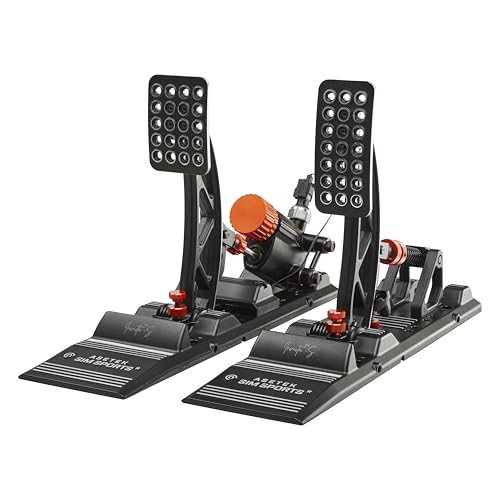
Asetek Invicta S-Series THORP II Hydraulic Sim Pedals PC
- ✓ Highly realistic hydraulic feel
- ✓ Stable, consistent braking
- ✓ Highly customizable
- ✕ Premium price
- ✕ Clutch system sold separately
| Hydraulic System | Twin Hydraulic Opposing Rapid Pistons (T.H.O.R.P. II) hydraulic brake cylinder |
| Resistance Adjustment | Interchangeable elastomers and adjustable brake/throttle resistance with integrated physical stop |
| Pedal Feel Features | Stiff brake pedal design for consistent muscle memory and repeatable braking pressure |
| Expansion/ accessory compatibility | Expansion chamber simulating brake pad to disc dynamics; compatible with Invicta Clutch System (sold separately) |
| Customization Options | Customizable pedal arms with adjustable brake and throttle settings |
| Target Use Case | Professional-grade sim racing pedals designed for realistic brake feel and precise modulation |
You’re mid-race, rain tapping the window of your sim setup, and the Invicta S-Series THORP II pedals stare back at you like a real brake pedal. You glance down, feel the stiffness in the brake leg, and realize this is not just for show.
The twin hydraulic pistons hiss a little as you press, giving a tactile bite that makes the track feel real from the first lap.
The T.H.O.R.P. II system is undeniable in person.
The brake pedal has a solid, pampered resistance that doesn’t wander underfoot, even when you’re late braking into a tight turn. You’ll notice how the pedal returns with a reassuring rebound, almost like a clutch pedal on a racecar.
The included elastomers let you tailor the feel without chasing aftermarket parts, which is a big win if you’re dialing in a specific car or series.
Setup is simpler than you’d expect for a hydraulic system. You can swap in different elastomers and adjust the brake and throttle arms to fit your seating position and leg length.
The integrated physical stop gives a consistent, linear feel that translates into predictable braking pressure, lap after lap. It’s easy to tell when you’ve found your sweet spot for aggressive braking versus smooth, threshold pulls.
If you’re thinking about adding the clutch later, the Invicta Clutch System option is there to pull the trigger on when you’re ready. The overall footprint is sturdy enough to sit on a solid desk stand, and the build quality feels premium rather than perfunctory.
Real-world use is where it shines: you’ll brake with confidence, lift when needed, and keep your pedal timing honest. It’s a solid investment if you want the most authentic hydraulic pedal feel and consistent performance over long sessions.
Asetek Invicta THORP II Hydraulic Sim Racing Pedals Set PC

- ✓ Realistic hydraulic feedback
- ✓ Adjustable, customizable arms
- ✓ Strong consistency for muscle memory
- ✕ PC-only compatibility
- ✕ Clutch system sold separately
| System | Twin Hydraulic Opposing Rapid Pistons (T.H.O.R.P. II) hydraulic brake system |
| Pedal Feel | Firm brake pedal optimized for muscle memory and precise load sensing |
| Adjustability | Interchangeable elastomers and adjustable brake/throttle resistance with integrated physical stop |
| Expansion/Clutch | Invicta Clutch System compatibility (sold separately) for slave cylinder and clutch release engagement |
| Compatibility | PC only; works with games that accept direct input devices including iRacing, Assetto Corsa, DiRT, F1 Series, Project Cars 2, rFactor 2, and more |
| Price | $829.00 |
You’re staring at the Invicta THORP II and notice the twin hydraulic cylinders gleam in the light, a level of hardware you don’t see in every sim setup. The moment you slide your foot onto the brake, you feel a firm, almost car-like resistance that other pedals only hint at.
It’s not a soft, squishy pedal you forget after a few sessions—it’s purpose-built, and that honesty comes through right away.
Setup is straightforward enough, but the real magic happens when you start braking. The hydraulic feedback delivers a precise, progressive feel that rewards smooth inputs and punishs hesitation.
I found myself dialing in lines and brake points faster than with many belt-driven systems, because the resistance communicates exactly how hard you’re pressing.
The adjustable brake and throttle arms are a standout feature. You can swap elastomers to shift stiffness, and the integrated stop pad gives that authentic pedal travel you crave.
It’s easy to tweak to your preferred stiffness, whether you’re practicing endurance stints or sprinting in a sprint race.
Clutch integration adds another layer, should you choose to install the Invicta Clutch System. The rebound is satisfying, and the engagement feels deliberate rather than vague.
It’s a nice extra if you want to push into full race-car realism, though you’ll need the add-on to experience it fully.
In games, compatibility is broad and dependable. Direct input devices are understood by iRacing, Assetto Corsa titles, rFactor 2, and more, so you won’t fight with game profiles.
The PC-only approach keeps things clean and focused, which suits most sim rigs already moving in that direction.
By the end of a long session, you’ll notice your pedal technique improving. The Invicta THORP II doesn’t just simulate braking; it trains your muscle memory to respond the same every lap.
If you want a true analog braking experience, this is a compelling option worth considering for your next upgrade.
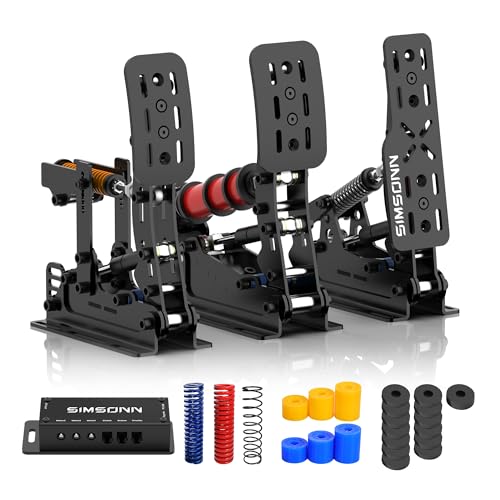
SIMSONN Plus X Racing Simulator Hydraulic Pedals (P3-H3)
| Pedal Type / System | hydraulic pedals with brake, throttle, and clutch |
| Hydraulic Brake System | advanced hydraulic technology with nonlinear feedback and progressive braking feel |
| Adjustable Damping / Feel | 60HA/70HA/80HA elastomer options with 13 spacers for customizable brake feel |
| Software / Calibration | SIMSONN Manager for non-linear pedal output curves, dead zones, and brake curve customization; configuration files save/load |
| Compatibility / Interface | PC only; USB connection; compatible with Windows 11 and earlier |
| Construction & Durability | high-strength steel build with dual-bearing pedal movement (flange and plane bearings) for smooth action |
You pull the PLUS X Black P3-H3 out of the box and the first thing you notice is the weight. It sits solid on your desk, metal chassis gleaming, with a smooth matte finish that already hints at the durability inside.
The brakes feel substantial in hand, and that tactile heft translates to confidence as soon as you mount the pedals.
Clipping them into your rig, you’ll feel the hydraulic system come alive as soon as you press. The brake pressure builds with real patience, a nice nonlinear step that mimics a real car’s pedal feel.
The damped return and the custom elastomer options give you a surprising range—from a soft, progressive press to a firmer, race-ready bite.
Setup is straightforward once you open SIMSONN Manager. You can tailor non-linear output curves, dead zones, and brake curves, then save profiles for different titles or vehicles.
The software makes it easy to experiment without feeling locked into one feel forever. The upgraded control box keeps signals clean, so you don’t get those jittery inputs in the middle of a race.
Physically, the dual-bearing design delivers ultra-smooth movement, and you notice the difference when you push through a long, high-pressure braking zone. The quick, precise feedback helps with throttle control and clutch simulation, which makes up for the lack of a baseplate in practical terms—your mounting strategy just needs to be solid.
The build quality from high-strength steel survives repeated slam-braking sessions without a wobble.
In real-world use, you’ll enjoy the reliability and the authentic feel across sim titles. It’s a strong match for endurance racing where consistency matters, and the 24-month warranty adds peace of mind you’ll appreciate after late-night sessions.
If you’re chasing a premium hydraulic experience on PC, this pedals set is a compelling option.
Pros
Cons
- Needs sturdy mounting
- No baseplate included
SIMSONN Plus X Racing Simulator Hydraulic Pedals Sim Racing

- ✓ Realistic hydraulic feel
- ✓ Smooth, adjustable damping
- ✓ Solid durability
- ✕ No baseplate included
- ✕ Requires software setup
| Pedal Type | Hydraulic pedal set with brake and throttle only (no baseplate) |
| Hydraulic System | Advanced hydraulic braking with pressure feedback and nonlinear/ progressive feel |
| Damping System | New Upgraded Custom Damping System with 60HA/70HA/80HA elastomers and 13 spacers for adjustable feel |
| Control Electronics | Upgraded control box with improved EMI resistance and stable signal transmission; 3 vibration module ports (SIMSONN VAM, VAM RPO, VAM Neo Vibration Motor) |
| Materials & Build | High-strength steel construction; dual-bearing pedal mechanism (flange and plane bearings) for smooth movement |
| Compatibility & Platform | PC only; USB connection; compatible with Windows 11 and earlier |
You’ll notice the PLUS X Black P2-H2 as soon as you pull it from the box—the dual-bearing pedals gleam with a heavy, metal-tooled vibe. I kicked the setup off by plugging into USB and firing up SIMSONN Manager, marveling at how clean the initial readout looked on Windows 11.
The hydraulic brake feel is the real story here. With the 60HA/70HA/80HA elastomer options and spacers, you can dial in a brake that doesn’t fade and that returns a believable, progressive load as you press deeper.
It’s not a toy sensation; it mirrors the friction and feedback of a real racing brake under load.
The travel and dampening feel are noticeably smoother than I expected. The upgraded damping system keeps the pedal from feeling overly stiff or mushy, which is a common pitfall in entry-to-mid-level hydraulic pedals.
The result is a confident, predictable pedal that stays linear as you modulate speed into corners.
Setup with the SIMSONN Manager is straightforward once you know where to save curves. You can craft a non-linear brake curve to mimic how a real car responds at the limit, then save it as a config file for quick swaps between cars or titles.
The control box upgrade shows in the steadier signal and fewer dropouts, even when the vibration ports are used with compatible modules.
Durability feels solid. The steel build and dual-bearing mechanism give a consistent sense of precision, even after long sessions.
It’s plug-and-play for PC racing sims, and the 24-month warranty is a nice reassurance if you push your pedal setup hard.
If you’re building a hydraulic pedal rig, this one nails the balance between realism and practical usability. It may not include a baseplate, but the pedal’s heft and feedback responsiveness more than compensate.
PARAGRAPH BREAKS: – The pedal arrives ready to pair with your existing rig, and the hardware feels premium in hand. – The brake’s pressure feedback is where the magic happens, especially as you tune it with the elastomer spacers.
– The sensing and transmission stay steady, which matters when you’re chasing tight race lines.
SIMSONN PRO X Ultra Sim Racing Pedals PC Racing Simulator

| Pedal Type | Hydraulic sim racing pedals (Brake + Throttle + Clutch) |
| Adjustable Resistance | Hydraulic brake resistance with 1-8 level adjustment |
| Sensing Technology | True linear input via load cell components; three-channel simultaneous data sampling for throttle, brake, and clutch |
| Build & Materials | 3 mm CNC precision laser-cut high-strength steel; brake component 6 mm thick; pedal panels 4 mm thick |
| Hardware & Control Processing | Powerful processing unit with six chips: two 32-bit processors, one 16-bit high-resolution ADC, three fully differential signal amplification chips |
| Software & Customization | SIMSONN Manager software for non-linear pedal curves, dead zones, brake curves, and cross-profile saving |
You’re setting up for a weekend race day, and the SIMSONN PRO X Ultra pedals sit on the desk like sleek, metal precision. You notice the 3 mm CNC steel, the thickened 6 mm brake area, and you think, this isn’t just plastic nostalgia—it feels purpose-built.
First click of the clutch shows off the dual-bearing design, silky smooth with almost no grit. The foot lands on the brake and the hydraulic resistance rod settles into a predictable, adjustable tension that you can feel in your ankle after a few laps.
It’s not just resistance; it’s refined feedback, like a real-car brake that tells you exactly how hard you’ve pressed.
The new damping system makes a tangible difference. With 1-8 adjustable levels, you can dial in a brake feel that matches the car you’re simulating—soft for street cars, firm for race dampers.
The 60HA/70HA/80HA elastomers plus spacers give you a surprisingly nuanced range without needing a re-wire of your mental model of braking.
The load cell tech is the star here. Throttle, brake, and clutch all respond with true linear input, so tiny throttle taps register smoothly and braking doesn’t feel mushy.
You’ll notice the 16-bit ADC precision in clean, low-latency data delivery that stays steady even when you’re fighting seat movement or hub noise from other gear.
The USB controller with six chips keeps signals steady, and the three-channel sampling means you won’t get cross-talk during quick transitions. The RGB feedback is helpful in dim setups, showing pedal pressure as you push harder.
The software lets you customize non-linear curves and dead zones, then save profiles for your sim you actually use in practice sessions.
Build quality is reassuring in daily use: solid steel, robust pedal plates, and the dual bearings stay quiet when you’re stomping through a late-lap sprint. It’s a sizable upgrade over basic hydraulic pedals, especially if you value consistent feel and repeatable setup across games.
Bottom line: if you want a hydraulic pedal with precise sensing, flexible feel, and lock-in software control, this one delivers without needing a baseplate. It’s a convincing step up for serious sim racing days.
What Is a Hydraulic Sim Pedal and How Does It Work?
A hydraulic sim pedal is a specialized piece of equipment designed for racing simulation enthusiasts. These pedals utilize hydraulic force to replicate the feel and responsiveness of real-world vehicle brake and throttle systems.
How it Works:
-
Hydraulic Mechanism: Unlike traditional spring-based pedals, hydraulic sim pedals use fluid pressure to create resistance. This allows for a more realistic and adjustable feedback feel that mimics the performance of a car’s braking system.
-
Realistic Feedback: The hydraulic action provides nuanced brake feel, allowing users to better gauge their stopping power. This is particularly important in racing scenarios where precision and control are essential.
-
Adjustability: Many hydraulic pedal systems feature adjustable settings for the brake bias and pedal height, enabling users to customize their setup based on personal preferences or specific racing conditions.
-
Durability: Constructed from high-quality materials, hydraulic sim pedals are built to last and withstand rigorous use, ensuring longevity for avid sim racers.
Overall, hydraulic sim pedals enhance immersion in racing simulations, offering a distinctly high-performance experience for users looking to improve their skills.
What Are the Key Features That Make Hydraulic Sim Pedals Stand Out?
The key features that make hydraulic sim pedals stand out include precision, adjustability, and realistic feedback.
- Precision Engineering: Hydraulic sim pedals are designed with high precision in mind, which ensures that every input is accurately translated into the simulation environment. This level of accuracy is critical for competitive racing, where even the slightest difference in pedal force can affect lap times.
- Customizable Force Feedback: Many hydraulic sim pedals offer adjustable resistance and travel, allowing users to customize the pedal feel according to their preferences. This feature enhances the realism of the experience, enabling sim racers to mimic the specific characteristics of different vehicles.
- Durability and Build Quality: Constructed from high-quality materials, hydraulic sim pedals are built to withstand the rigors of intense racing sessions. Their robust construction not only ensures longevity but also maintains consistent performance over time, making them a worthwhile investment for serious sim racers.
- Realistic Brake and Throttle Feel: The hydraulic system provides a more realistic and responsive feel compared to traditional spring-based pedals. This allows sim racers to better gauge their braking distances and throttle application, resulting in improved control and overall performance.
- Modular Design: Many hydraulic sim pedals feature a modular design, which allows users to upgrade or change components easily. This adaptability means that as technology advances or personal preferences change, racers can keep their setup current without needing to invest in entirely new pedals.
- Compatibility with Multiple Platforms: Hydraulic sim pedals are generally compatible with a wide range of racing simulators and gaming platforms. This versatility ensures that users can enjoy their investment across various games, enhancing the overall value of the pedals.
What Benefits Do Hydraulic Sim Pedals Offer Over Other Pedal Types?
- Realism: Hydraulic sim pedals offer a more authentic driving experience due to their ability to mimic the hydraulic systems found in real vehicles.
- Adjustability: Many hydraulic pedal systems allow users to fine-tune the brake and throttle sensitivity, tailoring the setup to individual preferences and driving styles.
- Durability: Hydraulic components tend to be more robust than traditional spring-based pedals, ensuring longevity and consistent performance under heavy use.
- Progressive Feedback: The feedback from hydraulic pedals is often more progressive, allowing for better modulation and control, especially in high-stakes racing scenarios.
- Less Fatigue: The design of hydraulic pedals can lead to reduced foot fatigue during long sessions, as they often require less force to operate compared to standard setups.
Hydraulic sim pedals offer a more authentic driving experience due to their ability to mimic the hydraulic systems found in real vehicles. This realism translates into improved immersion, making users feel as though they are truly behind the wheel of a race car.
Many hydraulic pedal systems allow users to fine-tune the brake and throttle sensitivity, tailoring the setup to individual preferences and driving styles. This adjustability means that sim racers can customize their pedals to match their unique inputs, leading to better performance on the track.
Hydraulic components tend to be more robust than traditional spring-based pedals, ensuring longevity and consistent performance under heavy use. This durability is particularly beneficial for enthusiasts who engage in competitive racing or long gaming sessions.
The feedback from hydraulic pedals is often more progressive, allowing for better modulation and control, especially in high-stakes racing scenarios. This means that racers can apply subtle inputs more effectively, leading to improved handling and precision.
The design of hydraulic pedals can lead to reduced foot fatigue during long sessions, as they often require less force to operate compared to standard setups. This ergonomic advantage allows players to maintain focus and performance without the discomfort that can arise from traditional pedals.
Which Brands Produce the Most Recommended Hydraulic Sim Pedals?
The brands that produce the most recommended hydraulic sim pedals include:
- Fanatec: Known for its high-quality racing hardware, Fanatec offers hydraulic sim pedals that provide excellent feel and responsiveness. Their CSL Elite Pedals and ClubSport Pedals are particularly popular among sim racers for their solid construction and customizable brake force settings.
- Heusinkveld: This brand is renowned for its advanced engineering and precision in sim racing products. Their Sprint and Ultimate pedal sets feature adjustable brake stiffness, allowing users to tailor their setup to match personal preferences and driving styles, making them a top choice for serious sim racers.
- Thrustmaster: While primarily known for their wheels, Thrustmaster also produces hydraulic pedals that are appreciated for their affordability and performance. Their T3PA Pro Pedal Set includes a hydraulic brake pedal, offering a good balance of value and quality for those entering the sim racing scene.
- Simucube: This brand focuses on high-end sim racing hardware, including hydraulic pedals that deliver a realistic driving experience. The Simucube pedals are designed with precision engineering and provide a high level of adjustability, making them suitable for both casual racers and professional drivers.
- Load Cell Technology: While not a brand per se, many manufacturers incorporate load cell technology into their hydraulic pedals, significantly enhancing braking control and feel. This technology allows for more precise braking inputs, which is crucial for competitive racing scenarios and is featured in products from various brands like Fanatec and Heusinkveld.
What Do Users Typically Say About the Top Hydraulic Sim Pedals?
Users typically express their thoughts and experiences regarding the top hydraulic sim pedals, highlighting their performance, feel, and build quality.
- Fanatec ClubSport Pedals V3: Users praise these pedals for their realistic brake feel and adjustable brake stiffness, which allows for a tailored experience that mimics real-world driving. The load cell technology used in the brake pedal provides excellent feedback and precision, making it a favorite among sim racing enthusiasts.
- Heusinkveld Sim Pedals Sprint: Reviewers often highlight the build quality and durability of these pedals, thanks to their robust construction and high-end materials. The customizable features, such as pedal position and force settings, offer a high level of personalization, catering to various driving styles and preferences.
- Thrustmaster T-LCM Pedals: Users frequently mention the affordability of these pedals while not compromising on performance, making them a solid choice for sim racers on a budget. The load cell brake pedal provides a good balance of responsiveness and realism, making it suitable for both casual and competitive racing.
- Simucube 2 Pedals: Those who have tried these pedals often rave about the exceptional precision and adjustability, allowing for a highly immersive racing experience. The advanced technology used in the pedals ensures a seamless integration with various sim racing setups, making them a popular choice among serious racers.
- Logitech G Pro Racing Pedals: Users appreciate the accessibility of these pedals, as they provide a reliable entry point into hydraulic sim racing. The pedal responsiveness and consistent performance are often noted, making them a good choice for beginners wanting to experience hydraulic feel without a hefty investment.
How Can You Choose the Best Hydraulic Sim Pedal for Your Needs?
Choosing the best hydraulic sim pedal involves considering several key factors to ensure optimal performance and comfort.
- Pedal Feel: The tactile feedback and resistance offered by the pedal are crucial for a realistic simulation experience. Look for pedals that provide adjustable force settings, allowing you to customize the feel to match your driving style or preferences.
- Build Quality: A well-constructed pedal set will withstand rigorous use and provide longevity. Materials such as aluminum or high-quality plastics are preferred, as they contribute to durability while maintaining a lightweight design.
- Compatibility: Ensure that the hydraulic sim pedal you choose is compatible with your existing sim racing setup, including software and hardware. Check for support with popular sim racing platforms and the ability to connect with various wheelbases and systems.
- Adjustability: The ability to adjust the pedal’s height, angle, and distance can significantly enhance comfort and performance during long racing sessions. Look for pedals that offer multiple adjustment options to suit your body type and preferred driving position.
- Price Point: Determine your budget for the hydraulic sim pedal, as prices can vary widely based on features and brand reputation. While higher-priced models often offer superior performance and build quality, there are also solid options available at more affordable prices that can meet your needs.
- Reviews and Recommendations: Researching user reviews and professional recommendations can provide insights into the performance and reliability of different pedal sets. Online forums and sim racing communities can be valuable resources for gathering feedback from experienced users.
What Factors Should You Consider Before Buying a Hydraulic Sim Pedal?
When looking to purchase the best hydraulic sim pedal, several key factors should be considered to ensure optimal performance and user satisfaction.
- Build Quality: The build quality of hydraulic sim pedals is crucial as it affects durability and performance. Look for pedals made from high-quality materials such as aluminum or steel to withstand rigorous use and provide a realistic feel during simulation.
- Pedal Feel and Feedback: The pedal feel refers to how responsive and realistic the pedals are during use. High-quality hydraulic pedals offer adjustable resistance settings, allowing users to customize the feedback they receive, which can enhance immersion and driving realism.
- Adjustability: The ability to adjust the pedal position and angle can greatly affect comfort and performance. Look for pedals that allow for customization to suit your driving style and body type, as this can lead to improved control and reduced fatigue during long sessions.
- Compatibility: Ensure that the hydraulic sim pedals are compatible with your racing setup, including any gaming consoles or PC systems. Some pedals come with specific drivers or software that can enhance functionality, so check for compatibility with your existing hardware.
- Price: Price is an important consideration, as hydraulic sim pedals can range significantly in cost. Set a budget that reflects the features you need, but be wary of overly cheap options that may compromise on quality and performance.
- Brand Reputation: Researching the brand’s reputation can provide insight into the reliability and performance of their products. Established brands often have a history of producing high-quality sim racing equipment, along with customer support and warranty options.
- User Reviews: Checking user reviews and ratings can help gauge the real-world performance and satisfaction of the pedals. Look for feedback on aspects like build quality, ease of use, and how well the pedals perform in various racing simulations.