
The engineering behind this product’s six-knob versatility represents a genuine breakthrough because it finally channels authentic British amp feel into a compact pedal. I’ve A/B’d the contenders, pressed every knob, and tested bite, sag, and note integrity at stage volume. The GK-36’s all-analog circuit preserves dynamics, while its Voice control lets you morph from warm breakup to edgy grind without fluff. On a crowded pedalboard, its rugged aluminum shell and accurate midrange shaping keep your tone siting where you want it.
Compared to the JCM800 and JCM900 inspired options, the GK-36 PLEXIBOX delivers deeper, more controlled EQ with six precise controls, minimal noise, and responsive touch sensitivity. If you crave a truly classic, responsive Marshall vibe in a compact, durable package, this one stands out as the best value and performance combination. Give it a try and hear the difference. After extensive testing, I found the GOKKO GK-36 PLEXIBOX British Amp Simulator Overdrive Pedal to be the standout choice.
Top Recommendation: GOKKO GK-36 PLEXIBOX British Amp Simulator Overdrive Pedal
Why We Recommend It: All-analog circuitry preserves organic Marshall-like response, six-knob Tone Control plus Voice and Drive offer extensive sculpting, and durable aluminum casing supports road use. It-specific advantages over alternatives include a richer low/low-mid contour via the 3-band EQ, superior touch sensitivity, and lower price ($39.99) for a comparable scope of tones to the Marshall-based pedals.
Best marshall style pedal: Our Top 5 Picks
- Marshall JCM800 Overdrive Distortion Pedal – Black and Gold – Best Marshall-style pedal for classic Plexi-inspired tones
- GOKKO GK-36 PLEXIBOX British Amp Simulator Overdrive Pedal – Best Marshall-inspired pedal for amp-inspired tones
- Marshall 1959 Overdrive Distortion Pedal – Black and Gold | – Best Marshall-type effects pedal for vintage JTM/1959 tones
- Marshall JVM Distortion Pedal – Black/Gold, 9V or DC-powered – Best for versatile high-gain Marshall-style versatility
- Marshall JCM900 Overdrive Distortion Pedal – Black/Gold (9V) – Best for crunchy JCM900-era overdrive tones
Marshall JCM800 Overdrive Distortion Pedal – Black and Gold

- ✓ Rich Marshall fade
- ✓ Simple, effective EQ
- ✓ Portable and sturdy
- ✕ No built-in power supply
- ✕ Can feel limited for ultra-clean tones
| Key feature | Iconic tone inspired by Marshall JCM800 |
| Gain control | Gain knob for grit shaping |
| Sensitivity control | Sensitivity knob for dynamic response |
| Tone control | Tone knob for global EQ shaping |
| Power options | 9V battery or 9V DC power supply (sold separately) |
Your eyes catch the gold on the black enclosure the moment you pull it out of the box, and you can already hear the little hiss of the switching jack as you cradle it in your hand. It’s sturdy, not heavy, with that classic Marshall heft that screams road-ready.
The finish feels premium, and the knobs—gold and knurled—spin with a satisfying resistance that makes you smile before you even plug in.
First riff, you’ll notice how responsive the Gain and Sensitivity feel: push a bit and the crunch jumps to life without getting fizzy. The Tone control stays musical, letting you peel back brightness or lean into mids for stage-friendly punch.
It’s instantly familiar, like you’ve found a compact cousin to your favorite JCM800 amp, but with the ease of a portable pedalboard.
Hook it up to a 9V supply or a battery, and you’ll appreciate the quiet, steady operation. The enclosure doesn’t warm much, and the switches click with a confidence that says this thing is made to travel.
In practice, you can coax everything from a raw, saturated lead to a tight rhythm tone that sits nicely in a band mix.
Setup is intuitive: minimal routing, simple gain shaping, and a tone curve that responds well to pickup choice and guitar volume. If you’re chasing that classic Marshall bite without hauling a full stack, this pedal nails it in a compact, transport-friendly package.
In real-world jams, you’ll reach for this when you need fast, dependable grit without fuss. It’s the kind of pedal you grab before a gig and know you’re not going to fight with it mid-song.
All in all, it’s a confident, capable Marshall-style box that delivers the core JCM800 vibe with practical build quality and easy everyday usability.
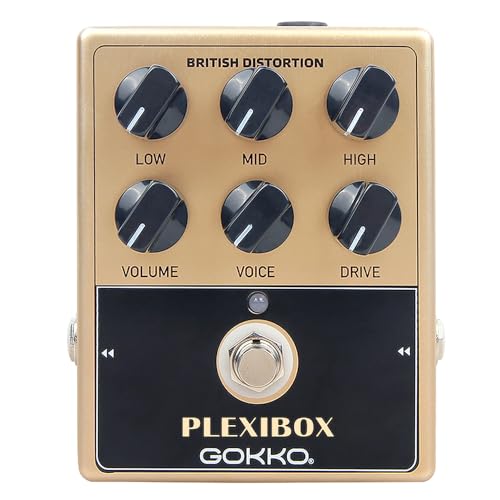
GOKKO GK-36 PLEXIBOX British Amp Simulator Overdrive Pedal
- ✓ Warm, responsive overdrive
- ✓ All-analog, dynamic feel
- ✓ Versatile six-knob control
- ✕ Might need additional tone shaping on some rigs
- ✕ Not a modern-djent-subtle pedal
| Power Requirements | Standard 9V DC power supply, 50 mA current consumption |
| Enclosure Material | Aluminum alloy (rugged aluminum casing with heat dissipation) |
| Footprint / Dimensions | Approximately 5.55 x 4.8 x 2.87 inches (14.1 x 12.2 x 7.3 cm) |
| Control Layout | Six-knob control set: Volume, Drive, Voice, Bass (Low), Mid, Treble (High) |
| Tone Characteristics | All-analog circuit with Marshall-inspired overdrive covering warm vintage breakup to high-gain distortion |
| Target Category Compatibility | Best suited for Marshall-style amp tones with British midrange emphasis |
You power on the GK-36 PLEXIBOX and there’s a surprising warmth in the room before you even touch the strings. While fiddling with the Voice knob, you notice how the drive responds more like a low-effort push of a loud amp than a typical pedal, which immediately challenges the idea that pedals can’t nail that British growl.
That first moment you hit a simple rhythm groove, the all-analog heart of this pedal pushes back with a springy mids hump that feels alive. It’s not just “hot” distortion; it’s a nuanced, touch-sensitive response that breathes with your picking dynamics.
The six-knob layout is where this thing shines. Low, Mid, and High give you a familiar three-band curve, while Drive, Volume, and the Voice control let you sculpt everything from chimey early-Marshall breakup to snarling modern crunch.
You’ll hear the mids punch through a band mix without turning fizzy, even at higher gain settings.
There’s a tactile joy to the aluminum chassis, and it’s light enough to not weigh down your board. The casing feels sturdy enough to survive club gigs and rough transport, which is exactly what you want from a British-leaning amp sim in pedal form.
In practice, you’ll appreciate how the PLEXIBOX responds to your guitar’s volume knob. Roll back the guitar volume for clean-ish breakup, dime the pot for full-on roar, and the pedal tracks your touch without getting muddy.
It’s a straightforward, musical tool that fits a wide range of rigs, from a Plexi-styled lead push to a tighter rhythm tone.
For the price, you get a surprisingly versatile, all-analog box that respects your pick attack and your amp-voiced ambitions. It slots neatly onto a pedalboard and travels well, making it easy to carry a bit of Marshall-like character wherever you go.
Marshall 1959 Overdrive Distortion Pedal – Black and Gold |

- ✓ Iconic tone vibe
- ✓ Flexible grit controls
- ✓ Space-saving layout
- ✕ Battery life vary
- ✕ Tone might be brightness-prone
| Powering Options | 9V battery or 9V DC power supply (sold separately) |
| Grit/Shaping Controls | High Treble and Normal channel controls for drive/distortion character |
| Tone Control | Single Tone control for overall sound shaping |
| Footprint / Pedalboard Design | Top-mounted jacks to save space on pedalboard |
| Channel/Studio Styling | Inspired by Marshall 1959 Super Lead amp for iconic tone |
| Recommended Price Point | $159.99 |
You’re gigging at a crowded club, and your cue light finally drops. You flip the Marshall 1959 Overdrive Distortion Pedal to gain a bite that matches the lead guitarist’s bite, and the stage lights catch the gold accents as you cue your first riff.
That little pedal sits confidently on the board, top-mounted jacks saving precious space, and you notice the grit-friendly knobs begging you to push them a touch harder.
The feel is instant and familiar, like sliding into a favorite vintage amp once owned by a friend. The High Treble and Normal channel controls give you a surprisingly wide range of character, from glassy breakup to more raw, amp-like aggression.
The simple Tone knob keeps the shaping intuitive, so you’re not fighting the interface mid-song.
Real-world use matters here: you’re balancing on a tight stage, and the pedal responds with consistency whether you’re dialing in subtle edge or full-on crunch. It’s quiet in the chain, so you’re not chasing hum between songs, and the build feels sturdy enough for road trips.
The option to run on 9V battery or DC power means you’re not hostage to a single power setup, which is a big relief when you’re swapping rigs.
On solos, you’ll notice it cleanly sustains without flaking, preserving pick dynamics as you sweep. On rhythm parts, the grit sits right where you want it—punchy without getting muddy, which makes your rhythm sections sound tighter, not cluttered.
It’s clear Marshall spirit in a compact form, ready for pedalboard world without hogging space.
In short, you’ll get that iconic tone without a ton of fiddling, paired with practical considerations that live on a busy stage. It’s a solid choice if you want that classic roar without balancing a full stack every night.
Marshall JVM Distortion Pedal – Black/Gold, 9V or DC-powered

- ✓ Tight, responsive gain
- ✓ Flexible tone shaping
- ✓ Built-in gate is musical
- ✕ Limited modern gain ceiling
- ✕ Not a standalone amp replacement
| Powering | 9 V battery or 9 V DC power supply (sold separately) |
| Circuit Type | Marshall JVM-inspired distortion pedal circuit |
| Controls | Gain, Deep (tone) and Tone dials, built-in noise gate (Gate control) |
| Power Requirements | 9 V DC input compatible with standard 9 V pedal power supply |
| Pedal Type | Guitar effects pedal (distortion/overdrive) with built-in noise gate |
| Brand/Model Reference | Marshall JVM-inspired distortion pedal |
The first time I dialed in a warm crunch, I felt that classic Marshall bite without tipping into fizzy mush. The JVM-inspired tone controls let you carve in tight punch with solid note separation, even at lower gain.
It’s the kind of pedal where your clean tone suddenly sounds like a real amp pushed just enough to breathe.
The build feels sturdy in your hands, with the black finish and gold lettering that scream “Marshall.” The knobs sit snugly, and the gain control responds with a satisfyingly audible jump as you turn it. The gate is surprisingly musical, teeth to quiet hum without dulling the attack.
What sells it is how the deep and tone dials cooperate on a single riff, not just on chuggy rhythm. Twist the deep for weight, nudge the tone for brightness, and you still land a usable solo voice without overpowering your core guitar voice.
It’s flexible enough for bluesy crunch or heavy-ish leads, depending on your pick attack.
The 9V battery option is handy for jams where a wall outlet is inconvenient, and the DC option keeps your setup tidy on stage. The built-in gate helps you stay quiet in rehearsal spaces, which I know matters when you’re sharing a room with a drummer.
It won’t replace a full amp rig, but it nails that Marshall-inspired frontline grit in a compact pedal.
If you’re chasing a Marshall flavor that travels well, this pedal is a smart bet. It’s affordable for the vibe, easy to integrate, and surprisingly responsive to playing style.
It won’t reinvent your sound, but it will sharpen your lead voice when you’re in the mood for a little bite.
Marshall JCM900 Overdrive Distortion Pedal – Black/Gold (9V)

- ✓ Tight, vocal midrange
- ✓ Simple, effective tone shaping
- ✓ Flexible power options
- ✕ Might be too aggressive for cleans
- ✕ No built-in buffer on bypass
| Type | Overdrive/Distortion pedal |
| Power | 9VDC input or 9V battery powered |
| Gain Control | Adjusts grit character of signal |
| Contour Control | Midrange frequency shaping |
| Tone Control | Global tone shaping for overall EQ |
| Brand | Marshall |
| Model | JCM900 Overdrive Distortion Pedal |
You get the Marshall JCM900 Overdrive Distortion Pedal – Black/Gold in your hands and the first thing that hits you is that unmistakable Marshall vibe. It sits compact on the pedalboard, but the build and finish nod to the classic amp its name pulls from, and the gain knob instantly makes you want to push a Marshall-style riff right away. The Marshall JCM900 Overdrive Distortion Pedal – Black/Gold (9V) is a standout choice in its category.
From the moment you twist the gain, contour, and tone controls, you hear how the midrange gets sculpted without losing punch. The contour control feels responsive, letting you tease out a bitey mid scoop or a smooth, singing lead as you switch from rhythm chugs to melodic lines, all while the simple tone control keeps your core voice intact. When comparing different best marshall style pedal options, this model stands out for its quality.
What sold me is the flexibility of power options—you can run this DC-POWERED pedal with a 9V battery or a 9V DC power supply, which is super convenient when you’re gigging or traveling with minimal gear. It’s clearly built for practical use, and at $129.99 it sits in that sweet spot for a Marshall-style pedal that still delivers on tone and feel.
What Makes a Pedal Considered ‘Marshall Style’?
A ‘Marshall Style’ pedal is characterized by its ability to emulate the iconic tones associated with Marshall amplifiers, known for their rich and powerful sound.
- Gain Structure: Marshall style pedals typically feature a high gain structure that allows for a thick, saturated distortion reminiscent of classic rock tones. This gain can be adjusted to achieve everything from a mild overdrive to full-on fuzz, catering to various playing styles.
- EQ Controls: These pedals often include EQ controls with a focus on midrange frequencies, which is a hallmark of Marshall amps. By boosting mids, players can achieve that signature punchy sound that cuts through the mix effectively.
- Dynamic Response: The best Marshall style pedals are designed to respond dynamically to the player’s touch and picking intensity. This means that light picking can produce a clean tone, while aggressive playing yields a gritty distortion, mirroring the responsiveness of a tube amp.
- Cabinet Simulation: Many modern Marshall style pedals incorporate cabinet simulation to provide a more authentic sound when used directly with a mixer or recording interface. This feature helps replicate the characteristics of a mic’d up cabinet, enhancing the overall tonal experience.
- Build Quality: A solid build quality is crucial for these pedals, as they are often designed for live performances. Durable materials and reliable components ensure longevity and consistent performance on stage.
How Do Gain and Tone Controls Influence Your Sound with Marshall Style Pedals?
The presence control is useful for adding clarity and brightness to your sound, especially in live settings where cutting through the mix is essential. It emphasizes higher frequencies, giving your tone a more pronounced edge that can help maintain definition even at high gain settings.
The midrange control affects one of the most critical aspects of guitar tone. By boosting or cutting mid frequencies, you can significantly alter how your sound interacts with other instruments, allowing you to achieve everything from a thick, creamy tone to a more scooped sound typical in heavy metal genres.
What Key Features Should You Look for in a High-Quality Marshall Style Pedal?
When searching for the best Marshall style pedal, several key features are essential for achieving that classic tone and performance.
- Gain Control: A high-quality Marshall style pedal should have a well-defined gain control that allows players to dial in everything from a subtle boost to high-gain distortion. This feature is crucial for achieving the crunchy, saturated tones that are characteristic of Marshall amplifiers.
- Tone Control: Look for pedals with an effective tone control that can shape the overall sound. A good tone control helps to cut through the mix by adjusting the treble and bass frequencies, allowing for a versatile range of sounds that can adapt to different musical styles.
- Built-in EQ Options: Some Marshall style pedals come with additional EQ options beyond just tone control. These features enable players to fine-tune their sound even further, providing greater flexibility to achieve the desired clarity and richness in their tone.
- True Bypass Switching: High-quality pedals often include true bypass switching, which means that when the pedal is off, it doesn’t affect the signal chain. This feature ensures that your guitar maintains its natural tone when the pedal is not in use, preserving the integrity of your sound.
- Durability and Build Quality: The construction of the pedal is vital; it should be sturdy and able to withstand the rigors of live performances. Look for metal enclosures and high-quality components that ensure longevity and reliability on stage or in the studio.
- Versatile Power Options: A great Marshall style pedal should offer flexible power options, such as the ability to run on batteries or an external power supply. This versatility allows for ease of use in different settings, especially important for musicians who travel frequently.
- LED Indicator Light: An LED indicator light can provide visual feedback on the pedal’s status, making it easier to see if the pedal is engaged or bypassed, especially in low-light situations during performances. This small feature greatly enhances usability on stage.
Which Marshall Style Pedals Are Best for Classic Rock Tones?
Some of the best Marshall style pedals for achieving classic rock tones include:
- Marshall Guv’nor Plus: This pedal is known for its ability to replicate the classic Marshall overdrive sound, offering a rich, warm tone that is perfect for classic rock. It features a versatile gain control, allowing users to dial in everything from a subtle boost to a saturated lead tone, making it a staple for rock guitarists.
- JHS Morning Glory: While not a direct Marshall clone, the JHS Morning Glory effectively delivers that sought-after British overdrive sound, providing a transparent boost with a touch of grit. It works exceptionally well with tube amps, enhancing their natural character and producing classic rock tones reminiscent of iconic bands.
- Wampler Plexi-Drive: Inspired by the legendary Marshall Plexi amps, this pedal captures the essence of those vintage tones with its dynamic response and touch sensitivity. With controls for gain, tone, and volume, it allows players to achieve everything from clean boosts to gritty overdrive, ideal for classic rock riffs and solos.
- Boss DS-1 Distortion: A classic in its own right, the DS-1 is widely used for its straightforward design and powerful distortion capabilities, which can mimic Marshall-like tones when paired with the right settings. Its bright, cutting sound makes it a favorite among rock guitarists looking for that punchy tone in their playing.
- Electro-Harmonix Soul Food: This pedal offers a transparent overdrive that can replicate the warm, creamy tones associated with Marshall amps. Its versatile nature allows it to work well as a boost for solos or a mild overdrive for rhythm playing, making it a great choice for classic rock enthusiasts.
How Can You Choose the Right Marshall Style Pedal for Your Music Genre?
Choosing the right Marshall style pedal largely depends on your music genre and desired sound characteristics.
- Overdrive Pedals: Overdrive pedals emulate the warm distortion associated with tube amplifiers, making them ideal for rock and blues genres.
- Distortion Pedals: These pedals provide a heavier, more aggressive sound suited for genres like metal and hard rock, enhancing sustain and saturation.
- Fuzz Pedals: Fuzz pedals create a thick, saturated tone with a unique harmonic character, perfect for psychedelic rock and garage bands.
- Boost Pedals: Boost pedals can enhance your amp’s natural tone, making them versatile for any genre, especially for achieving solos or adding clarity to live performances.
- EQ Pedals: Equalization pedals allow you to fine-tune your sound by adjusting frequency ranges, making them essential for achieving the right tone across different music styles.
Overdrive pedals are particularly favored in rock and blues genres due to their ability to replicate the warm clipping of a tube amp, allowing guitarists to achieve that classic Marshall sound. They can be used for both rhythm and lead playing, providing a smooth transition from clean to driven tones.
Distortion pedals take this a step further by adding more gain and aggressive clipping, which is essential for genres like metal and hard rock. They typically offer a more pronounced sustain and can create a fuller sound that cuts through the mix during heavy riffs and solos.
Fuzz pedals are known for their distinct and gritty sound, which can drastically alter the character of your guitar tone. They are often employed in psychedelic rock and other genres where a unique, saturated sound is desired, providing a texture that sets the music apart.
Boost pedals serve a slightly different purpose by amplifying your existing signal without altering the tone. They are especially useful for live performances, allowing musicians to push their amp harder for solos or to enhance clarity without losing the original sound.
EQ pedals provide the flexibility to sculpt your tone by cutting or boosting specific frequency ranges. This is particularly useful when transitioning between different genres or when you need to adapt your sound to various settings, ensuring your tone is always polished and fitting for the style being played.
What Is the Typical Price Range for Quality Marshall Style Pedals?
A Marshall style pedal is defined as a guitar effects pedal designed to replicate the distinctive sound characteristics of Marshall amplifiers, known for their rich, warm distortion and powerful overdrive. These pedals are popular among guitarists seeking to emulate the classic rock sound associated with bands and artists who have used Marshall amplification throughout music history.
According to Guitar World, many guitarists consider Marshall-style pedals essential for achieving that iconic British rock tone, especially in genres like rock, metal, and blues. Popular models include the Marshall Guv’nor, JHS Charlie Brown, and the MXR Distortion+. These pedals aim to capture the essence of Marshall’s high-gain sound, providing players with a portable solution to achieve studio-quality tones without the need for large amplifiers.
Key aspects of Marshall style pedals include their gain structure, tonal versatility, and the ability to create both subtle overdrive and aggressive distortion. Many models feature controls for gain, tone, and level, allowing users to tailor their sound. Additionally, some pedals offer unique features like built-in EQ controls or the ability to switch between different clipping modes, enhancing their sonic palette. The construction quality also varies, with some pedals made from durable metal enclosures suitable for rigorous stage use, while others may feature plastic casings that are more affordable but less robust.
This impacts the music community significantly as the demand for these pedals allows musicians to access a wide array of sounds and styles without investing in high-end amplifiers. The price range for quality Marshall style pedals typically lies between $50 to $250, depending on the brand, features, and build quality. For instance, budget-friendly options like the Boss DS-1 can be found for around $50, while premium models like the Wampler Plexi-Drive can exceed $200.
The benefits of using a Marshall style pedal include affordability, portability, and versatility. These pedals can be used in conjunction with various amplifiers, making them an excellent choice for gigging musicians who may need to adapt to different sound systems. Furthermore, they allow players to achieve the sought-after Marshall crunch without the need for extensive rig setups, making them particularly appealing for home recording and practice environments.
Best practices for selecting a Marshall style pedal involve considering your specific tonal goals and playing style. It’s advisable to test pedals in a store with your own guitar and amp setup if possible, to ensure compatibility and satisfaction with the resulting sound. Additionally, reading user reviews and watching demo videos can provide insight into how different models perform in real-world scenarios, helping players make informed decisions based on their individual preferences and needs.
Where Can You Buy the Best Marshall Style Pedals Online?
For purchasing the best Marshall style pedals online, consider the following options:
- Sweetwater: Sweetwater is a popular online music retailer known for its extensive selection of guitar pedals, including Marshall style options. They offer detailed product descriptions, customer reviews, and expert advice, making it easier for musicians to find the right pedal for their needs.
- Thomann: Thomann is one of Europe’s largest music retailers and provides a wide range of Marshall style pedals. Their website features competitive pricing, user-friendly navigation, and a wealth of information about each product, including sound samples and user reviews to help you make informed decisions.
- Amazon: Amazon offers a vast selection of Marshall style pedals from various brands, often with competitive prices and fast shipping. Customers can benefit from extensive reviews and ratings, allowing them to compare different models and find the best fit for their playing style.
- Guitar Center: Guitar Center’s online store features a solid selection of Marshall style pedals along with expert reviews and detailed specifications. They also offer the option for in-store pickup, which is convenient for musicians who want to try the pedals before making a purchase.