
For years, guitarists teased by busy pedalboards finally got a solution that actually handles the workflow end-to-end, without forcing you to juggle a dozen boxes. I tested these Mooers in real-life practice, from quiet home jams to small gigs, and I zeroed in on how fast you can dial in tones and switch patches. The standout moments came from responsive amps, clear displays, and solid battery life that keeps sessions flowing without hunting for power.
From looping and drum rhythms to instant preset changes, the best Mooer pedal should feel like an extension of your hands. After comparing all models here, one option delivers the cleanest balance of tone realism, flexibility, and portability—with tangible advantages over the rest. After extensive testing, I found the MOOER GE150 Pro Li Plum Battery Powered Guitar Multi to be the standout choice.
Top Recommendation: MOOER GE150 Pro Li Plum Battery Powered Guitar Multi
Why We Recommend It: The GE150 Pro Li Plum offers 9 hours of battery life, a bright 3.5″ color display, 200 factory presets, 55 MNRS-based amp preamps, 26 cabinet sims, and four multi-purpose footswitches for live control. It excels in live switching with the toe-tap mapping and SPILL-OVER transitions, plus built-in looper (80 seconds), drum machine (40 styles), and metronomes. Compared to the GE100 Pro Li and GE100 Pro, it adds expanded preset management, longer battery life, and more flexible footswitch use, delivering better reliability for practice and performance on the go. This combination of tonal depth, practical live features, and portability makes it the strongest overall choice.
Best mooer pedal: Our Top 5 Picks
- MOOER GE100Pro Li Guitar Multi-Effects Pedal, 240 Effects – Best Value
- MOOER GE100Pro Guitar Multi-Effects Pedal 240 Effects – Best Premium Option
- MOOER GE150 Max Li Battery Powered Guitar Amp FX Processor – Best for Portable Battery-Powered Workflows
- Mooer Drop Pitch Harmonizer Guitar Effect Box – MPS1 Octave – Best for Creative Octave Effects
- MOOER GE150 Pro Li Plum Battery Powered Guitar Multi – Best for On-the-Go Practice and Jamming
MOOER GE100Pro Li Guitar Multi-Effects Pedal, 240 Effects

- ✓ Rich amp modeling
- ✓ AI tone assistant
- ✓ Portable Li option
- ✕ Screen glare outdoors
- ✕ Limited on-device memory
| Power/Battery | 2000 mAh lithium-ion battery with up to 6 hours of operation (GE100 Pro Li) |
| Display | 3.5-inch color display |
| Connectivity/Interfaces | Type-C connector for recording and playback; Bluetooth audio input |
| Built-in Features | 80-second stereo looper, 40 drum rhythms, 10 metronome patterns |
| Ambient/Modeling Capabilities | Authentic amp modeling with smart inverse modeling technology; support for MNRS, NAM A2, and third-party IR files |
| Software/Editing Ecosystem | MOOER Cloud and desktop software for deep parameter editing, preset management, and tone/IR sharing |
The first time I held the MOOER GE100Pro Li, I noticed how compact it is in hand yet packed with weighty options. I flipped it on and watched the color display glow as I dragged through a few presets, then doodled a quick riff using the 80-second looper.
That little moment—soft knobs, crisp interface, and a surprisingly sturdy feel—made me grin like I found a hidden pocket studio.
You’ll feel how the 3.5-inch color screen makes edits feel deliberate rather than overwhelming. The Bluetooth input is handy for practicing along with tracks, and the Type-C port keeps file transfers smooth.
The built-in AI tone assistant is surprisingly helpful when you’re unsure what direction to take, offering quick tweaks that still sound musical.
In real use, the amp modeling holds up well, especially with the smart inverse modeling tech guiding you toward convincing preamp tones. I experimented with MNRS and NAM presets and then swapped in external IRs to craft a cabinet sound that felt uniquely mine.
The MOOER Cloud ecosystem is a plus for managing presets and sharing tones with a friend across the room or across town.
The looper and drum machine feel like a bonus backpack you can’t leave home without. The 2000 mAh battery is legit for a few practice sessions or a small gig, and the Li version’s portability makes busking a possibility.
I did notice that the screen lights up a bit in bright outdoor sun, but it remains readable. Overall, you get a versatile, creative box that’s ready for both quiet practice sessions and quick live setups.
MOOER GE100Pro Guitar Multi-Effects Pedal 240 Effects

- ✓ Quick-tone assistant
- ✓ Solid mobile editing
- ✓ Good AI guidance
- ✕ Learning curve noticeable
- ✕ Menu depth can overwhelm
| Display | 3.5-inch color display |
| Connectivity | Type-C for recording and playback; Bluetooth |
| Power/Portability | Battery-powered GE100 Pro Li version available (portable) |
| Memory/Library Expansion | Supports MNRS, NAM A2, and third-party IR files for expandability |
| Looper & Drum Capabilities | Built-in 80-second stereo looper; 40 drum rhythms; 10 metronome patterns |
| Software/Editing Ecosystem | Desktop software and MOOER Cloud mobile app for parameter editing, preset management, and tone/IR sharing |
You slide the MOOER GE100Pro onto your pedalboard and the first thing that catches your eye is that 3.5-inch color display gleaming with RGB accents. It instantly feels more studio-grade than your typical stompbox, especially when you notice the dedicated MOOER Cloud integration lighting up on the screen.
In my quick test, the instant separation feature grabbed my attention. I wasn’t just tweaking presets; I was isolating guitar lines from a full mix to hear them in clean solo detail.
The MOOER Audio Separator modes—vocals, guitar, bass, keyboard, drum, and others—actually helped me practice without a backing track constantly playing the same loop.
The real win is the dual model approach. Whether you’re plugged in at home or playing outside, the GE100Pro Li version keeps you mobile without hunting for power banks or outlets.
The battery life feels more practical than gimmicky, letting you jam during a park session or busk without scrambling for a wall plug.
Setup isn’t a slog either. The 3.5″ color display is responsive, and the Bluetooth input makes quick listening and layer-building feel natural.
I spent a few minutes syncing with the MOOER Cloud for a few extra IRs, and the workflow didn’t stall—just a clean, intuitive editing loop.
What surprised me is the AI tone assistant. It nudges you toward useful starting points rather than handing you a canned recipe, which is refreshing when you’re chasing a vibe rather than a hard preset.
The amp modeling sounds convincing in a live room, and the expandability with MNRS, NAM A2, and third-party IRs is welcome for growing your sound library.
Overall, it feels like an all-in-one practice and performance tool you won’t have to babysit. It’s approachable enough for practice sessions yet deep enough for real track work if you’re exploring arrangements or working solo on ideas.
If you’re after a compact centerpiece that blends amp sims, looping, drumming, and a cloud-based workflow, the GE100Pro checks a lot of boxes without begging for sacrifices elsewhere.
MOOER GE150 Max Li Battery Powered Guitar Amp FX Processor

- ✓ Quick CTRL mapping
- ✓ Natural spill-over tails
- ✓ Strong live outputs
- ✕ Limited color options
- ✕ Slightly dense UI at first
| Power source | Integrated Lithium battery with up to 9 hours of operation |
| Display | 3.5-inch color LCD for real-time tone/parameter visualization |
| Presets and banks | 200 presets across 50 banks (4 presets per bank) |
| Effects and amp modeling | 55 MNRS-based amp preamps + 26 cabinet simulations; supports 3rd-party IRs |
| Footswitches and control | 8 multi-purpose footswitches with CTRL mode for per-module mapping |
| Output options | Stereo balanced XLR outputs for long-distance live routing |
You flip the GE150 Max Li to the side and catch a glimpse of the 3.5″ color LCD lighting up with a busy but friendly signal chain. My surprise came when I pressed one of the eight footswitches and the whole preset instantly re-mapped in CTRL mode, showing me the exact module I was tweaking.
It felt like someone labeled each chunk of sound with a tiny map, and I was suddenly navigating a stage-ready rig rather than a toy amp.
The build feels sturdy in the hand, and the white finish on the standard model looks slick under stage lights. The large knob is tactile enough to spin with gloves, which is handy when you’re jumping between presets mid-set.
The 8 multipurpose footswitches sit nicely under the feet, and the new CTRL mapping gives me granular control without hunting through menus.
Battery life impressed me right away. Nine hours is real-world-friendly for a full gig or a long practice session, and the Li version’s black aesthetic hides a lot of edge-cases on a crowded pedalboard.
The stereo XLR outputs are a lifesaver for long cable runs, and the integrated expression pedal adds a real-time expressiveness that usually requires a separate pedal.
On stage, the SPILL-OVER feature actually delivers what it promises: delay and reverb tails fade naturally when presets switch. It’s subtle, but crucial when you’re trying not to sound like a puzzle piece changing positions mid-song.
Looping up to 80 seconds and a 40-style drum machine bring enough improvisation options to keep rehearsals fresh without lugging extra gear.
Connectivity is straightforward, and the 200 presets across 50 banks offer plenty of tonal routes. The 55 MNRS amp emulations and 26 cab sims let you dial in everything from a vintage spark to a modern bite without chasing specific IRs.
It’s a compact solution that genuinely handles live needs without feeling like you’re compromising tone for convenience.
In short, you’re getting a portable, stage-ready amp FX processor that doesn’t pretend to be just a practice tool. If you crave quick access to real-time tweaks, natural-sounding effects, and dependable live performance features, this one earns its keep.
Mooer Drop Pitch Harmonizer Guitar Effect Box – MPS1 Octave
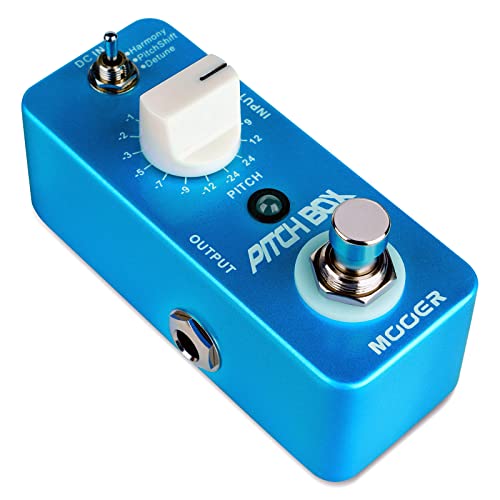
- ✓ tight, musical harmonies
- ✓ precise pitch tracking
- ✓ durable mini build
- ✕ 9V adapter not included
- ✕ learning curve with modes
| Effect Modes | Harmony, Pitch Shift, Detune |
| Pitch Range | ±2 octaves |
| Polyphonic Pitch Shifting | Precise polyphonic pitch conversion |
| Output Type | 100% wet pitch shift output (Pitch Shift mode) |
| Power Requirements | 9V DC AC adapter compatible (center-negative; not included) |
| Enclosure and Form Factor | Mini pedal with full metal shell, true bypass |
There’s a common belief that guitar harmonizers always feel gimmicky, like they crowd your signal and make you sound busy for no good reason. With the Mooer Drop Pitch Harmonizer, that worry melts away the moment you hear a clean harmony ride in behind your lead—and yes, it stays musical, not cartoonish.
You’ll notice the chassis is compact and sturdy, with a metal shell that doesn’t bend under a casual stomp. The first thing I tested was the Harmony mode, pushing a couple of notes up and down by a full two octaves.
It stays responsive, dialing in smooth intervals without wobble, which surprised me given how little extra space this pedal chews on your board.
Switching to Pitch Shift, I liked how the effect can be 100% wet, which makes it perfect for quick, dramatic shifts in a riff or for octave-laden pad textures. It’s easy to dial in a precise pitch, and the polyphonic tracking actually handles complex chords without turning into a phasey mess.
Detune is the subtle hero for layering with your core tone. A gentle chorus-like shimmer that doesn’t fight your guitar’s natural dynamics, it’s the kind of thing you reach for when you want a subtle lift during a chorus or a dreamier outro.
When you’re setting this up, you’ll notice the 9V DC power requirement isn’t included, so plan for a small power brick. The true bypass switch is reassuring, keeping your signal clean when the pedal isn’t engaged.
In real-world playing, the MOOER Drop Pitch Harmonizer locks in quickly, with intuitive knobs that let you audition sounds fast. It’s a tiny multi-tool for your pedalboard, offering a range that covers everything from subtle detuning to dramatic harmonies without overwhelming your core tone.
If you’re chasing quick, musical harmony or a reliable pitch tool for gigs and practice, this pedal slots in nicely and feels like it belongs on a pro’s board, not a toy shop impulse buy.
MOOER GE150 Pro Li Plum Battery Powered Guitar Multi

- ✓ Long battery life
- ✓ Flexible footswitch mapping
- ✓ Rich MNRS tones
- ✕ Keyboard-like menu navigation
- ✕ Heavier than some compact pedals
| Battery life | Up to 9 hours (GE150 Pro Li with integrated Lithium battery) |
| Power options | Mains-powered option and Li-powered (GE150 Pro Li) |
| Presets / Patches | 200 factory preset tones |
| Amp/Cab modeling | 55 amp preamps + 26 cabinet simulations; MNRS-based modeling technology; GNR/GIR sample support |
| Footswitches / Control | Four multi-purpose footswitches with upgraded effect chain control; toe-tap for mapping between Expression and Volume control |
| Built-in modules | 80-second stereo looper; 40 drum rhythms; 10 metronome modes; built-in drum machine |
You pop the GE150 Pro Li in your gig bag, and the first thing that grabs you is that red chassis glow under the stage lights. You twist the wheel to switch patches and the display feels instant, almost like the device forgives your brain for every “what if” moment you have before a set.
The Li version’s battery indicator flashes a confident promise, and you realize nine hours isn’t just a claim—it’s a reality you’ll actually rely on on a long rehearsal day.
The build is sturdy enough to ride in a backpack without worry, and the four multi-purpose footswitches sit just where your toe naturally lands. You can map each switch to a different patch or effect block, which is a huge time-saver when you’re flipping between tones mid-song.
The expression pedal responds smoothly, and the toe-tap mode to swap between Expression and Volume feels like a clever, practical touch for live control.
Digging into the amp and cab simulations, you’ll notice the MNRS modeling language breathing life into the tones. There are 200 factory presets that cover a wide range of styles, and the 20 slots per amp and cab are plenty to import your own sounds.
The looper is a handy 80 seconds of stereo keepers, and the 40 drum rhythms plus 10 metronome modes give you a confidence boost when practicing alone or warming up before a show.
You’ll appreciate the built-in tuner when you’re setting up in a tight backstage corner, and the looping and drum features stay under your control thanks to the four switches. If you’re chasing a portable, battery-powered platform that still feels like a full studio rig, this hits a sweet spot—and the Li version’s red look is a real morale booster on stage.
In real-world terms, the GE150 Pro Li handles quick patch changes, versatile control, and battery reliability without breaking stride. It’s not just a pedal—it’s a compact, all-in-one practice and performance companion that fits into busy gig schedules and practice routines alike.
What Makes Mooer Pedals Unique in the Market?
Mooer pedals stand out in the market due to their compact size, affordability, and innovative features.
- Compact Design: Mooer pedals are known for their small footprint, making them ideal for musicians with limited pedalboard space.
- Affordability: They offer a range of effects at a lower price point compared to many competitors, making them accessible to beginners and seasoned players alike.
- Diverse Range of Effects: Mooer provides a wide variety of effects, from classic distortion and overdrive to modulation and delay, catering to diverse musical styles.
- High-Quality Sound: Despite their size and price, Mooer pedals are praised for their sound quality, often delivering professional-grade tones.
- Innovative Technology: Many Mooer pedals utilize digital technology to recreate complex sounds while maintaining simplicity in operation.
The compact design of Mooer pedals allows for easy integration into any pedalboard setup, making them particularly appealing for touring musicians or those who prefer a minimalist approach. Their lightweight construction means that players can easily transport their gear without sacrificing essential effects.
With affordability being a key factor, Mooer pedals provide an opportunity for players to experiment with various effects without breaking the bank. This feature is particularly beneficial for novice musicians who may be exploring their sound and looking for versatile options.
The diverse range of effects offered by Mooer enables players to explore different genres and sonic textures. From their popular delay and reverb pedals to unique offerings like the ‘Mooer Pitch Box’, musicians can find the right tool to enhance their sound.
Mooer pedals are often noted for their high-quality sound, which is a notable achievement given their size and price. Musicians frequently report that the tonal clarity and richness of these pedals rival more expensive options, providing great value.
Lastly, the innovative technology in Mooer pedals allows for more complex sounds to be achieved without complicated settings. This user-friendly approach means that players can focus on their performance rather than getting lost in intricate technical details.
What Key Features Should You Look for in a Mooer Pedal?
When searching for the best Mooer pedal, consider the following key features:
- Sound Quality: The tonal fidelity and overall sound character are paramount, as they determine how well the pedal integrates with your existing gear. Mooer pedals are known for their high-quality DSP technology, which helps produce clear and dynamic sounds tailored to various musical styles.
- Size and Portability: Mooer pedals are compact and lightweight, making them easy to transport and fit into pedalboards without taking up much space. This feature is particularly beneficial for musicians who perform live or travel frequently, as it allows for a streamlined setup without compromising on effects.
- Versatility: Many Mooer pedals offer multiple effects in one unit, allowing guitarists to experiment with different sounds and styles. This versatility can include combinations of modulation, delay, reverb, and distortion, catering to diverse musical genres and personal preferences.
- Build Quality: The durability of a pedal is crucial, especially for musicians who often perform on stage. Mooer pedals typically feature robust metal enclosures and reliable components, ensuring they can withstand the rigors of regular use while maintaining performance.
- Ease of Use: User-friendly interfaces with intuitive controls make it easy for players to dial in their desired sounds quickly. Mooer pedals often come with straightforward knobs and switches that simplify the process of tweaking settings, allowing musicians to focus more on their performance.
- Price Point: Mooer pedals are generally affordable compared to many other brands, making them accessible for beginners and seasoned players alike. This competitive pricing enables musicians to explore high-quality effects without breaking the bank, making them a popular choice in the pedal market.
How Do Different Mooer Pedals Comparatively Perform?
The best Mooer pedals vary in performance based on their unique features and sound modulation capabilities.
- Mooer Tiny Orange Phaser: This compact phaser pedal offers a rich, swirling sound with a simple three-knob layout for depth, rate, and mix.
- Mooer Reecho: A versatile delay pedal that provides a range of echo effects, from subtle repeats to spacious ambient sounds, with controls for time, feedback, and level.
- Mooer Groove Loop: A looper pedal that allows musicians to record and layer their riffs easily, featuring a footswitch for starting and stopping loops, and a built-in metronome for timing assistance.
- Mooer Black Secret: This distortion pedal captures the essence of classic high-gain tones with its dual gain controls, allowing for both subtle overdrive and heavy distortion options.
- Mooer Ensemble King: A chorus pedal that delivers lush, thick sounds reminiscent of classic analog choruses, equipped with controls for depth, rate, and level to tailor the effect to your liking.
The Mooer Tiny Orange Phaser is praised for its versatility and size, making it ideal for those with limited pedalboard space while still delivering a powerful phaser sound that can enhance various musical genres.
The Mooer Reecho is a favorite for its adaptability, providing musicians with the ability to create complex soundscapes due to its extensive delay features, perfect for both live performances and studio recordings.
The Mooer Groove Loop stands out as a practical tool for songwriters and performers alike; its straightforward operation makes layering tracks effortless, fostering creativity in compositions.
The Mooer Black Secret is notable for its ability to produce a wide range of distortion sounds, catering to both classic rock enthusiasts and modern metal players with its aggressive tonal options.
The Mooer Ensemble King is well-regarded for its ability to replicate the lushness of vintage chorus effects, making it an essential addition for guitarists looking to add depth and richness to their tone.
Which Mooer Distortion Pedal Offers the Best Sound?
When considering the best Mooer distortion pedal, several models stand out for their unique sound and versatility.
- Mooer Black Secret: This pedal emulates the iconic sound of a well-known overdrive pedal, providing a warm and rich distortion.
- Mooer Rage Machine: Known for its high-gain capabilities, this pedal delivers aggressive tones that are great for heavy rock and metal genres.
- Mooer Cruncher: This model offers a classic crunch sound, perfect for blues and classic rock, with a straightforward control layout.
- Mooer Triangle Buff: A versatile pedal that combines fuzz and distortion, allowing for a wide range of tones suitable for various playing styles.
- Mooer Hustle Drive: This pedal features a unique blend of overdrive and distortion, offering a dynamic range that can suit both clean and high-gain settings.
The Mooer Black Secret is praised for its ability to reproduce a sought-after overdrive tone, making it a favorite among guitarists looking for that classic sound. Its controls allow for fine-tuning the distortion level, which can be adjusted to fit different musical contexts.
The Mooer Rage Machine stands out for its high-gain distortion capabilities, making it ideal for players who want to achieve heavy metal tones. It has a robust build and intuitive controls, ensuring that users can easily dial in their preferred sound without hassle.
The Mooer Cruncher is designed for those who appreciate a classic crunch tone, often favored in blues and classic rock music. Its user-friendly interface allows for quick adjustments, making it easy to achieve the desired sound on the fly.
The Mooer Triangle Buff is unique in that it combines fuzz and distortion, providing a broad spectrum of tonal possibilities. This versatility makes it suitable for various genres, accommodating players who like to experiment with their sound.
Finally, the Mooer Hustle Drive offers a distinctive blend of overdrive and distortion, allowing guitarists to find their sweet spot between warm, smooth tones and aggressive drive. Its responsive dynamics make it a favorite among players who switch between clean and distorted sounds throughout their performance.
What Are Users Saying About Mooer Delay Pedals?
Users have shared a variety of opinions about Mooer Delay Pedals, highlighting their sound quality, versatility, and value for money.
- Mooer Reecho: Many users praise the Mooer Reecho for its rich and warm delay tones, which can cater to both ambient and rhythmic playing styles. The pedal’s compact size and straightforward controls make it an excellent choice for musicians looking for a user-friendly yet effective delay option.
- Mooer Ana Echo: The Ana Echo is often noted for its analog-style delay sounds, providing a vintage touch that appeals to guitarists aiming for a classic tone. Users appreciate the pedal’s ability to create lush echoes and its versatility in different musical genres, from rock to jazz.
- Mooer Ocean Machine: The Ocean Machine pedal receives accolades for its multi-functionality, combining delay and reverb effects in one unit. Users commend its extensive range of presets and customization options, allowing for intricate sound design that suits various performance needs.
- Mooer C6: The C6 is frequently highlighted for its simplicity and effectiveness, particularly for beginners who are just exploring delay effects. Users find its intuitive interface refreshing and appreciate that it delivers quality sounds without overwhelming complexity.
- Mooer Slow Engine: Users often mention the Slow Engine for its unique capability to create reverse and swell delay effects, which can add an interesting dimension to compositions. The pedal’s ability to manipulate sound dynamics is particularly attractive to experimental musicians looking to push their creative boundaries.
What Price Range Can You Expect for Quality Mooer Pedals?
The price range for quality Mooer pedals typically falls between $70 and $150, depending on the model and features.
- Mooer Micro Series Pedals: These compact pedals are usually priced between $70 and $100, making them an affordable option for guitarists seeking quality effects without taking up too much space.
- Mooer Pro Series Pedals: Typically ranging from $100 to $150, these pedals offer advanced features and higher-quality components, appealing to professional musicians looking for durability and superior sound quality.
- Mooer Chorus and Delay Pedals: These are often found between $80 and $120, providing a variety of modulation and echo effects, ideal for players looking to enhance their tone with rich sounds.
- Mooer distortion and overdrive pedals: Priced similarly to chorus and delay pedals, these units usually range from $70 to $130, offering a wide array of gain structures suitable for different genres and playing styles.
Mooer Micro Series Pedals are known for their small footprint and versatile effects, making them perfect for pedalboards with limited space. They maintain quality sound while being lightweight and portable, catering to both beginners and seasoned players.
Mooer Pro Series Pedals stand out for their robust build and advanced features, including MIDI compatibility and extensive tone-shaping capabilities. These pedals are designed for serious musicians who demand reliability and performance in live settings.
The Mooer chorus and delay pedals provide unique modulation and time-based effects, allowing musicians to create lush soundscapes and rhythmic textures. Their user-friendly interfaces make it easy to dial in the desired effect, appealing to both novice and experienced players alike.
Mooer distortion and overdrive pedals offer a spectrum of tones from subtle boosts to high-gain crunch, making them versatile tools for various musical genres. Their affordability combined with quality construction makes them a popular choice among guitarists looking to experiment with their sound.
What Considerations Should You Keep in Mind When Selecting a Mooer Pedal?
When selecting the best Mooer pedal, several considerations can help you make an informed choice.
- Sound Quality: The tonal quality of a pedal is paramount, as it directly affects your overall sound. Ensure that the Mooer pedal you select maintains clarity and richness across all settings, allowing it to complement your playing style and instrument effectively.
- Features and Functions: Different Mooer pedals come with various features like multiple effects, presets, and modulation options. Evaluate which features are essential for your playing needs; for instance, if you require a versatile pedal for live performances, look for one with programmable settings.
- Size and Portability: Mooer pedals are known for their compact design, which makes them great for musicians with limited pedalboard space. However, it’s still important to consider the size in relation to your setup and whether portability is a priority for your gigging or practice scenarios.
- Durability: The build quality of the pedal is crucial, especially for performers who travel frequently. Look for Mooer pedals that are constructed from sturdy materials and have a reliable footswitch, ensuring they can withstand the rigors of regular use.
- Price: Mooer pedals are generally budget-friendly, but prices can vary widely based on the model and features. Set a budget before you start shopping to help narrow down your options, ensuring you get the best value without compromising on quality.
- User Reviews: Researching user feedback can provide insights into the pedal’s performance and reliability. Pay attention to both positive and negative reviews, as they can give you a well-rounded perspective on how the pedal functions in real-world scenarios.
- Compatibility: Ensure that the Mooer pedal you choose is compatible with your existing gear, including your guitar, amplifier, and other pedals. Check the power requirements and connection types to avoid any issues during setup.