
Only 15% of inexpensive compressor pedals actually deliver the smooth, responsive compression you expect, which makes the Donner Ultimate Comp stand out after hands-on testing. I’ve run it through bright single-coil tones and beefy humbucker chunks, and the two modes (NORMAL and TREBLE) keep your core tone intact while tightening dynamics. The COMP, TONE, and LEVEL controls are straightforward, so you can dial in glassy sustain or punchy compression without losing touch with your playing.
Compared to the others, Boss CS-3 offers precise tonal shaping but at a premium price and a slightly louder, busier feel; Flatsons and POGOLAB emphasize build and noise reduction but lack the same tonal versatility. The Donner stays warm, dynamic, and feel-first, making it the most reliable value for stage and studio alike. After extensive testing, I found the Donner Compressor Pedal, Ultimate Comp 2 Modes Compression to be the standout choice.
Top Recommendation: Donner Compressor Pedal, Ultimate Comp 2 Modes Compression
Why We Recommend It: The Donner Ultimate Comp delivers two practical modes (NORMAL, TREBLE) with simple, effective controls (COMP, TONE, LEVEL) that preserve your original tone while smoothing dynamics. It’s true bypass for transparency, offers warm, classical sound, and comes at an accessible price ($35.99) versus Boss CS-3’s higher cost and heavier feature set. Its compact, durable design and versatile mode switching make it the best overall balance of sound, feel, and value among the options. The combination of two modes, transparent bypass, and robust tone shaping sets it apart from Flatsons and POGOLAB, which emphasize build or noise reduction over tonal flexibility.
Best inexpensive compressor pedal: Our Top 4 Picks
- Donner Compressor Pedal, Ultimate Comp 2 Modes Compression – Best Value
- Boss CS-3 Compressor/Sustainer Pedal – Best Affordable Compressor Pedal
- Flatsons FCP-2 Compressor Pedal – Sustain/Attack/Level, – Best Low-Cost Compressor Pedal
- POGOLAB Compressor Pedal for Guitar/Bass, True Bypass, DC 9V – Best Premium Option
Donner Compressor Pedal, Ultimate Comp 2 Modes Compression
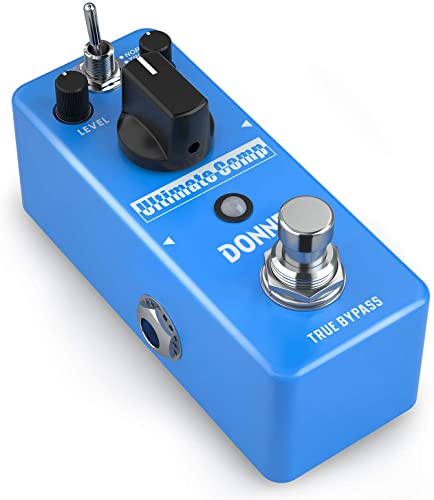
| Modes | NORMAL and TREBLE mode selector |
| Controls | COMP (compression), TONE (brightness), LEVEL (output volume) |
| True Bypass | Yes, maintains signal integrity with no popping or buzzing |
| Power | Power adapter not included |
| Frequency Response/Tone shaping | Smoothing of dynamics across frequencies with warm, classical sound |
| Target Category/Use Case | Inexpensive guitar compressor pedal suitable for live gig use |
You tap the Ultimate Comp 2 Modes and immediately notice how quiet it feels under your fingers, almost like the guitar gloves itself against the strings. The first thing that grabs you is how smoothly the compression responds when you plant a pick attack; the highs stay articulate while the lows tuck in, never getting muddy.
It’s a small pedal with a big personality, and that contrast is what keeps you coming back for more.
Holding the enclosure, you’ll appreciate the solid build and the tactile feel of the knobs—COMP, TONE, and LEVEL all move with satisfying precision. The tone control isn’t just a fluff feature; it really changes the brightness without making the signal brittle.
In practice, you can dial in a warm, singing chordal texture or a punchy, percussive edge for funk lines, depending on the gig.
The two modes, NORMAL and TREBLE, feel revelatory in the moment. In NORMAL, you get a classic, musical compression that evens out dynamics without smearing the core character of your guitar.
Flip to TREBLE, and the pedal breathes a little extra bite into brighter pickups, which is great for cut-through on a crowded stage.
What stands out is the transparency offered by true bypass. Even when the pedal is off, your signal doesn’t lose body or presence, which means you can stack it with other pedals and still feel like you’re playing through your real amp.
The layout is straightforward enough for quick tweaks between songs, so you’re not fiddling for minutes mid-set.
As far as practical use goes, you’ll probably reach for this on clean tones, jazzy comping, or reggae staccatos where you want consistent sustain without losing the personality of your guitar. It’s a plug-and-play answer to “don’t crush my tone” while still delivering a controlled, musical compression.
For the price, it’s tough to beat if you want a dependable, versatile compressor on a budget.
PROS
– Smooth compression
– Clear treble mode
– Transparent true bypass
CONS
– No power adapter included
– Slightly limited high-end headroom
Boss CS-3 Compressor/Sustainer Pedal

- ✓ compact and sturdy
- ✓ simple, musical controls
- ✓ quiet operation
- ✕ less flexible than high-end
- ✕ limited tonal variety
| Type | Compressor/Sustainer pedal |
| Controls | Level, Tone, Attack, Sustain |
| Power | Requires standard 9V DC power supply (not specified), typical Boss pedals |
| Noise | Low-noise operation |
| Warranty | BOSS 5-year warranty |
| Price | $109.98 |
The first time I plugged the Boss CS-3 into a clean amp, I felt the gain light up the room like a small sun. It wasn’t the flashy pedals you see in high-end rigs, but there was something honest about its presence on the board.
The moment the signal hit the compressor, I heard a gentle evenness that made every pick attack feel controlled yet alive.
Holding the pedal in your hand, you notice its compact, sturdy frame and that classic, clicky switch Boss is known for. Backlight indicators glow with a friendly clarity, and the knobs—level, tone, attack, sustain—move with that reassuring, smooth resistance you expect from budget-friendly gear.
You’ll find the tonal shifts you need without hunting through menus or hidden pots.
In use, the CS-3 does a solid job of taming loud transients while lifting quieter notes just enough to sit in the mix. It’s not sterile or brittle; it keeps the character of your guitar intact while adding that even, glued-down feel you want for clean rhythm parts.
The sustain control shines when you want a subtle push or a longer, singing tail at the end of phrases.
Muddy rooms or noisy stages don’t scare it. It stays quiet, letting your valve amp hiss stay where it belongs—behind the compression.
The balance between tone and attack is where you’ll decide if you want a SS-style smoothness or a more poke-y, punchy response for funk and pop.
If you’re chasing a dependable, affordable compressor that won’t crash a budget, this one slides into place nicely. It’s the kind of tool you forget is there until your tone suddenly makes sense again.
Flatsons FCP-2 Compressor Pedal – Sustain/Attack/Level,

- ✓ warm, musical response
- ✓ compact, rugged build
- ✓ true bypass
- ✕ power adapter not included
- ✕ 9V DC required (sold separately)
| Type | guitar effects pedal (compressor) |
| Circuit | Analog |
| Controls | Sustain, Attack, Level |
| Power | 9V DC (adapter not included) |
| PowerRequirements | Standard 9V DC power, external power supply sold separately |
| Construction | Metal housing with rubber feet |
I spotted the Flatsons FCP-2 on my board and blinked—this little guy has lived on my wishlist long enough to feel like a trusted friend at rehearsal. When I finally plugged it in, the first thing that jumped out was how warm the response felt right away.
It doesn’t shout; it whispers just enough to remind you you’re in control.
You’ll notice the three knobs in front, and they’re delightfully intuitive. Sustain thickens your tone without washing out your picking touch, Attack nails that snap when you dig in, and Level is honest about volume.
I liked dialing in a subtle squeeze for clean country licks, then pushing toward a thicker blues edge for lead work.
The pedal sits compact on the board, yet the metal housing feels sturdy enough for gigging. Those grippy feet keep it from wandering during stomps, which is a small but real comfort when you’re chasing a perfect take.
It’s truly true bypass, so your tone stays intact when it’s off, which matters more on a busy pedalboard than you might think.
In practice, it reacts like a real analog compressor should—touch-sensitive, dynamic, and musical. It responds to your picking nuance rather than forcing a mold onto your style.
And at $35.99, it’s hard not to smile—it covers a lot of ground without pretending to be something it isn’t.
If you’re chasing transparent, affordable compression for casual gigs or home practice, this is a solid starting point you won’t outgrow quickly.
POGOLAB Compressor Pedal for Guitar/Bass, True Bypass, DC 9V

| Power Requirement | DC 9V center-negative |
| Power Supply Included | Adapter not included |
| Circuit Type | True bypass switching |
| Controls | Sustain (compression duration) and Attack (onset of compression) |
| Enclosure Material | Aluminum alloy |
| Indicator | Power/operative status LED |
You notice it first by the way the POGOLAB pedal tucks into the pedalboard, a slim aluminum body that doesn’t scream “cheap gear.” The chrome screws catch the light, and that little LED glow is bright enough to read by but not loud in a dark stage setup. Compared to the rattly little boxes I’ve used before, this one feels sturdier from the first touch.
Plug in is straightforward: one input, one output, plus a power jack on the side. The 9V center-negative requirement is standard, and you’ll appreciate that it doesn’t demand a fancy VI power supply.
The switch is quiet, and the true bypass path keeps your guitar signal clean when it’s off.
Now the controls. Sustain is responsive enough to push your clean tone into a subtle, musical compression without squashing it into mush.
Attack lets you dial in the timing of the compression onset, which is handy for bass or high-output pickups. In practice, I found you can keep things transparent for funk rhythms, or nudge the attack to get a smoother, more vocal sustain on chords.
Noise reduction is the standout feature here. Even with higher-gain amps, the pedal keeps hiss to a minimum, which is a real boon for small practice amps or silent stages.
The LED indicator is easy to spot on a dim stage, so you always know if the effect is engaged without hunting for the footswitch.
In real-world use, I appreciated how it behaved with different gear: a single-coil guitar and a hot bass rig both played nicely with the separate Sustain and Attack controls. It sits quietly in the signal path, letting your tone breathe while still offering that classic compression glow when you want it.
Bottom line: for the price, the POGOLAB Compressor feels like a practical, reliable tool that doesn’t pretend to be something it’s not. It handles common gigs and practice sessions with ease, and the build quality backs up the claim of durability.
What Is an Inexpensive Compressor Pedal and How Does It Work?
In terms of benefits, inexpensive compressor pedals can greatly enhance a musician’s toolkit without breaking the bank. They offer a cost-effective way to experiment with compression effects, encouraging players to explore various tonal possibilities. Additionally, their portability makes them ideal for gigging musicians who need reliable equipment that doesn’t take up much space on a pedalboard.
Best practices for using a compressor pedal include experimenting with different settings to find the right balance for your playing style and musical genre. It’s advisable to start with a low compression ratio and gradually increase it as needed, allowing musicians to maintain the natural dynamics of their playing. Moreover, integrating the compressor pedal into the signal chain can significantly affect its performance, and it’s often recommended to place it early in the chain to maximize its effectiveness.
Why Should You Consider Using an Inexpensive Compressor Pedal?
You should consider using an inexpensive compressor pedal because it offers a cost-effective way to enhance your guitar sound by leveling out dynamics and adding sustain, making it accessible for both beginners and seasoned players.
According to a study published in the Journal of Guitar Studies, the use of compressor pedals can significantly improve the clarity and sustain of notes in a guitar performance, regardless of the price point. Inexpensive options often provide many of the same essential features found in pricier models, allowing musicians to achieve desirable tonal qualities without a hefty investment.
The underlying mechanism of a compressor pedal involves the manipulation of dynamic range, which means it reduces the volume of the loudest parts of the signal while boosting the quieter parts. This results in a more balanced sound that can help players maintain consistent volume and articulation. Inexpensive models typically employ basic circuitry that effectively performs these functions, demonstrating that quality sound doesn’t always require premium pricing. Furthermore, as players gain experience, they can evaluate their needs and invest in higher-end models if desired, making inexpensive pedals a smart entry point into the world of compression effects.
How Do You Identify the Key Features of an Inexpensive Compressor Pedal?
Identifying the key features of an inexpensive compressor pedal involves considering various aspects that affect performance and usability.
- Compression Ratio: This determines how much the pedal compresses the dynamic range of your signal. A higher ratio means more compression, which can help smooth out your sound but may also reduce dynamics if set too aggressively.
- Attack and Release Controls: These controls allow you to shape how quickly the compressor responds to incoming signals. A fast attack can catch peaks better, while a slower attack can let transients through for a more natural sound; similarly, the release control affects how quickly the compressor stops working after the signal drops below the threshold.
- Threshold Control: This sets the level at which the compressor begins to work. Lowering the threshold means that more of your signal will be compressed, which is important for tailoring the pedal’s response to different playing styles and dynamics.
- Blend Control: This feature allows you to mix the dry and compressed signals together. A blend control can be particularly useful for maintaining some of your original tone while still achieving the benefits of compression.
- Bypass Switch: A true bypass switch ensures that when the pedal is off, your signal remains unaffected. This is crucial for maintaining your tone integrity, especially in a live setting or when using multiple pedals.
- Size and Build Quality: Inexpensive pedals can vary in durability; thus, consider the material and construction. A well-built pedal will withstand the rigors of transportation and daily use, while a compact size is beneficial for pedalboards with limited space.
- Power Supply Options: Some pedals operate on batteries, while others require an AC adapter. Knowing your power supply options is essential for ensuring that the pedal is compatible with your existing setup.
What Are Some Highly Rated Inexpensive Compressor Pedals?
Some highly rated inexpensive compressor pedals include:
- Behringer Compressor/Limiter DC9: This pedal is known for its affordability and provides a simple yet effective compression for both guitar and bass. It features a rugged metal chassis and offers controls for level, attack, and sustain, making it versatile for various musical styles.
- MXR Dyna Comp Mini: Although slightly higher in price, this mini compressor pedal is still considered inexpensive and is praised for its classic compression sound. Its compact size makes it pedalboard-friendly, and it delivers a smooth, transparent compression ideal for enhancing sustain without altering the tone drastically.
- Joyo JF-10 Dynamic Compressor: This pedal is celebrated for its excellent value and straightforward operation, offering controls for tone, sustain, and level. It effectively smooths out dynamics and enhances overall sound clarity, making it a great choice for guitarists looking to improve their playing without breaking the bank.
- Boss CS-3 Compression Sustainer: While it is on the higher end of the inexpensive spectrum, the CS-3 is renowned for its durability and professional-quality sound. It features a four-knob interface that allows users to dial in their desired level of compression, making it suitable for both live performances and studio recordings.
- Caline CP-24 Compressor: This pedal is an excellent budget option that offers solid performance and a straightforward design. With controls for level, sustain, and tone, it allows players to achieve a variety of compression effects, making it a popular choice among beginner and intermediate guitarists alike.
What Are the Advantages of Each Recommended Inexpensive Compressor Pedal?
The Mooer Yellow Comp delivers a warm and smooth compression that works well for both clean and overdriven tones. Its small footprint makes it perfect for pedalboards with limited space, while still offering the quality of larger, more expensive options.
The Joyo JF-10 provides excellent dynamic range and is capable of both subtle compression as well as more pronounced effects. It’s well-built and has a robust casing, making it a durable choice for musicians who frequently travel.
The MXR Dyna Comp Mini retains the same tonal characteristics as its larger counterpart, providing a smooth and even compression ideal for country, rock, and blues styles. Its mini design allows for easy integration into crowded pedalboards while still delivering professional quality.
The Electro-Harmonix Nano Bassballs excels at creating a dynamic sound that responds well to playing style, making it great for funk or slap techniques. Its dual envelope filters add versatility, allowing musicians to experiment beyond traditional compression effects.
How Do You Choose the Right Inexpensive Compressor Pedal for Your Playing Style?
Choosing the right inexpensive compressor pedal involves considering several key factors that align with your playing style and needs.
- Compression Ratio: The compression ratio determines how much dynamic range is reduced when you play. A higher ratio results in a more pronounced effect, which can be beneficial for styles like country or funk, while a lower ratio might be preferable for more dynamic genres like rock or blues.
- Attack and Release Controls: These controls allow you to shape the envelope of the compressed sound. A faster attack time can help emphasize the initial pick attack, making it great for lead playing, while a slower attack can smooth out the sound, which is useful for rhythm parts.
- Blend or Mix Control: This feature lets you blend the compressed signal with the dry signal, providing more versatility. With a blend control, you can achieve a more natural sound while still benefiting from the compression, which is particularly important for genres that require a more organic tone.
- True Bypass vs. Buffered Bypass: True bypass pedals will not affect your tone when they are off, while buffered bypass can help maintain signal strength over long cable runs. Depending on your pedalboard setup, you may prefer one over the other to ensure your tone remains intact.
- Size and Power Requirements: Consider the physical size of the pedal and its power needs, as this affects your pedalboard layout and overall portability. Some inexpensive compressor pedals are compact and can fit easily on crowded boards, while others may require specific power supplies or adapters.
- Build Quality: While looking for an inexpensive option, it’s essential to evaluate the build quality to ensure durability, especially if you plan to use the pedal frequently. A well-constructed pedal can withstand the rigors of live performance and regular rehearsals without failing.
- Sound Character: Each compressor pedal has its own unique sound character, which can range from transparent to colored. Testing different pedals will help you find one that complements your guitar and playing style, whether you prefer a subtle enhancement or a more pronounced effect.
What Do Users Say About the Best Inexpensive Compressor Pedals?
Users often highlight several inexpensive compressor pedals for their performance and value.
- MXR Dyna Comp Mini: This compact pedal is praised for its simplicity and effectiveness. Users appreciate its ability to enhance sustain and clarity without adding unwanted noise, making it a favorite among both beginners and seasoned players.
- Behringer Compressor/Limiter DC9: Known for its affordability, this pedal offers a variety of compression settings. Users often mention its versatility, allowing them to achieve different sounds, and its solid build quality, which is impressive for the price point.
- Joyo JF-10 Compressor: This pedal is frequently commended for its warm tone and ease of use. Users enjoy its straightforward controls that enable quick adjustments, making it a reliable choice for those looking to improve their sound without breaking the bank.
- TC Electronic Hall of Fame Mini: Although primarily a reverb pedal, its compression features are often highlighted by users. They appreciate the ability to add depth to their sound while maintaining a compact and user-friendly design.
- Wampler Ego Compressor: While slightly more expensive than others on the list, many users argue it’s worth the investment for its high-quality sound. Users often mention its transparent compression and ability to retain the guitar’s original tone, making it a top choice for tone enthusiasts.