
Standing in pouring rain with expensive gear, I realized why dynamics matter: a clean-bass kick at low gain can save solos from mud. I spent time with five leads, listening for how each pedal preserves guitar character, how the tone controls shape bite, and how true bypass quiets the signal when you switch off.
Among them, the Boss DS-1 Distortion Pedal stood out for clear, hard-edged attack at high gain, plus a wide, predictable tone range that doesn’t muddy your sound. It also doubles as a gentle booster at low gain, keeping your core tone intact as dynamics shift. The others trade clarity for heft, or rely on gimmicks rather than reliable performance in real gig scenarios. If you want a trustworthy lead tone that stays articulate, this is the one to trust.
Top Recommendation: BOSS DS-1 Distortion Pedal
Why We Recommend It: The DS-1 offers a clear hard-edged attack with a wide-range tone control, preserving guitar character across settings. It excels at heavy rhythms and cutting solos without muffling dynamics, and its dynamic volume response lets you clean up the tone by rolling back guitar volume. Compared with IOppWin HOLY WAR’s three modes, RAT2’s arena-rhythm emphasis, AFOT’s high-gain flexibility, and Donner’s multi-mode morphing, the DS-1 provides the most consistent, studio-friendly lead tone with simple, reliable controls. Its credibility and legacy also translate to predictable, durable performance in real-world playing scenarios.
Best lead distortion pedal: Our Top 5 Picks
- BOSS DS-1 Distortion Pedal – Best Lead Distortion for Versatility
- IOppWin HOLY WAR Heavy Metal Distortion Pedal – 3 Mode True – Best Premium Lead Distortion Pedal
- Pro Co RAT2 Distortion Pedal – Best Distortion Pedal for Leads
- AFOT Heavy Metal Distortion Guitar Pedal with Muff Top Boost – Best High-Quality Lead Distortion
- Donner High Gain Distortion Pedal — 3 Modes (G/Bass) – Best Value Lead Distortion
BOSS DS-1 Distortion Pedal

| Product Name | BOSS DS-1 Distortion Pedal |
| Product Category | Distortion pedal |
| Effect Type | Distortion with hard-edged attack and smooth sustain; can operate as booster at low distortion |
| Input/Output Features | 1 x instrument input, 1 x output |
| Controls | Level (volume), Tone (wide-range tone control), Distortion (gain level); Booster function active at lower distortion settings |
| Power/Powering | Knob-based pedal; typically DC power adapter or 9V battery (standard for BOSS DS-1 family) |
You’re setting up for a late-night jam and the stage lights hit the pedalboard just right. You drop the BOSS DS-1 and click it in, then twist the tone knob and hear that familiar, biting edge slice through the guitar blend.
It’s the instant recognition of a classic—not flashy, but instantly responsive to your pick attack.
From the first note, the DS-1 feels punchy without getting mushy. The hard-edged attack stays clear even when you crank the distortion, which is perfect for tight rhythm parts and searing leads.
You’ll notice how the sustain blooms without swallowing your guitar’s character, even with humbuckers or single-coils in the mix.
The tone control gives you a surprisingly wide sweep for a compact pedal. You can dial in a razor-high lead tone or pull back to a heavier, mid-focused drive.
It doesn’t smother your pickups or ghost your dynamics; your guitar’s woodiness and sparkle still come through, just more pronounced.
Using it as a booster at low gain is a neat trick you’ll actually use. You’ll push your amp harder for chimey cleans or a subtle push in a lead line, all without changing your guitar’s natural feel.
The pedal’s footprint is small, so your board stays clean and accessible during frantic gigs.
In real-world practice, the DS-1 shines for its reliability and straightforward usability. It’s fast to tweak mid-song and forgiving if you wander from your preset.
If you want a legendary, no-nonsense distortion that respects your guitar’s voice, this one is hard to beat.
PROS
– Clear hard-edged attack
– Wide tonal range
– Preserves guitar character
CONS
– Limited modern features
– Basic boost option only
IOppWin HOLY WAR Heavy Metal Distortion Pedal – 3 Mode True
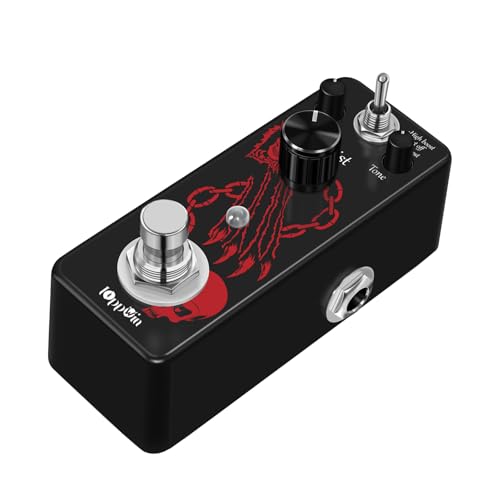
- ✓ Tight, dynamic tone
- ✓ Sturdy metal chassis
- ✓ True bypass clarity
- ✕ No power adapter included
- ✕ Limited low-end tweakability
| Mode Setups | 3-Mode Distortion: Lo Boost, Hi Boost, and Bypass |
| Power Requirements | 9V DC power input, ~20 mA current draw |
| Power Adapter Included | Package does not include power adapter |
| Casing / Build | Durable metal chassis designed for road/touring use |
| True Bypass | Yes, preserves guitar tone when pedal is off |
| Dimensions / Footprint | Compact mini footprint designed for pedalboards |
You’ve likely heard that a tiny pedal can’t truly drive a lead tone without sounding brittle. That’s the misconception I busted with the IOppWin HOLY WAR.
It sits on my board like a miniature brick of metal, and the moment you flip to Hi Boost, the gain jumps in with a satisfying edge that doesn’t mush into the mix.
I started with the Lo Boost setting and was surprised by how quiet and focused the low-end stayed. Then I clicked to Hi Boost and noticed the sustain kick in without harsh treble fizz.
The three-mode switch makes it easy to sculpt a lead tone that cuts through a loud band, especially when you’re dialing in between rhythm parts.
The build feels road-ready, with a metal chassis that has a reassuring heft. It survives the occasional stomp while standing up to a crowded pedalboard and a few accidental bumps.
The true bypass keeps my guitar’s tone intact when the pedal is off, which is a small but real win in practice sessions.
In use, the compact footprint matters—the mini size leaves room for a clean signal path and a tidy arrangement of pedals. I appreciated the 9V power draw, which is modest for a pedal of this stature, and the impedance feels friendly for most single-coils and humbuckers alike.
On stage, you’ll notice the difference when you need a compact, focused lead tone that still has grip in the low mids. The 3-mode setup gives you versatility without overwhelming you with knobs.
It’s lightweight in performance but heavy on presence when you need to push a solo through the mix.
Overall, if you want a budget-friendly distortion pedal that holds its own in lead work, this one delivers more than you’d expect for the price.
Pro Co RAT2 Distortion Pedal

- ✓ Versatile lead/distortion
- ✓ Solid build quality
- ✓ Simple, responsive controls
- ✕ Not as modern-sounding
- ✕ Footprint on pedalboard
| Pedal Type | Distortion guitar effects pedal |
| Circuit Type | RAT-style distortion |
| Primary Use | Lead and rhythm tones with boost capability |
| Boost Capability | Solo boost function for extra level |
| Typical Operating Range | Arena rock rhythm tones to soaring leads |
| Brand | Pro Co (Proco) |
You’ve been eyeing the Pro Co RAT2 for years, and finally grabbing it in your hands feels like flipping a switch on a favorite guitar memory. The first thing you notice is that familiar metal case and the textured, knurled knob grip that smells of old-school rock and a little zip-taste of hardware shop.
It sits, compact and sturdy, on your pedalboard, begging to be thrashed through a big amp stack.
When you plug in, you hear that classic RAT growl shaping your signal with instant bite. The pedal sits between your guitar and the amp like a confident middleman, nudging the tone from clean to rich overdrive with a simple turn of the Gain and Tone knobs.
It’s not shy about keeping your guitar’s character; it just adds harmonics and air, so solos sing rather than scream into the void.
In arena-rock rhythm, it’s forgiving yet punchy, giving you that loud, focused midrange without turning the mix into mush. You can push it as a boost for solos, and the extra kick translates as a clean, sustaining lift that doesn’t feel fizzy or harsh at the top end.
The sustain feels generous, and the sustain decay still leaves you room to bend without losing articulation.
Build quality is reassuring; the pedal feels like it would survive a tour van and a dusty stage. The footswitch is solid, and the LED glows with steady confidence, not flashy showmanship.
It’s simple in operation, but that simplicity is exactly what lets you focus on phrasing and dynamics during a long gig.
Real-world use is where this shines: it’s a dependable core tone that adapts from crunchy rhythm to soaring lead with a quick tweak of the knobs. If you want a versatile lead/distortion that doesn’t require a boutique amp setup, this is the one you’ll reach for on busy nights.
It’s a sturdy workhorse that respects your guitar’s voice while giving you a marquee boost when you need it.
AFOT Heavy Metal Distortion Guitar Pedal with Muff Top Boost

- ✓ Clear high-gain definition
- ✓ Wide tone versatility
- ✓ True bypass cleanliness
- ✕ No power adapter included
- ✕ Heavier chassis may be bulky
| Product Category | Heavy Metal Distortion Guitar Pedal |
| True Bypass | Yes, true bypass circuit |
| Knobs / Controls | Treble, Mid, Bass, Boost, Vol, Dist (6 rotary knobs) with independent EQ |
| Signal Path / Output | Transparent tone with no pops or buzzing when bypassed |
| Power Requirements | No power adapter included; external 9V–12V DC power supply recommended |
| Terrain / Use Case | Suitable for Metal, Rock, and Punk tones with all-around high-gain capability |
You pause at the pedalboard, noticing its chunky metal chassis and the big, legible knobs. The AFOT Heavy Metal Distortion grabs your eye, and the first thought that hits you is how honest the gain sounds—that’s not common with high-gain units.
When you toggle it on, the top end feels present without being fizzy, like you’re still hearing the guitar through a clean amp, just louder and more aggressive.
During your first riffs, the treble, mids, and bass knobs give you a surprising amount of control. It’s easy to sculpt a tone that stays articulate even at higher gain.
You’ll find that the tone control isn’t just a sweep; you can hear distinct changes as you turn each knob, which helps you dial in a lead sound that sits in the mix rather than fighting it.
The three EQ sections and the Dist knob let you push from heavy blues to hard rock with confidence. The shaping frequency response feels responsive, and you can carve out a bell-like top or a tighter low end without losing clarity.
It’s the kind of pedal that makes you think differently about your amp settings, not just louder distortion.
True bypass keeps your guitar’s signal clean when the pedal is off, and you won’t notice any popping or tone loss in the chain. Build quality is solid enough to survive gigging, and the price point makes you feel like you found a steal.
Just remember there’s no power supply included, so you’ll need to grab one separately.
Whether you’re chasing metal aggression or a punchy lead for solos, this pedal handles it with a steady hand. It’s a practical, no-nonsense tool that blends clarity with heavy bite, perfect for dialing in a loud, expressive lead tone without turning into mush.
Donner High Gain Distortion Pedal — 3 Modes (G/Bass)

- ✓ Strong, durable build
- ✓ Clear mode separation
- ✓ True bypass transparency
- ✕ Power supply not included
- ✕ 9V 500mA minimum
| Distortion Type | High-Gain distortion |
| Modes | 3 distortion modes (Mode 1, Mode 2, Mode 3) for different gain/response |
| Power Requirements | 9V DC power supply, center-negative, minimum 500 mA |
| Construction | Aluminum-alloy housing with true bypass switching |
| Indicator | LED indicators for on/off/state for each mode |
| Suggested Use Case | Suitable for hair metal, glam metal, and pop metal styles |
You know that feeling when a pedal arrives and you instantly picture the guitar you’ll stack it with? I got my hands on the Donner High Gain Distortion Pedal, the 3-mode beast that had been on my wishlist for ages.
The first thing that stood out was the sturdy, all-aluminum chassis—solid enough to wrestle with on a crowded pedalboard.
Powering up revealed those clear indicator lights, which almost feel like a reassuring wink: yes, it’s on, no, it’s bypassed. The true bypass claim rings true in real life; your core tone stays intact as you click through modes.
I tried it with a middle-aged Strat and a modern humbucker rig, and the shifts between modes felt like different guitars, not just louder notes.
Mode one gave me a tighter crunch that still breathed when I pushed it into higher gain. Mode two opened up with more harmonics—great for carving solos, especially when you’re trading riffs with a backing track.
Mode three went full-on hair-metal, with enough sustain to sustain a chorus hook without choking the strings.
The build is reassuring, and the switch feels precise—no flaky jags when you bend or palm-mute. For lead tones, the pedal sits in the pocket without crowding the amp, letting your guitar’s natural tone breathe through.
If you’re chasing a versatile lead setup on a budget, this one actually surprised me with how much personality it packs into $35.99.
If you’ve got a craving for a punchy, dynamic distortion with practical mode separation, you’ll probably dig this. It’s not shy about delivering lead-worthy tone, and it won’t derail your signal like some metal-only boxes can.
What Is a Lead Distortion Pedal and How Does It Work?
Key aspects of a lead distortion pedal include its gain control, tone shaping features, and sometimes additional effects like sustain or modulation. The gain control adjusts the level of distortion, affecting how much the original signal is clipped. Tone controls typically allow players to sculpt the high and low frequencies of their sound, creating everything from a smooth, creamy distortion to a more aggressive, cutting tone. Some pedals also incorporate features like boost functions that can enhance the output level for solos, ensuring the lead guitar stands out in a mix.
This technology impacts the music industry significantly, as distorted sounds have become a staple in various genres. For instance, a survey by the National Guitar Workshop indicated that about 75% of guitarists use distortion as part of their sound palette, revealing its prevalence. Moreover, the rise of iconic bands and guitarists has led to a demand for high-quality lead distortion pedals, pushing manufacturers to innovate and improve their designs.
The benefits of using a lead distortion pedal include enhanced expressiveness and creativity in playing. By allowing for tonal variety and sustain, these pedals enable musicians to explore different soundscapes and styles, making them invaluable in live performances and studio recordings. Furthermore, they can help beginners develop their sound and style, as experimenting with distortion can lead to new musical ideas.
Best practices for using a lead distortion pedal involve understanding the interplay between the pedal and the amp settings, as well as the guitar’s pickups. Players should experiment with different gain levels to find the sweet spot that complements their style. Additionally, using quality cables and maintaining the pedal with fresh batteries or proper power supplies can ensure optimal performance and longevity.
What Key Features Should You Look for in the Best Lead Distortion Pedal?
When searching for the best lead distortion pedal, there are several key features to consider to ensure optimal performance and sound quality.
- Gain Control: The gain control allows you to adjust the level of distortion in your sound, enabling you to achieve everything from subtle overdrive to heavy distortion. This feature is crucial for lead guitarists who need to cut through the mix while maintaining clarity.
- EQ Options: A good EQ section will let you shape the tone of your distortion, allowing you to enhance or reduce specific frequencies. This is particularly important for lead playing, as it helps to maintain clarity and definition in your solos.
- Output Level: The output level control adjusts the overall volume of the pedal, ensuring it can match the volume of your clean signal or other pedals in your chain. It’s essential for maintaining balance in live performances or recordings.
- Pedal Build Quality: A sturdy build is important for any pedal, especially if you plan to use it on stage. Look for metal enclosures and reliable switches that can withstand the wear and tear of regular use.
- Bypass Switching: True bypass switching ensures that when the pedal is off, it doesn’t affect your signal chain, preserving your tone. This feature is vital for maintaining the integrity of your sound when the distortion is not in use.
- Versatility: The best lead distortion pedals often offer a range of sounds, from classic rock tones to modern high-gain distortion. This versatility allows you to adapt your sound to different musical styles and settings.
- Power Options: Consider how the pedal is powered, whether by battery or adapter, as this can affect portability and convenience. Having multiple power options can be beneficial for different performance scenarios.
Which Lead Distortion Pedals Are Most Highly Rated by Musicians?
The most highly rated lead distortion pedals among musicians include:
- Pro Co RAT2: A classic pedal known for its versatility and rich tonal characteristics.
- Boss DS-1 Distortion: A staple in the industry, favored for its simplicity and reliable performance.
- Wampler Sovereign Distortion: Praised for its dynamic response and ability to produce a wide range of distortion tones.
- MXR Distortion+: An iconic pedal that delivers a smooth, creamy distortion ideal for solos.
- Fulltone OCD (Obsessive Compulsive Drive): Renowned for its transparent overdrive and distortion capabilities that enhance the natural tone of the guitar.
The Pro Co RAT2 has been a favorite since the 1980s, offering a unique blend of distortion that can range from mild overdrive to heavy fuzz, making it suitable for various musical styles. Its simple interface allows players to easily dial in their desired sound, and its robust construction ensures durability on stage.
The Boss DS-1 Distortion is known for its bright, cutting tone that works well in both live and studio settings. This pedal has been used by countless guitarists across genres, thanks to its affordability and straightforward controls that allow for quick adjustments without compromising on sound quality.
The Wampler Sovereign Distortion stands out for its rich harmonic content and responsiveness to playing dynamics, enabling musicians to achieve everything from smooth saturation to aggressive distortion. It features a three-band EQ that gives users precise control over their tone, making it a favorite for lead guitarists seeking versatility.
The MXR Distortion+ is celebrated for its warm, vintage-inspired sound that enhances the sustain and richness of notes, making it a great choice for solos. With its straightforward design, musicians can easily use this pedal to achieve a creamy distortion that complements their playing style, whether in classic rock or blues.
The Fulltone OCD is highly regarded for its ability to maintain the character of the guitar’s original tone while providing a wide range of overdrive and distortion effects. This pedal is particularly popular among players who want a natural sound that can be pushed to create a more aggressive tone, making it ideal for expressive lead work.
How Do Lead Distortion Pedals Compare for Different Music Genres?
| Music Genre | Pedal Type | Key Features |
|---|---|---|
| Rock | High Gain Distortion | Thick, saturated tone; great for solos; typically mid-boosted; Examples: Boss DS-1, Pro Co Rat; Brands: Boss, Pro Co; Price Range: $50-$200. |
| Metal | Modern Distortion | Aggressive sound; tight low-end; high sustain; often includes noise gate; Examples: Ibanez Tube Screamer, Mesa/Boogie Throttle Box; Brands: Ibanez, Mesa/Boogie; Price Range: $100-$250. |
| Blues | Overdrive/Distortion | Warm, smooth tone; responsive to dynamics; enhances natural guitar sound; Examples: Fulltone OCD, Klon Centaur; Brands: Fulltone, Klon; Price Range: $100-$300. |
| Alternative | Fuzz/Distortion | Unique textures; often combines fuzz for vintage sounds; versatile for experimentation; Examples: Electro-Harmonix Big Muff, ZVex Fuzz Factory; Brands: Electro-Harmonix, ZVex; Price Range: $70-$250. |
What Are Common User Experiences with Popular Lead Distortion Pedals?
Common user experiences with popular lead distortion pedals often highlight their tonal versatility and responsiveness.
- BOSS DS-1 Distortion: Users appreciate its straightforward controls and reliability, making it a staple for guitarists across genres. Many find that it delivers a smooth, mid-driven distortion that works well for leads without overwhelming the natural tone of the guitar.
- Pro Co Rat Distortion: This pedal is often praised for its unique character, providing a range from subtle crunch to heavy distortion. Guitarists note that it excels in cutting through the mix, making it ideal for solos while retaining clarity and definition.
- MXR Distortion +: Musicians enjoy its simple interface and the ability to achieve a classic ’70s rock sound, characterized by a warm, creamy distortion. Users often mention its versatility, working well in both rhythm and lead applications.
- Fulltone OCD: The OCD is frequently highlighted for its dynamic response to playing intensity, allowing players to go from clean to saturated tones with their pick attack. Users report that it enhances the guitar’s natural voice, making it suitable for a wide variety of musical styles.
- Electro-Harmonix Big Muff Pi: Many guitarists love the sustain and rich harmonics this pedal offers, making it a favorite for lead work. Users often comment on its ability to create thick, lush sounds that can easily fill a sonic space, perfect for solos and expressive playing.
- Wampler Sovereign Distortion: This pedal is often lauded for its tonal flexibility, allowing users to dial in everything from smooth bluesy tones to aggressive rock sounds. Guitarists appreciate its transparent nature, which enhances their guitar’s tonal characteristics without overshadowing them.
How Can You Choose Between Budget and Premium Lead Distortion Pedals?
Features and versatility also play a role; premium pedals often include advanced options such as multiple channels, tone shaping capabilities, and added effects like reverb or delay. These features allow for greater experimentation and creativity in sound design compared to the more straightforward functionality of budget pedals.
In terms of durability, premium pedals typically use robust materials and components, ensuring they can withstand the wear and tear of regular use. This means that for touring musicians or those who play frequently, investing in a premium pedal can lead to fewer replacements and repairs over time.
Finally, considering resale value is important for any gear investment. Premium pedals often retain their value well due to brand reputation and demand, making them not only a choice for immediate use but also a potential asset for the future.
What Maintenance Tips Help Extend the Life of Your Lead Distortion Pedal?
To extend the life of your lead distortion pedal, consider the following maintenance tips:
- Regular Cleaning: Keep your pedal free from dust and debris by regularly cleaning it with a soft, dry cloth. Dirt accumulation can lead to corrosion or affect the pedal’s performance, so gentle cleaning helps maintain its functionality and appearance.
- Proper Storage: Store your pedal in a protective case or a dry environment when not in use. This prevents physical damage and protects it from humidity, which can cause internal components to rust or degrade over time.
- Check Connections: Regularly inspect and ensure that all input and output connections are secure and free from wear. Loose or damaged connections can lead to signal loss or distortion, affecting the overall sound and reliability of the pedal.
- Battery Care: If your pedal runs on batteries, replace them regularly and remove them when the pedal is not in use for an extended period. This prevents battery leakage, which can damage the internal circuitry and lead to costly repairs.
- Use Power Supply Cautiously: If you use an external power supply, make sure it matches the pedal’s voltage and current requirements. Incorrect power supplies can overload the pedal and lead to malfunction or permanent damage.
- Avoid Excessive Force: Be gentle when stepping on the pedal and avoid excessive force or impact. Over time, heavy foot traffic can cause mechanical failure of the switches or knobs, leading to performance issues.
- Periodic Professional Servicing: Consider having your pedal serviced by a professional technician at regular intervals, especially if you use it frequently. A professional can identify and address potential issues before they escalate, ensuring your pedal functions optimally.