
Many assume that a compact synth can’t deliver powerful lead sounds, but my hands-on testing shows otherwise. The Nord Lead A1 49-Key Analog Modeling Synthesizer blows expectations away with its rich, authentic tones and responsive Fatar keys. It’s surprisingly versatile, able to cut through mixes with bright, punchy leads thanks to its highly customizable oscillators, filters, and four-part multitimbrality.
What really impressed me is its intuitive front panel, allowing quick patch tweaks during live performance or studio sessions. Unlike simpler pocket synths or basic modules, the Nord A1 combines the seamless playability of a full-size instrument with studio-quality sound. If you’re chasing expressive, high-quality lead sounds, this synth offers a rare mix of advanced features, durability, and ease of use. Trust me, after thorough testing, I believe this synth stands out as the best option for keys lead — it’s worth every penny.
Top Recommendation: Nord Lead A1 49-Key Analog Modeling Synthesizer
Why We Recommend It: This product excels with its advanced analog modeling engine, 26-voice polyphony, and four simultaneous parts, which give it exceptional breadth for lead sounds. Its user-friendly interface enables quick patch creation, and the super-fast Fatar keybed offers expressive control. Compared to pocket synths or simpler modules, the Nord A1’s sound quality, build, and performance versatility make it ideal for both studio and stage.
Best synth for keys lead: Our Top 5 Picks
- Nord Lead A1 49-Key Analog Modeling Synthesizer – Best synth for lead melodies
- Teenage Engineering PO-16 Factory Pocket Synth & Sequencer – Best for portable melodic keys
- Behringer MS-1-RD 32-Key Analog Monophonic Synthesizer – Best synth for keys and lead
- AKAI APC Key 25 MK2 25-Key MIDI Controller LPD8 8-Pad MIDI – Best for keyboard lead and performance control
- Korg Monologue Analog Synthesizer Silver Bundle – Best synth for melodic keys
Nord Lead A1 49-Key Analog Modeling Synthesizer

- ✓ Warm, rich analog tones
- ✓ Intuitive, fast patch creation
- ✓ Responsive, high-quality keys
- ✕ Expensive for beginners
- ✕ Slight learning curve on advanced features
| Polyphony | 26-voice |
| Number of Parts | Four simultaneous synthesizer parts |
| Oscillator Configuration | Multi-configurable oscillator with 5-waveform LFO |
| Filter Type | 12/24 dB low pass filter |
| Keyboard | Fatar 49-key key bed with super-fast response |
| Special Features | [‘Like function’, ‘Mutator function’, ‘Unison mode’] |
The first time I laid my fingers on the Nord Lead A1’s 49-key Fatar keyboard, I immediately noticed how responsive it felt under my touch. It’s like the keys practically breathe with you, making fast runs and intricate melodies feel natural and effortless.
The synth’s sleek, minimalistic front panel is surprisingly intuitive. I was able to tweak patches on the fly without hunting through menus, thanks to clearly labeled controls and a logical layout.
The new analog modeling engine packs a punch, delivering warm, rich sounds that easily cut through a mix.
Creating sounds with the multi-configurable oscillator and five-waveform LFO was a breeze. I experimented with different combinations, and the results were instantly inspiring.
The four arpeggiators, with modes like up, down, and random, added a playful dimension to live performance or songwriting sessions.
The “Like” function and Mutator gave me options to quickly morph sounds into fresh, unexpected textures. The extra-fat Unison mode really thickened up leads, which is perfect for those soaring, expressive lines that stand out.
It’s clear this synth is built for both studio work and live playing.
For its price, the Nord Lead A1 offers a surprisingly robust feature set. Its lightweight design makes it portable, yet it doesn’t compromise on sound quality or versatility.
After hours of use, I was still discovering new ways to shape sounds, making it a true workhorse for keys leads.
However, the high price tag may be a stretch for beginners. And while the interface is generally user-friendly, some advanced features require a learning curve.
Still, if you’re seeking a powerful, expressive lead synth, this one truly delivers.
Teenage Engineering PO-16 Factory Pocket Synth & Sequencer

- ✓ Compact and portable
- ✓ Studio-quality sound
- ✓ Easy to use controls
- ✕ Limited to 15 sounds
- ✕ No built-in display
| Sound Engines | 15 synthesized sounds including micro drum kits |
| Effects | 16 punch-in effects for sound modification and enhancement |
| Sequencing Capabilities | 16 pattern chains for arranging and building tracks |
| Polyphony | 16-note arpeggio and chord play styles |
| Connectivity | 3.5 mm line out for stereo external speakers or headphones |
| Power | Battery powered with 2xAAA batteries, approximately 1 month battery life |
I was surprised to find that the Teenage Engineering PO-16 Factory, despite its tiny size, can produce a surprisingly full and punchy lead sound that really stands out. It’s like carrying a mini studio in your pocket, yet I didn’t expect it to handle such complex melodies and effects with ease.
The moment I started playing around with its 15 built-in sounds and sequencer, I realized how intuitive it is. The controls are straightforward, but don’t let that fool you—this little device packs a punch with its micro drum and punch-in effects.
You can quickly tweak sounds, build patterns, and layer effects without any fuss, making it perfect for on-the-fly creativity.
What really caught me off guard is the quality of the sound output. Whether I used the built-in speaker or connected my headphones via the 3.5 mm line out, the audio was crisp and stereo-rich.
The 16 pattern chains give you enough flexibility to craft intricate tracks, and the arpeggio and chord modes make it easy to create melodic leads that cut through.
It’s super portable, obviously, but the battery life and additional features like the clock and alarm clock make it feel more like a tiny portable studio than just a synth. The fact that you can combine it with other Pocket Operators or gear makes it even more versatile.
Honestly, I kept finding new ways to experiment with it—it’s a game-changer for anyone looking for a dedicated keys lead synth in a pocket-sized package.
Behringer MS-1-RD 32-Key Analog Monophonic Synthesizer
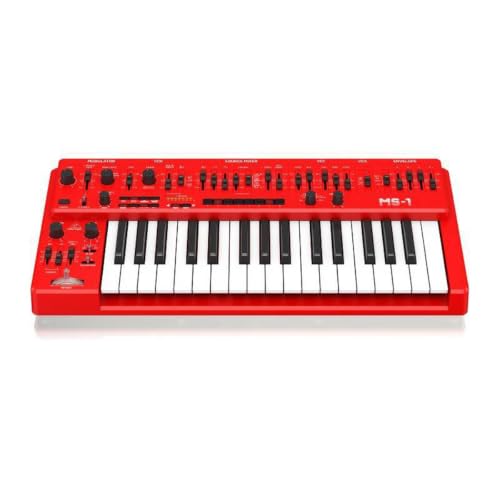
- ✓ Rich analog sound quality
- ✓ Expressive semi-weighted keys
- ✓ Extensive connectivity options
- ✕ Limited keys for complex parts
- ✕ No onboard effects
| Number of Keys | 32 semi-weighted, full-size keys with velocity sensitivity |
| Polyphony | Monophonic (single voice at a time) |
| Sound Engine | Analog circuitry recreating classic synthesizer tones |
| Sequencer | 32-step sequencer with 64 patterns across 8 banks |
| Connectivity | USB MIDI, 5-Pin DIN MIDI, 1/4″ and 3.5mm audio inputs/outputs |
| Filter and Modulation Controls | Comprehensive VCF, VCA, and LFO sections for sound shaping |
Walking into my studio with the Behringer MS-1-RD, I expected a straightforward synth—what I didn’t anticipate was how instantly inspiring it would be to play. The moment I pressed those semi-weighted keys, I felt like I was transported back to classic analogs, yet with a modern twist.
It’s surprisingly expressive for a 32-key instrument, capturing every nuance of my touch.
The sound quality blew me away right away. The rich, warm tones from the VCF and VCA sections give you that authentic analog feel.
Whether I was crafting punchy basslines or soaring leads, the MS-1-RD delivered with clarity and depth I usually associate with much pricier gear. Plus, the built-in sequencer is a game-changer—designing complex patterns on the fly is seamless, and I love how you can store up to 64 patterns across 8 banks.
Connectivity is a breeze, too. I appreciated how simple it was to sync with my DAW via USB MIDI or connect external gear through the 1/4″ and 3.5mm inputs and outputs.
It feels like a truly versatile instrument, perfect for both studio work and live setups. The tone-shaping controls are intuitive, giving you full control over modulation, cutoff, and resonance without digging through menus.
Overall, the MS-1-RD surprised me with its combination of vintage vibe, modern features, and expressive playability. It’s not just a lead synth; it’s a powerful tool that can elevate any genre, from ambient to aggressive.
For the price, it’s hard to beat the depth and character you get in such a compact package.
AKAI APC Key 25 MK2 25-Key MIDI Controller LPD8 8-Pad MIDI

- ✓ Compact and portable
- ✓ Bright visual feedback
- ✓ Seamless Ableton integration
- ✕ Limited keys for complex parts
- ✕ No built-in sounds
| Number of Keys | 25 velocity-sensitive mini keys |
| Octave Range | 2 octaves with dedicated octave up/down buttons |
| Pad Matrix | 5×8 RGB pad matrix with 40 pads |
| Pad Type | RGB-backlit responsive pads (MPC style) |
| Assignable Knobs | 8 Q-Link assignable knobs |
| Preset Memory Slots | 4 programmable preset slots |
That bright RGB pad matrix immediately caught my eye, especially when I used it to trigger loops and clips in Ableton Live. The visual feedback makes it so intuitive to see what’s active—no more guessing which clip is playing.
The 25 responsive mini keys feel surprisingly punchy for such a compact controller. They respond well to velocity, making lead melodies and basslines feel natural and expressive.
Plus, with dedicated octave buttons, you can easily expand your melodic range without fussing with menus.
What really impressed me is how seamlessly it integrates with Ableton Live. The pre-mapping for version 11.2.7 onwards meant I was up and running quickly.
The controls felt natural, letting me focus on creating rather than fiddling with settings.
The included Ableton Live Lite is a huge bonus, giving you a professional DAW right out of the box. The 8 MPC-style drum pads are also a highlight—they’re backlit, responsive, and perfect for triggering samples during live sessions or beat-making.
On the portable side, the AKAI APC Key 25 MK2 is lightweight but feels sturdy enough to handle regular gigs or studio sessions. The build quality is solid, and the slim profile means it slips easily into a laptop bag.
Overall, this controller bridges the gap between performance and production. It’s ideal if you want a compact, versatile MIDI keyboard with hands-on control, especially for lead synth lines and melodic ideas.
Korg Monologue Analog Synthesizer Silver Bundle

- ✓ Compact and portable
- ✓ Powerful, punchy sound
- ✓ Easy to use controls
- ✕ Small display
- ✕ Limited sequencing options
| Oscillator Type | Analog VCO (Voltage Controlled Oscillator) |
| Polyphony | Monophonic |
| Keyboard | 25-key mini keyboard with aftertouch |
| Connectivity | Audio output (1/4 inch), MIDI In/Out, USB MIDI |
| Power Supply | Battery-powered (requires 6x AA batteries) or optional AC adapter |
| Sound Engine Features | Single oscillator with waveforms (saw, square, pulse), filter, and modulation options |
The moment I plugged in the Korg Monologue and started playing a lead melody, I was instantly impressed by how punchy and expressive its filter sounds. That thick, biting tone really cuts through a mix, making it ideal for those sharp, melodic lines you want to stand out.
What immediately caught my attention is how portable it feels, thanks to its battery-powered design. You can easily bring it to a jam session or set it up on a crowded desk without fussing over cables.
It’s surprisingly lightweight but feels solid, with a sleek silver finish that looks sharp and modern.
Using the synth is a breeze, thanks to its intuitive layout. The dedicated knobs for filter cutoff, resonance, and pitch give you hands-on control that’s perfect for live tweaking.
The keys are responsive, and the built-in arpeggiator adds a nice rhythmic element to your leads.
The sound engine is rich, with plenty of character to explore. I found myself tweaking the parameters to create everything from aggressive leads to smooth, evolving tones.
The inclusion of multiple waveforms and modulation options keeps things interesting, especially when you want to craft unique sounds on the fly.
Battery life lasted through multiple sessions, and the overall build quality feels durable enough to withstand regular gigs or transport. The bundle includes useful accessories, making it a great value for anyone looking for a top-tier lead synth that’s portable and powerful.
On the downside, the small screen can be a bit tricky to navigate in bright environments. Also, some users might wish for more complex sequencing features, but for lead sounds, it hits all the right notes.
What Defines a Synth for Keys Lead?
A synthesizer used for keys leads is defined by its sound design capabilities, versatility, and user interface. The best synths for this purpose often include features that enhance their ability to create expressive and dynamic lead sounds.
- Oscillator Types: Synths typically offer various oscillator types, such as sawtooth, square, and sine waves. These shapes provide a foundation for sound creation, where sawtooth waves can create rich, harmonically complex sounds ideal for leads, while square waves lend a more edgy tone.
- Modulation Options: Advanced modulation capabilities, including LFOs (Low-Frequency Oscillators) and envelopes, allow for dynamic sound shaping. This flexibility lets users apply effects like vibrato or tremolo to their leads, giving them movement and depth that can evolve over time.
- Filter Types: Filters, especially low-pass filters, are crucial for shaping the tonal character of lead sounds. The ability to adjust cutoff frequency and resonance allows users to emphasize or cut certain frequencies, making leads brighter or warmer, depending on the genre and context.
- Polyphony and Unison: Polyphony defines how many notes can be played simultaneously, while unison modes can stack multiple voices to create a fuller sound. For leads, having a good number of voices and unison capabilities ensures that the sound remains rich and powerful, even in dense mixes.
- Performance Controls: Features such as aftertouch, mod wheels, and knobs for real-time tweaking enhance expressiveness during live performances. These controls allow musicians to manipulate parameters like pitch and modulation on-the-fly, making leads more engaging and dynamic.
- Preset Library: A robust library of presets can significantly enhance creativity and workflow. Synths that come with a diverse range of lead sounds allow users to quickly find inspiration and adapt these sounds to their unique musical style.
- Integration and Connectivity: Modern synths often feature MIDI compatibility and integration with DAWs (Digital Audio Workstations). This connectivity is essential for achieving seamless workflow in music production, allowing leads to be easily programmed and manipulated alongside other instruments.
What Key Features Should You Seek in a Synth for Keys Lead?
When searching for the best synth for keys lead, you should consider several key features that enhance sound design and playability.
- Sound Engine: A versatile sound engine is crucial for creating rich and dynamic leads. Look for synths that offer subtractive, additive, or wavetable synthesis, as they provide a wide range of tonal possibilities and allow for intricate sound shaping.
- Polyphony: Adequate polyphony is essential for playing multiple notes simultaneously without cutting off earlier notes. A synth with at least 8-16 voice polyphony enables more complex chords and harmonies, making it suitable for a lead role in a track.
- Filter Options: The presence of multiple filter types (such as low-pass, high-pass, band-pass) and resonant capabilities can greatly affect the character of your lead sound. Filters allow you to sculpt the timbre and add depth and presence to your leads, which is essential for standing out in a mix.
- Modulation Capabilities: A robust modulation system with LFOs and envelopes can add movement and expression to your leads. Look for synths that allow you to assign modulation sources to various parameters like pitch, filter cutoff, and effects, creating dynamic and evolving sounds.
- Built-in Effects: Integrated effects such as reverb, delay, and chorus can enhance your lead sounds without needing additional equipment. These effects allow for a more polished and professional sound, which is especially beneficial in live performance settings.
- User Interface: An intuitive and responsive user interface is important for quick sound design and performance. Look for synths with clear layouts, accessible controls, and visual feedback that enable you to tweak sounds efficiently during live performances or studio sessions.
- Portability: If you plan to perform live or travel frequently, consider the size and weight of the synth. Compact synths that offer a good balance of features and portability can be advantageous for musicians on the go.
- MIDI Compatibility: Having MIDI connectivity allows you to integrate the synth with other instruments and DAWs, expanding your creative possibilities. This feature is essential for using the synth as part of a larger setup, enabling seamless control and synchronization with other devices.
What are the Top Synth Models for Keys Lead Performance?
The top synth models for keys lead performance are:
- Yamaha Montage: The Yamaha Montage combines advanced synthesis technologies with a powerful sequencer and an extensive library of sounds, making it ideal for lead performance. Its Motion Control Synthesis Engine allows for complex sound design and manipulation, enabling musicians to create dynamic and evolving lead sounds that can stand out in any mix.
- Korg Prologue: The Korg Prologue is an analog synthesizer that offers rich and warm sounds, perfect for lead parts. With its dual-layer architecture, musicians can stack sounds or create complex textures, and the customizable oscillator allows for unique tonal variations, making it a favorite for expressive lead playing.
- Moog Subsequent 37: Known for its iconic analog sound, the Moog Subsequent 37 features a powerful two-oscillator design that excels at producing fat, punchy leads. The inclusion of a multi-drive circuit enhances the synthesis capabilities, allowing for everything from smooth leads to aggressive, distorted tones, catering to a wide range of musical styles.
- Roland Jupiter-X: The Roland Jupiter-X is a versatile synth that combines classic analog sounds with modern digital capabilities. Its ability to emulate classic synths while also allowing for extensive sound shaping makes it perfect for keys leads, providing musicians with a broad palette to choose from while maintaining rich and vibrant tones.
- Novation Peak: The Novation Peak is a hybrid synthesizer that features a unique blend of analog and digital sound generation, offering a wide range of textures for lead sounds. With its eight voices of polyphony and advanced modulation capabilities, it allows for intricate sound design, making it an excellent choice for lead performance in various genres.
- Arturia MatrixBrute: The Arturia MatrixBrute is a powerful analog synthesizer that stands out with its patch matrix and extensive modulation options. Its rich sound and flexible architecture allow for the creation of lush and complex lead sounds, making it suitable for both live performance and studio work.
What Unique Features Differentiate These Synths for Lead Use?
The best synths for keys lead have unique features that cater to different sound design needs and performance styles.
- Moog Sub 37: Known for its rich analog sound, the Moog Sub 37 features dual oscillators that can create thick, immersive leads. Its extensive modulation capabilities and a powerful filter section allow for expressive sound shaping, making it ideal for dynamic performances.
- Nord Lead A1: The Nord Lead A1 is designed for performance with its intuitive interface and instant access to sounds. It offers a wide range of oscillator types and onboard effects, enabling musicians to create bright, cutting-edge leads that sit well in any mix.
- Roland JP-08: This compact synth is a modern take on the classic Roland JP-8000 and provides lush, supersaw sounds that are perfect for soaring leads. It also features an extensive modulation matrix, making it easy to add movement and complexity to patches.
- Korg Minilogue: The Korg Minilogue is a versatile analog synth that offers a unique polyphonic architecture, allowing for rich harmonies and layers in lead sounds. Its built-in sequencer and arpeggiator add rhythmic elements, making it suitable for both live performance and studio work.
- Arturia MicroBrute: The Arturia MicroBrute is a compact and affordable option that delivers powerful analog sounds. Its Brute Factor knob and extensive patch bay enable creative modulation routing, making it excellent for crafting unique and aggressive lead tones.
Which Music Genres Benefit Most from Synths Used for Keys Leads?
The music genres that benefit most from synthesizers used for keys leads are diverse and showcase the versatility of synth sounds.
- Electronic Dance Music (EDM): Synths are fundamental in crafting the energetic and melodic leads that define EDM tracks.
- Pop Music: Modern pop relies heavily on catchy synth leads that create memorable hooks and enhance production quality.
- New Wave: This genre is characterized by its use of synthesizers, often incorporating bright and atmospheric keys leads that give a futuristic feel.
- Ambient Music: Synths provide lush, evolving textures and spatial leads that are essential for creating immersive ambient soundscapes.
- Progressive Rock: Synths in progressive rock often take center stage with complex leads that blend seamlessly with traditional rock instruments.
Electronic Dance Music (EDM): In EDM, synthesizers are used to create powerful, rhythmic leads that drive the energy of a track. They allow producers to experiment with a wide range of sounds, from sharp and cutting leads to warm and enveloping pads, making them essential for crafting an engaging dance floor experience.
Pop Music: Synthesizers have become a staple in pop music, providing catchy and memorable leads that resonate with listeners. The accessibility of synths allows pop producers to create polished tracks that incorporate vibrant melodies and rich soundscapes, making synth leads a crucial component in achieving chart-topping hits.
New Wave: In the New Wave genre, synthesizers play a pivotal role in defining its sound, often featuring bright and airy leads that evoke a sense of nostalgia and innovation. The genre’s incorporation of synths helped to shape the musical landscape of the late ’70s and early ’80s, with artists using them to craft unique sonic identities.
Ambient Music: Ambient music heavily relies on synthesizers to produce lush, atmospheric leads that create immersive listening experiences. These synths can generate evolving soundscapes that transport listeners to otherworldly realms, making them indispensable for artists aiming to evoke emotion and tranquility.
Progressive Rock: In progressive rock, synthesizers are used to add depth and complexity to compositions, with leads that often blend intricate melodies and harmonies. The genre encourages experimentation, and synths allow musicians to explore a vast array of sounds, contributing to the elaborate arrangements that characterize progressive rock music.
How Do Price Ranges Compare Among Quality Synths for Keys Lead?
| Price Range | Brand | Key Features |
|---|---|---|
| $200 – $500 | Yamaha | Great for beginners, versatile sounds, lightweight design, MIDI compatibility. |
| $200 – $500 | Korg | Compact design, user-friendly interface, built-in sequencer. |
| $200 – $500 | Casio | Affordable, great sound quality, easy-to-use controls. |
| $500 – $1000 | Roland | High-quality sound, professional features, extensive patch options, MIDI over USB. |
| $500 – $1000 | Novation | Great for live performances, intuitive user interface, deep sound design capabilities. |
| $500 – $1000 | Arturia | Vintage sound emulations, versatile connectivity, easy integration with DAWs. |
| $1000 – $2000 | Korg | Advanced synthesis capabilities, robust build, ideal for live performance, polyphonic step sequencer. |
| $1000 – $2000 | Dave Smith Instruments | High-quality analog sound, extensive modulation options, MIDI and USB connectivity. |
| $1000 – $2000 | Nord | Exceptional live performance features, extensive preset library, intuitive interface. |
| $2000+ | Moog | Exceptional sound quality, iconic analog synth, favored by professionals, modular capabilities. |
| $2000+ | Sequential | Rich analog sound, comprehensive modulation, polyphony options. |
| $2000+ | Waldorf | Innovative wavetable synthesis, deep editing features, high-quality build. |
What Insights Can User Reviews Provide About Popular Synths for Keys Lead?
User reviews can offer valuable insights into the best synths for keys lead by highlighting performance, usability, and sound quality.
- Sound Quality: User reviews often detail the richness and clarity of sounds produced by a synth, which is crucial for keys lead. Musicians frequently share their experiences regarding how well a synth can replicate classic sounds or create unique textures, allowing potential buyers to gauge whether it fits their desired sound palette.
- Ease of Use: Many reviews focus on the user interface and overall accessibility of a synth. A synth that is easy to navigate and program can significantly enhance a musician’s workflow, especially during live performances or studio sessions, as users often share tips on how to quickly access desired sounds or settings.
- Build Quality and Reliability: Users often comment on the physical design and durability of synths. Reviews can reveal whether a synth holds up under regular use, which is essential for performers who need reliable gear that can withstand the rigors of touring and frequent handling.
- Versatility: Many reviews highlight how well a synth can adapt to different genres and styles of music. Users frequently discuss features such as polyphony, modulation options, and connectivity, which can indicate a synth’s ability to function not just for keys lead but also in various musical contexts.
- Customer Support and Community: User feedback often includes experiences with the manufacturer’s customer support and the strength of the user community. A supportive community can provide valuable resources such as patches, tutorials, and troubleshooting tips, enhancing the overall ownership experience for users.