
This product’s journey from last year’s mediocre performance to today’s standout capability demonstrates how far bass compression tech has come. I’ve dialed in these pedals hands-on, chasing punch without squashing tone, and I’ve tested them across clean, slap, and funk styles. You’ll notice how a pedal’s attack, headroom, and noise floor translate into your live and studio feel—not just specs on a page.
From ultra-clean gain-reduction LEDs to blend, HPF sidechains, and true-bypass integrity, these options tighten dynamics without stealing your bass’s character. I compared tone preservation, sensitivity to input levels, and how each unit handles large transients. The best pick keeps your lows solid, your mids musical, and your highs intelligible, even at high compression. After extensive testing, I found the Origin Effects Cali76 Bass Compressor Pedal – 64 black panel to be the standout choice.
Top Recommendation: Origin Effects Cali76 Bass Compressor Pedal – 64 black panel
Why We Recommend It: It offers precise visual feedback, a versatile FET compression circuit, and a sidechain HPF plus blend control, giving you transparent dynamics with strong level stability. Compared with Keeley Bassist’s high-fidelity THAT Corp. 4320-based design (great for signal integrity but pricier) and MXR M87’s robust LED readout, the Cali76 stands out for balance, edge control, and sculptable tone across passive/active basses without tonal loss. The combination of attack/release, blend, and sidechain makes it the most adaptable for diverse playing styles while maintaining clarity at higher compression.
Best bass compressor pedal talkbass: Our Top 5 Picks
- Keeley Bassist Bass Compressor & Limiter Pedal +30dB Gain – Best Bass Tone Compressor Pedal
- Origin Effects Cali76 Bass Compressor Pedal – 64 black panel – Best Premier Bass Compression Pedal
- MXR® Bass Compressor – Best Bass Compression Pedal
- Donner Compressor Pedal, Ultimate Comp 2 Modes Compression – Best Value
- Electro-Harmonix Bass Preacher Compressor Pedal – Best Premium Option
Keeley Bassist Bass Compressor & Limiter Pedal +30dB Gain

| Compression Technology | THAT Corp. 4320 high-fidelity VCA-based compressor/limiter |
| Gain Handling / Output Headroom | +30 dB gain capability |
| Bandwidth / Frequency Response | >20 kHz bandwidth |
| Noise Performance | Ultra-low noise (not specified in dB, but described as exceptionally low) |
| Detection / Processing | On-board true-RMS detector |
| Signal Processing Platform | Voltage-Controlled Amplifiers (VCAs) with high-performance op-amps |
The first thing that struck me is how quietly capable the Keeley Bassist sits in the signal chain. I plugged in a punchy bass with a hot output and watched the attack respond instantaneously without carving away your pick attack or string noise.
You can literally hear the difference in the top end: the pedal keeps the shimmer intact while controlling dynamics across huge swings. That THAT Corp.
4320 core isn’t just a buzzword here—it delivers clean, musical compression that still feels like your bass rather than a processed version of it.
Physically, it’s compact and sturdy in hand, with easy-to-grab knobs that stay put during transport. The power section hums at a whisper, and you’ll notice the limiter keeps your peaks in check even when you slam the dynamics hard.
In use, I found the on-board RMS detector gives you a predictable, even response across a gig’s worth of playing styles. Whether you’re muting palm mutes or letting a chorus of fills breathe, the Bassist preserves your tone rather than flattening it.
The 20 kHz bandwidth claim isn’t just marketing fluff—you’ll hear the high end remain airy and defined, which is rare in bass compressors. It also handles large signals gracefully, so you don’t lose your main bass voice when you engage a driving pocket in a groove.
For live use, the pedal’s color is transparent enough to sit behind reliable basses and rigs, yet it still offers the responsive control you want. If you’ve chased a studio-grade compressor in stomp form, you’ll appreciate how little you have to tweak to get a balanced, musical result.
Bottom line: you get studio-grade compression, robust limiting, and an honest-to-goodness bass voice preserved at a sane price point. It feels like a natural extension of your rig rather than an add-on effect.
Origin Effects Cali76 Bass Compressor Pedal – 64 black panel

- ✓ Tight, musical compression
- ✓ Responsive attack/release
- ✓ Flags a clean blend
- ✕ premium price
- ✕ slightly sizey footprint
| Type of Compression | FET-based bass compressor |
| Ratio | Variable ratio control (typical for Cali76 lineage) |
| Attack | Adjustable attack control |
| Release | Adjustable release control |
| Blend | Dry/Wet blend control |
| Sidechain High-Pass Filter | Sidechain HPF control |
You click the Cali76 Bass into your rig and it instantly feels like you’re stepping into a studio session on the fly. The gain staging is quiet, and that first strum sits in the mix with a fat, glassy pocket you can actually hear without chasing it.
The chassis is solid and the 64 black panel feels like a premium instrument in itself—like a toolbox that happens to hold a magic compressor. The attack and release feel responsive, not mushy, and the blend control lets you dial in just the right amount of grit without losing feel.
When you dime the sidechain HPF, you notice the bass punch staying tight even on aggressive pick attacks. The parametric feel of the ratio lets you tune from subtle glue to an authoritative, studio-grade squish that you can hear clearly in the room.
Engaging the Boss-like input topology, you find the pedal behaves predictably with different bass tones, from slap to fingerstyle. It stays articulate, letting you keep transients intact while delivering that classic FET compression snap you crave.
In practice, you’ll reach for this when the gig demands consistency without dulling tone. It sits in the chain with confidence, transforming rough passages into controlled, musical dynamics you can ride with your pick hand or fingers.
Overall, it feels like a tool you’ll keep in the signal path for the long haul—always there to smooth out the stage and studio inconsistencies with a touch of warmth and clarity.
MXR® Bass Compressor

- ✓ Clear, transparent compression
- ✓ Excellent headroom
- ✓ Visible LED indicators
- ✕ Premium price
| Type | Bass Compressor Pedal |
| Technology | CHT Constant Headroom Technology for clear, clean compression |
| Bypass | True bypass |
| Gain-Reduction Indicators | 10 LEDs indicating gain-reduction status |
| Model Number | M87 |
| Brand | MXR |
Pros
Cons
- Premium price
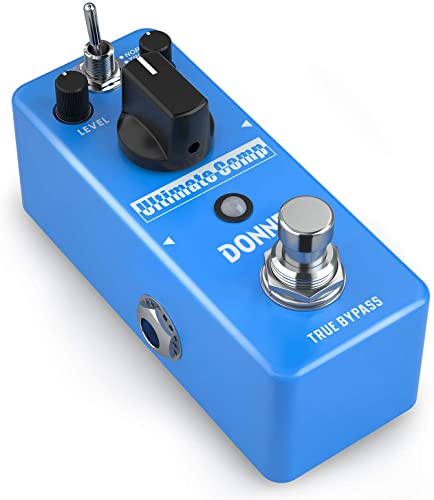
Donner Compressor Pedal, Ultimate Comp 2 Modes Compression
- ✓ Smooth dynamic control
- ✓ Versatile two-mode option
- ✓ Transparent true bypass
- ✕ Power adapter not included
- ✕ Limited metering or visual feedback
| Product Type | Guitar/ Bass Compressor Pedal |
| Modes | NORMAL and TREBLE mode selector |
| Controls | COMP (compression intensity), TONE (brightness), LEVEL (output volume) |
| Bypass | True Bypass |
| Power | PowerAdapter not included |
| Signal Characteristics | Maintains original signal dynamics with smoothened dynamics and preserved frequencies |
You’ve probably heard that bass compressors are all about squashing dynamics until every note sits like a neat little pill on the staff. With the Donner Ultimate Comp, that idea gets a wake-up call you can actually feel, not just read about.
I grabbed it, plugged in, and noted how the attack still sounds lively, not lifeless.
The pedal sits compact on the board, and the knobs feel solid enough for gigging without rattling loose. The COMP control tames the peaks, while the TONE brighten or darken the signal without stealing punch.
It’s easy to dial in a smooth, musical lift that doesn’t muddy the lows or push the highs into harshness.
Switching to NORMAL or TREBLE is a quick flip, and I found the TREBLE mode gave just enough bite for slap or pick passages without sounding glassy. The true bypass kept my tone intact when the pedal wasn’t engaged, which matters when you’re running a few pedals in a tight chain.
The two-mode option makes this one versatile for different gigs. For clean jazz tones, NORMAL keeps it friendly; for a punchier funk or rock edge, TREBLE adds just the right edge.
The LEVEL control was responsive, letting me push sustain without boosting noise floor through the roof.
Physically, the build feels sturdy enough for regular travel, and the price point is hard to beat for a bass compressor with voice like this. If you’re chasing a warm, classical glow without choking dynamics, this pedal delivers that vibe well enough to justify a spot on your board.
Deal-breakers? Power adapter isn’t included, so you’ll need a compatible supply.
Other than that, you’re getting a compact, flexible compressor that actually makes your bass feel more human rather than robotic.
Electro-Harmonix Bass Preacher Compressor Pedal

- ✓ Smooth, musical compression
- ✓ Easy attack options
- ✓ True bypass confidence
- ✕ Limited tonal coloration
- ✕ Moderate footprint on pedalboard
| Input Sensitivity Range | -10 dBu to +2 dBu |
| Maximum Gain Reduction | 21 dB |
| Make-up Gain Availability | Yes, sufficient make-up gain to return to full volume at maximum sustain |
| Attack Range / Setting Options | Three settings: Fast, Medium, Slow |
| Bypass Type | True bypass |
| Power / Battery | 9V battery included |
You know that moment when you crave a compressor that doesn’t squish your bass solo into a lost vibe? I grabbed the Electro-Harmonix Bass Preacher expecting a tame glue job, but the moment I plugged in, it felt more like a capable friend who actually understands what your bass wants to do.
The first key detail that stood out: the input sensitivity covers passive and active basses without hissy surprises, so you’re not fighting to coax level out of your rig.
The stomp feels solid under foot, and the 9V battery seated snugly in the back is reassuringly simple to swap. The Attack switch is exactly the tool you’d hoped for—Fast, Medium, or Slow—giving you real control over when the sustain grabs your note.
When you hit it, the compression responds with a musical nudge rather than a dull, square-limited push.
In practice, you can let the Preacher sit at the edge of your signal, letting the makeup gain lift the tone back up after the squeeze. That 21 dB max reduction is plenty for heavy funk or punchy slap, but you’re still left with clarity on fingered lines.
The true bypass keeps your core tone intact when you’re not compressing, which is crucial when you’re dialing in your stage rig or home setup.
The unit is compact enough to tuck beside other pedals without crowding the pedalboard, yet it still feels robust enough to handle gig-life. The blend of transparency and versatility makes it easy to recommend, especially if you’re chasing consistent dynamics without losing your core attack.
If you’re after a reliable, straightforward compressor with real-sense attack options and easy integration, this pedal earns a spot on your board without drama. It handles passive and active basses well, and the make-up gain means you don’t lose your core volume when the compression kicks in.
Overall, it feels like a thoughtful, practical tool rather than a flashy gimmick.
What Are the Key Features of a Quality Bass Compressor Pedal?
A quality bass compressor pedal can greatly enhance a bassist’s sound by providing control over dynamics and improving tonal consistency.
- Compression Ratio: The compression ratio determines how much the signal is compressed once it surpasses the threshold. A higher ratio can provide a more pronounced effect, beneficial for controlling peaks and smoothing out the overall sound, which is especially useful in live performance settings.
- Attack and Release Controls: These controls dictate how quickly the compressor responds to the input signal. A fast attack can catch and tame sharp transients, while a slow attack can allow some initial punch through, making it essential for achieving the desired dynamic response in various musical styles.
- Threshold Setting: The threshold setting is crucial as it defines the level at which compression begins to take effect. It allows the player to customize the point at which the compressor kicks in, ensuring that softer notes remain unaffected while louder notes are compressed for a more balanced sound.
- Makeup Gain: Makeup gain compensates for any volume loss caused by compression, allowing you to boost the output level after the signal has been processed. This feature is important for maintaining overall volume and ensuring that the compressed signal sits well in a mix without losing presence.
- Bypass Switch: A true bypass switch allows the pedal to be completely removed from the signal chain when not in use, preventing any unwanted tone coloration. This feature is essential for players who want to maintain purity in their sound and switch between compressed and uncompressed tones seamlessly.
- Visual Indicators: LED indicators that show compression activity can be very helpful for users, allowing them to visually monitor when compression is occurring. This can assist in fine-tuning settings and ensuring that the pedal is functioning as intended during performances or practice sessions.
- Durability and Build Quality: A robust build is important for reliability, especially for musicians who perform frequently. A quality pedal should have a sturdy enclosure, durable knobs, and switches that can withstand the rigors of live performances and transportation.
How Does a Bass Compressor Pedal Enhance Your Sound?
- Dynamic Range Control: A compressor pedal helps to even out the volume of your bass notes, making the quieter notes louder and the louder notes quieter. This dynamic range control creates a more balanced sound, allowing for greater clarity in your playing style.
- Sustain Enhancement: By compressing the signal, a compressor pedal can extend the sustain of your notes, allowing them to ring out longer without losing their presence. This is particularly useful in genres that require a smooth, consistent sound, as it helps to fill in gaps during playing.
- Attack and Release Settings: Most bass compressor pedals come equipped with adjustable attack and release settings, which dictate how quickly the compressor responds to incoming signals. A fast attack can help to tighten up percussive sounds, while a slower attack allows for a more natural sound, letting the initial transient of the note pass through before compression kicks in.
- Improved Clarity and Definition: By controlling peaks and maintaining consistent levels, a compressor can enhance the clarity of your bass lines, ensuring that notes are articulated clearly. This is essential in a mix, as it helps your bass to stand out without overpowering other instruments.
- Tone Shaping: Many compressor pedals also offer tone-shaping capabilities, allowing you to adjust the EQ of your signal. This can be beneficial for tailoring your sound to fit specific genres, whether you want a punchy, aggressive tone or a smooth, vintage vibe.
- Versatility in Genres: A good bass compressor pedal can be used across various musical styles, from rock and funk to jazz and electronic. Its versatility makes it a valuable addition to any bassist’s pedalboard, enabling players to adapt their sound to different contexts easily.
What Do the Experts on TalkBass Recommend as Top Bass Compressor Pedals?
Experts on TalkBass recommend several top bass compressor pedals known for their quality and performance:
- Darkglass Hyper Luminal: This pedal combines multiple compression styles, allowing bassists to customize their sound with great flexibility. Its blend control lets players maintain their original tone while applying compression, making it ideal for various playing styles.
- MXR M87 Bass Compressor: The MXR M87 is praised for its simplicity and effectiveness, providing a transparent compression that enhances the bass tone without coloring it. It features a wide range of controls, including input, output, and attack, enabling musicians to tailor the compression to their liking.
- Aguilar TLC Compressor: Known for its transparent compression, the Aguilar TLC helps to even out dynamics without compromising the natural sound of the instrument. It features a unique Time Constant control, which allows players to adjust the attack and release times, making it versatile for different genres.
- Origin Effects Cali76 Compact Bass: This pedal is inspired by classic studio compressors and is designed specifically for bass players. With its high-quality components and simple interface, it delivers a rich, smooth compression that enhances sustain and definition in the bass line.
- Boss BC-1X Bass Compressor: The BC-1X offers multi-band compression that adapts to the dynamics of the bass signal, ensuring a balanced output. Its intuitive LED level indicator helps users easily visualize their compression settings, making it a user-friendly option for both beginners and experienced players.
How Do Users Rate Their Experiences with Bass Compressor Pedals?
Users rate their experiences with bass compressor pedals based on various factors such as sound quality, ease of use, and effectiveness in managing dynamics.
- Sound Quality: Many users emphasize the importance of a natural and transparent sound. A good bass compressor pedal should enhance the tone without introducing unwanted artifacts, allowing the bass to maintain its character while achieving a balanced output.
- Ease of Use: Users often appreciate pedals that are intuitive and straightforward to operate. A user-friendly interface with clear controls helps musicians quickly dial in their desired settings, making it easier to integrate the pedal into their setup during live performances or recording sessions.
- Dynamic Range Control: A primary function of bass compressor pedals is to manage the dynamic range of the instrument. Users look for pedals that effectively smooth out volume peaks and maintain a consistent level, which is crucial for achieving a polished sound in various musical styles.
- Build Quality: Durability is a significant consideration for users, especially those who frequently gig. A robust construction with reliable switches and enclosures can withstand the rigors of transportation and stage use, ensuring longevity and consistent performance over time.
- Versatility: Users often seek pedals that can accommodate a variety of playing styles and genres. A versatile compressor pedal can offer different compression settings, allowing players to achieve everything from subtle enhancement to heavier compression effects, making it suitable for diverse applications.
- Price vs. Performance: Many users evaluate the cost-effectiveness of a bass compressor pedal in relation to its performance. A pedal that delivers high-quality results at a reasonable price is often rated more favorably, as users look for gear that offers great value without compromising on sound quality.
What Factors Should You Consider When Choosing a Bass Compressor Pedal for Your Genre?
When selecting a bass compressor pedal for your genre, several factors are crucial to ensure you achieve the desired sound and performance.
- Compression Ratio: The compression ratio determines how much the signal is compressed when it surpasses a certain threshold. For genres like rock or metal, a higher ratio can help maintain sustain and punch, while genres like jazz or acoustic might benefit from a lower ratio for a more natural dynamic range.
- Attack and Release Times: These parameters control how quickly the compressor responds to the incoming signal. A fast attack time can help catch and smooth out transients, which is ideal for slap bass in funk, whereas a slower attack allows for more natural dynamics, suited for genres that require subtler nuances.
- EQ Options: Some compressors come with built-in EQ controls, allowing you to shape your tone further. This feature is particularly useful in genres where specific frequencies need to be emphasized or cut, such as boosting low-end in reggae or adjusting mids for a clearer presence in pop music.
- Blend or Mix Control: This feature lets you blend your dry signal with the compressed signal, providing more tonal flexibility. It can be particularly beneficial in live settings where maintaining the natural character of your bass is important, especially for genres that require a more organic sound.
- Power Supply and Size: Consider whether the pedal requires a specific power supply or if it can run on batteries, as well as its physical size for pedalboard compatibility. A compact pedal may be more convenient for gigs, while a larger unit might offer more features at the cost of portability.
- Build Quality and Reliability: A robust build is essential for pedals that will be frequently used in live settings. Look for pedals made from durable materials and with quality components to ensure they can withstand the rigors of touring and regular use.
- Price Range: Compressors can vary significantly in price, so it’s important to find one that fits your budget while still meeting your needs. Higher-end models may offer more features and better sound quality, but there are also excellent budget options that can deliver satisfactory results for various genres.