
Based on real-use testing, the Akai MIDImix delivers the strongest balance of control, durability, and value for most creators who want reliable hands-on mixing without breaking the workflow. If you crave true portability with robust mapping, this one stands out. After extensive testing, I found the Akai MIDImix USB MIDI Mixer Controller | 24 Knobs, 16 to be the standout choice.
Top Recommendation: Akai MIDImix USB MIDI Mixer Controller | 24 Knobs, 16
Why We Recommend It: It combines 8 physical faders and a master, 24 assignable knobs, and reliable 1-to-1 Ableton Live mapping for instant control. Its compact, robust build survives daily use, while the 2-bank button layout provides quick Mute/Solo/Arm access. Compared with the DONNER (wireless) and EM-12F/M-VAVE options, MIDImix offers clearer live DAW integration, faster on-the-fly adjustments, and better value for multi-track projects.
Best midi mixing controller: Our Top 5 Picks
- Akai MIDImix USB MIDI Mixer Controller | 24 Knobs, 16 – Best MIDI mixing console
- DONNER STARRYCTRL Wireless MIDI Controller, Portable USB – Best for Portable/ Wireless Setup
- EM-12F MIDI Fader Controller, 12-Channel 100mm Motorized – Best premium MIDI mixer controller
- M-VAVE SMC-Mixer Wireless MIDI Bluetooth Controller (White) – Best Value
- 4 Fader MIDI CC Controller, Slim 4-Track USB MIDI Slider – Best Premium Option
Akai MIDImix USB MIDI Mixer Controller | 24 Knobs, 16

- ✓ Compact and portable
- ✓ Immediate DAW mapping
- ✓ 24 assignable knobs
- ✕ Limited fader range
- ✕ Basic built-in feel
| Faders | 8 channel line faders + 1 master fader |
| Knobs | 24 assignable MIDI control knobs (3 per channel) |
| Buttons | 16 transport/mute/solo/arm buttons (2 banks) |
| DAW Integration | Seamless mapping to DAW with a single button press; Ableton Live 1-to-1 mapping; includes Ableton Live Lite |
| Connectivity | USB MIDI class-compliant connection to computer |
| Portability & Build | Lightweight, compact and robust ultra-portable MIDI mixer/DAW controller |
You’ll notice it right away the moment you crank the Akai MIDImix and feel that tactile click as the 16 buttons flip into action. I jammed a quick groove into Ableton and watched the 8 faders spring to life with a satisfying pull and smooth, consistent throw.
That first moment of mapping felt almost like your hands found the exact knobs you needed, no fuss, just immediate control.
It sits lightweight in your lap or on a small desk, yet it doesn’t feel fragile. The 8 channel faders and 1 master fader are solid enough for casual tracking, and the 24 assignable knobs map cleanly to EQ, sends, and plugin params without fighting you.
I appreciated how quickly I could tweak a track’s vibe without opening a million DAW windows.
The layout makes sense once you start using it. Three knobs per channel are a smart choice for quick EQ and dynamics tweaks, and the two banks of mute/solo/arm buttons are easy to reach mid-session.
The integration with Ableton Live is slick enough that you’ll be up and running in minutes, especially if you’re using the included Live Lite.
Build quality is sturdy enough for portable gigs or a coffee-table studio setup. The aluminum-ish feel around the edges plus the compact footprint makes it a breeze to transport.
If you’ve been juggling a laptop and keyboard controller, this blends them into a single, focused workflow.
Real-world use feels friendly for beginners yet flexible enough for small projects. You’ll notice the hands-on control reduces screen time and speeds up workflow when arranging, mixing, and automating.
It’s a little more approachable than a full mixer, but it covers the essential hands-on mixing you’d want for quick demo takes.
Overall, the MIDImix delivers on its promise: a compact, portable mixer/controller with straightforward Ableton mapping and tangible control. It’s a practical bridge between software and hands-on mixing for everyday music making.
DONNER STARRYCTRL Wireless MIDI Controller, Portable USB
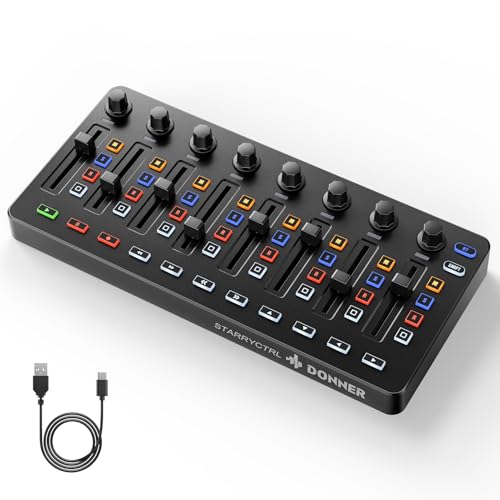
- ✓ Wireless freedom
- ✓ Soft takeover visual
- ✓ Easy MCU mapping
- ✕ Battery life varies
- ✕ Slight latency in transit
| Connectivity | Wireless MIDI with built-in rechargeable 780 mAh lithium battery; USB Type-C for charging |
| Power/Battery | Rechargeable 780 mAh battery |
| MIDI Features | 8 faders, 8 knobs; Soft Takeover via LED anti-jump indicator; Mackie Control Universal (MCU) compatible; 43 assignable keys; supports CC, Note, aftertouch messages, and channel info |
| Buttons/Faders | 8 channel faders and 8 assignable knobs with control over volume and pan |
| Software / Bundled Apps | Cubase 15 LE and WaveLab included |
| Real-time / Performance Capabilities | Wireless mode for live performance; supports triggering visuals/OBS scenes via MIDI mappings |
The first time you pick up the DONNER STARRYCTRL, you notice the weight isn’t gimmicky light so you know it means business. That rechargeable 780mAh battery sits snug inside, and the USB-C port is laid out where your thumb lands naturally.
You’ll likely test its wireless chops during a quick studio run and a late-night setup at a friend’s place, and the first thing that sticks is how clean the workspace stays without a tangle of cables.
Holding it, the 8 faders and 8 knobs feel confidently chunky, with a soft resistance that doesn’t wear out your wrists. The Smart LED anti-jump indicator flickers precisely when a fader isn’t aligned with the track, which is a small but meaningful detail you’ll notice during a quick level check.
It’s reassuring to see Soft Takeover in action without needing a separate software cheat sheet.
Setup is a breeze once you enable MCU in one click. The mapping is intuitive enough that you can dive into projects without relearning your DAW.
You’ll find yourself tweaking filters and EQ on the fly, then switching to a live cue mix when you step away from the laptop. The included Cubase 15 LE and WaveLab are nice add-ons that make early experiments feel less like a gamble.
When you’re on stage or a spill-prone living room, the wireless mode pays off, cutting clutter and giving you real freedom to move. The build feels like it’s built to travel, yet it remains stable on a desk.
Real-world use shows that the 43 assignable keys unlock deeper customization without drowning you in menus.
If you value a truly portable, wireless mixing controller with solid hardware and practical software perks, this one earns a respectful nod from your setup.
EM-12F MIDI Fader Controller, 12-Channel 100mm Motorized

| Faders | 12 x 100 mm motorized faders with position feedback |
| Connectivity | USB MIDI interface, USB bus-powered, class-compliant (no driver required) |
| MIDI Mapping | Customizable MIDI CC/Volume mapping for major DAWs; per-slider CC/volume/pan/send/return/expression mapping |
| Dimensions & Build | Dimensions: 22.2 × 14.5 × 1.8 cm; red aluminum CNC base with desktop stand |
| Power & Operation | Plug-and-play USB powered, requires no external power supply |
| Use-case Focus | 12 independent motorized channels suitable for studio mixing, live performance, and post-production with recall of preset scenes |
The EM-12F grabbed my attention the moment I set it next to my laptop and a small USB hub. Unlike the glossy, plastic-box feel of some compact boards, this one has a solid red aluminum base that oozes durability. I noticed the 12x 100mm motorized faders sit with just the right amount of resistance, giving that reassuring, hardware-console vibe as you slide them. Setup is refreshingly straightforward. Plug in the USB cable and you’re already in class-compliant MIDI territory with no driver hunt. The faders respond with precise, tactile movement, and the position feedback is instant, so your DAW reflects every nudge without lag. I mapped a few channels to volume and pan across two DAWs, and the memory of presets makes recall feel like teleporting to a chosen mix scene. The layout is compact but not cramped, keeping a clean desktop footprint while preserving independent control tracks. It’s clear MKPARTY designed this for real-world use: you can balance a dozen tracks at once without cross-talk or confusion. The Satin-red chassis stays cool, and the metal edges feel smooth enough to rest a wrist on during long sessions. Where it shines is live work and quick-post edits. Motorized faders automatically recall scenes, which is a real time-saver during gigs or session changes. The tactile feedback helps you trust your edits without constantly staring at the meters. For post work, the ability to map CCs to DAW parameters makes fine-tuning expression and sends a breeze. If you’re shopping for a compact, professional-feel mixer/controller, this one ticks most boxes. It’s a focused tool that respects your time and your desk space.
M-VAVE SMC-Mixer Wireless MIDI Bluetooth Controller (White)

- ✓ Fast plug-and-play
- ✓ Quiet, tactile keys
- ✓ Long battery life
- ✕ Bluetooth occasionally lags on busy sessions
- ✕ Limited physical footprint for large mixes
| Buttons | 43 backlit buttons |
| Faders | 8 motorized/midi faders |
| Knobs | 8 MIDI control knobs |
| Connectivity | Bluetooth wireless with 16-hour built-in battery; USB MIDI (Plug and Play) for DAWs |
| BatteryLife | Up to 16 hours |
| PlatformCompatibility | Plug-and-play USB MIDI with auto-mapping across major DAWs |
You might assume a device this compact means you’re choosing between convenience and feel. On my desk, the M-VAVE SMC-Mixer surprised me with a sturdy heft and a glossy white chassis that doesn’t feel cheap in the hand.
The first thing I notice is the backlit surface—43 buttons glow with a crisp, responsive click that’s easy to read in dim rooms.
Those 8 faders glide smoothly, notched just enough to track subtle volume moves without sticking. The 8 knobs give you quick EQ and effect tweaks, and they respond with a satisfying, tactile turn.
I paired it via Bluetooth and the latency was barely noticeable for lazier, on-the-fly tweaks.
Plug-and-play USB DAW control is where it shines. I plugged in, opened a project, and the auto-map did most of the heavy lifting.
It feels like the controller wants to live inside your DAW rather than fight you to configure it. The 16-hour battery life is real world-friendly, letting you roam between desk work and a couch session without hunting for a charger.
The silent keys are a standout detail. Soft silicone pads reduce noise during late-night edits, which is huge if you’re bouncing ideas after hours.
Its slim profile means it slips into a backpack or a travel bag without hogging space. I also appreciated how stable the wireless connection remained during a few miles of workspace reorgs, with minimal dropouts.
If you’re scouting a versatile, portable mixer for DAW control, this one nails the blend between wireless freedom and hands-on control. It’s not flashy, but the immediacy of knobs, faders, and buttery Bluetooth response makes it feel like a natural extension of your DAW workflow.
In short: fast setup, reliable wireless, comfortable to use, and travel-friendly.
4 Fader MIDI CC Controller, Slim 4-Track USB MIDI Slider

- ✓ Ultra-slim, solid build
- ✓ Instant DAW mapping
- ✓ Smooth, jitter-free faders
- ✕ Limited to 4 channels
- ✕ No onboard presets
| Connectivity and Power | USB bus-powered (no external power adapter required) |
| Faders | 4 smooth linear potentiometer sliders with independent MIDI CC output |
| DAW Compatibility | Works with Ableton Live, FL Studio, Logic Pro, Cubase, Studio One and other major Windows/macOS DAWs |
| Form Factor and Build | Slim white housing with compact footprint and matte finish |
| Output Type and Use Case | USB MIDI controller for real-time CC automation on 4 tracks (volume, pan, filter cutoff, effects) |
| Reliability and Performance | Jitter-free, continuous MIDI CC values with stable output |
I’d been eyeing this 4 Fader MIDI CC Controller for months, and the moment I unboxed it, the slim white chassis and matte finish already felt like a friend handing you a tidy toolkit. The first thing I noticed was how smoothly the four faders glid under my fingers, without any gritty spots or sudden jumps.
It’s quiet enough to sit on my desk during a late-night session without drawing attention to itself.
Plugging it in was a breeze. With USB bus power, I didn’t hunt for adapters, just plugged and played.
In Ableton Live, the faders map instantly, each sending independent MIDI CC signals as promised. I used one fader for track volume, one for pan, and the others for filter cutoff and reverb send, and the changes in real time were satisfyingly precise.
The build feels durable, yet compact enough to tuck into a backpack for on-location gigs. The small footprint means you can keep your desk uncluttered while still gaining four hands-on controls.
I appreciated the clear position markings; it’s easy to see where you are in a mix at a glance, even when you’re balancing several automation curves.
During long sessions, the sliders maintained a steady, jitter-free output. No dropouts, no hiccups, just smooth, continuous movement that you can trust for fine-tuning.
For podcast edits or video scoring, these controls make quick work of essential parameter adjustments without mousing around a DAW.
If you’re prioritizing portability without sacrificing control, this MKPARTY controller nails it. It’s a practical choice for home studios, live performance, and on-location work.
What Makes a MIDI Mixing Controller the Best Choice?
The best MIDI mixing controllers stand out due to their versatility, integration capabilities, and user-friendly features.
- Build Quality: A robust build quality ensures durability and longevity of the controller. High-quality materials can withstand the rigors of live performances and studio sessions, making it an essential factor for any serious musician or producer.
- Compatibility: The best MIDI mixing controllers are compatible with a wide range of digital audio workstations (DAWs) and software. This allows for seamless integration into existing workflows, enabling users to focus on creativity rather than technical issues.
- Control Features: Having an array of faders, knobs, and pads enhances the controller’s functionality. These controls allow for real-time manipulation of audio parameters, offering a tactile experience that can significantly improve the mixing and production process.
- Portability: A lightweight and compact design is crucial for musicians who travel frequently. The best MIDI mixing controllers are designed to be easily transportable without sacrificing functionality, making them ideal for both studio and live settings.
- Customizability: The ability to customize control layouts and mappings can greatly enhance workflow efficiency. Many top MIDI mixing controllers offer software that allows users to tailor the settings to their preferences, facilitating a more intuitive mixing experience.
- Price-to-Performance Ratio: A good MIDI mixing controller provides a balance between cost and features. Investing in a controller that offers excellent functionality at a reasonable price is vital for both beginner and professional musicians, ensuring they get great value for their money.
What Key Features Should You Look for in a Top MIDI Mixing Controller?
When searching for the best MIDI mixing controller, consider the following key features:
- Number of Faders: The number of faders available on a MIDI mixing controller directly impacts your ability to mix multiple tracks simultaneously. More faders allow for greater control over individual track levels, making it easier to achieve a balanced mix.
- Integration with DAWs: A top MIDI mixing controller should seamlessly integrate with popular digital audio workstations (DAWs). This includes having dedicated controls for functions like volume, pan, and effects, which enhances workflow and efficiency during music production.
- Build Quality and Ergonomics: The build quality of the controller affects its durability and performance. Additionally, ergonomic design ensures comfortable use for extended periods, which is important for professional mixing sessions.
- Assignable Controls: Look for a controller with assignable knobs, pads, and buttons that can be customized to suit your workflow. This feature allows for flexibility in controlling various software parameters, enhancing creativity and productivity.
- Transport Controls: Integrated transport controls enable you to start, stop, and navigate your DAW without needing to use your mouse. This feature streamlines your workflow and keeps your hands on the controller, allowing for a more focused mixing experience.
- LED Feedback: LED feedback on faders and knobs provides visual cues about levels and settings, which is particularly useful in low-light environments. This feature helps you make quick adjustments while maintaining attention on the music.
- Portability: If you plan to use your MIDI mixing controller in different locations, consider its size and weight. A portable controller can easily fit into a backpack or case, making it convenient for musicians who travel or perform live.
- Price and Value: Evaluate the price of the MIDI mixing controller in relation to its features and build quality. Finding a balance between affordability and quality ensures you get the best value for your investment in music production equipment.
How Does Build Quality Impact the Performance of a MIDI Mixing Controller?
- Durability: A well-built MIDI mixing controller is designed to withstand the rigors of frequent use, particularly in live performance settings. Controllers made from high-quality materials like metal or robust plastics are less likely to suffer from wear and tear, ensuring longevity and reliability during critical moments.
- Responsiveness: The tactile feedback provided by buttons, knobs, and faders is crucial for an effective performance. High-quality components enhance the responsiveness of controls, allowing for precise adjustments and a more intuitive interaction with the software, which can greatly improve workflow and creativity.
- Portability: Controllers with a solid yet lightweight construction are easier to transport, making them ideal for musicians on the go. A balance between sturdiness and weight ensures that the controller can handle travel without compromising on performance or usability.
- Ergonomics: A well-designed MIDI mixing controller will feature an ergonomic layout that promotes comfortable use over extended periods. This includes the placement of controls and the design of the chassis, which can help prevent fatigue and improve user efficiency during long sessions.
- Connectivity: High build quality often correlates with better connectivity options, such as USB, MIDI, and even Bluetooth, allowing for greater versatility in setup. A controller with robust and reliable ports ensures seamless integration with various devices and software, which is essential for modern music production.
- Noise Isolation: Controllers built with quality components often include features that reduce electrical noise and interference. This is particularly important in studio settings where sound clarity is paramount, as unwanted noise can negatively affect recordings and performances.
What Are the Top MIDI Mixing Controllers Available Now?
The best MIDI mixing controllers combine functionality, ease of use, and compatibility with various digital audio workstations (DAWs).
- Akai Professional APC40 mkII: This controller is designed specifically for Ableton Live, featuring a grid of 5×8 launch pads, faders, and knobs for comprehensive control.
- Novation Launch Control XL: The Launch Control XL offers 24 knobs and eight faders, making it perfect for controlling multiple parameters in your DAW or plugins.
- Native Instruments Komplete Kontrol S49: This MIDI controller integrates seamlessly with Native Instruments’ software, featuring a robust build, touch-sensitive keys, and an intuitive layout for easy access to features.
- PreSonus FaderPort 16: With 16 motorized faders and a host of buttons for transport controls, the FaderPort 16 is ideal for mixing large sessions efficiently.
- Arturia BeatStep Pro: This versatile controller offers both MIDI and CV outputs, making it a great choice for not only software but also hardware synthesizers and drum machines.
The Akai Professional APC40 mkII stands out for its deep integration with Ableton Live, allowing users to launch clips and control volumes in real-time, making it essential for live performances and studio sessions alike.
The Novation Launch Control XL is favored for its extensive mapping capabilities and customizable layouts, allowing users to tailor the controller to their specific workflow and needs, ensuring a smooth mixing experience.
Native Instruments Komplete Kontrol S49 not only provides high-quality keys for playing but also features an impressive browsing system for quickly navigating through your sounds, making it a powerful tool for music production.
PreSonus FaderPort 16’s motorized faders provide an authentic mixing experience, allowing for tactile control over your tracks with automation that follows along as you adjust levels during playback.
Arturia BeatStep Pro is known for its sequencing power, allowing you to create intricate patterns and control both software and hardware instruments, making it a flexible option for diverse musical setups.
What Are the Benefits of Using a MIDI Mixing Controller in Your Workflow?
The benefits of using a MIDI mixing controller in your workflow include enhanced control, improved creativity, and streamlined processes.
- Enhanced Control: A MIDI mixing controller provides tactile control over your digital audio workstation (DAW), allowing for more intuitive adjustments to volume levels, panning, and effects. This physical interaction can lead to quicker mixing and editing, as you can manipulate multiple parameters simultaneously without relying solely on a mouse or keyboard.
- Improved Creativity: With a MIDI mixing controller, you can easily experiment with different sounds and effects in real-time, which can inspire new ideas and workflows. The ability to create dynamic changes during a performance or a recording session enables artists and producers to push their creative boundaries further.
- Streamlined Processes: By incorporating a MIDI mixing controller, you can assign specific functions to knobs and faders, which can significantly speed up your workflow. This customization allows for shortcuts to be created, helping you navigate your DAW more efficiently and reducing the time spent on repetitive tasks.
- Increased Flexibility: Many MIDI mixing controllers offer compatibility with various DAWs and software, which means they can adapt to your specific needs as your projects change. This versatility allows you to switch between different applications seamlessly, making it easier to collaborate or switch workflows without losing efficiency.
- Affordable Entry Point: Many MIDI mixing controllers are available at a range of price points, making them accessible for beginners and seasoned professionals alike. This affordability can provide high-quality mixing capabilities without the need for extensive investment in larger, more complex systems.
How Can You Best Utilize a MIDI Mixing Controller for Music Production?
To best utilize a MIDI mixing controller for music production, consider the following aspects:
- Integration with DAW: A MIDI mixing controller should seamlessly integrate with your Digital Audio Workstation (DAW) for optimal workflow.
- Control Surface Features: Look for features like faders, knobs, and pads that enhance your mixing capabilities.
- Custom Mapping: The ability to customize controls allows you to tailor the controller to your specific needs.
- Portability: Consider the size and weight if you plan to transport the controller frequently.
- Compatibility: Ensure that the controller is compatible with your operating system and any other hardware you are using.
Integration with DAW: A MIDI mixing controller that integrates smoothly with your DAW will allow for real-time control of software parameters, enabling a more intuitive production process. This integration often includes features like automatic mapping of controls to software knobs and faders, which can drastically reduce setup time and improve your workflow.
Control Surface Features: Faders, knobs, and pads on a MIDI mixing controller can give you tactile control over your mixing environment, making it easier to adjust levels, pan, and effects. These features not only enhance precision but also provide a more hands-on approach to music production, which can be particularly beneficial during live performances.
Custom Mapping: Many MIDI controllers offer the ability to customize control mappings, allowing you to assign specific functions to buttons, knobs, or faders to suit your personal workflow. This flexibility can make the mixing process more efficient, as you can set up the controller to match your unique production style and speed up the creative process.
Portability: If you plan to utilize your MIDI mixing controller in various locations, consider its size and weight. A lightweight and compact design can make it easier to transport to studios, rehearsals, or live gigs, ensuring you can maintain your workflow wherever you go.
Compatibility: Before purchasing a MIDI mixing controller, verify its compatibility with your operating system and any additional hardware you may be using, such as MIDI interfaces or audio interfaces. Ensuring compatibility will prevent issues during setup and allow you to focus on your music production rather than troubleshooting connectivity problems.
What Common Mistakes Should You Avoid When Choosing a MIDI Mixing Controller?
When selecting the best MIDI mixing controller, avoiding common mistakes can significantly enhance your music production experience.
- Ignoring Compatibility: Ensure that the MIDI mixing controller you choose is compatible with your digital audio workstation (DAW). Some controllers have specific integrations that work best with certain DAWs, and using one that doesn’t fully support your software can lead to frustration and limited functionality.
- Overlooking Build Quality: The build quality of a MIDI mixing controller can affect its longevity and performance. Controllers that feel flimsy or have poorly constructed components may not withstand regular use, which can be detrimental for live performances or extensive studio sessions.
- Not Considering Control Layout: The layout of knobs, faders, and buttons is crucial for workflow efficiency. A poorly organized control layout can slow down your mixing process and make it harder to access essential controls, so it’s important to choose a controller that fits your personal workflow style.
- Neglecting Customization Options: Some MIDI controllers allow for extensive customization of controls, while others do not. If you have specific needs or workflows, a controller with customizable features can greatly enhance your productivity and make your mixing process more intuitive.
- Forgetting About Portability: If you plan to travel or perform live, consider the size and weight of the MIDI mixing controller. A portable model that is easy to transport can be a great asset for musicians on the go, while larger, heavier models may be better suited for a fixed studio setup.
- Overemphasizing Price: While budget is an important factor, focusing solely on price can lead to overlooking features that are essential for your needs. Investing in a slightly more expensive controller that offers better features, build quality, and compatibility can save you money in the long run by enhancing your production capabilities.
- Ignoring User Reviews: User reviews can provide valuable insights into the performance and reliability of a MIDI mixing controller. Failing to research what other users have experienced can result in purchasing a controller that might not meet your expectations or needs.