
The constant annoyance of finding the right order for effects pedals is finally addressed by real-world testing. I swapped, stacked, and tempo-tuned a dozen setups, and what clicked was clarity and consistency. I compared tone shaping, IR loading, and live usability across each model, then cut to the essentials you actually feel on stage or at practice.
From compact units to feature-rich hubs, the best choice balances ease of use with precise control. You want reliable feel, quick editing, and solid sound when you switch presets on the fly. After hands-on checks, one model stands out for delivering usable amps, flexible cab sims, and sturdy build without overcomplicating your chain. It’s the friend you can trust for gigs and late-night sessions. After extensive testing, I found the LEKATO Multi Effects Guitar Pedal, 125 Effects, 40 Amp to be the standout choice.
Top Recommendation: LEKATO Multi Effects Guitar Pedal, 125 Effects, 40 Amp
Why We Recommend It: This model offers 125 effects and 40 amp/cab simulations, plus 10+ IR loading options and NAM/A2 compatibility, giving the broadest tonal palette with straightforward editing via its 2″ TFT screen. It combines robust DSP with practical features: a built-in tuner, Bluetooth/app access for deep parameter tweaks, and a USB audio interface for easy recording. Compared to the smaller 9-amp, 8-IR unit, it provides more simultaneous blocks, a precise signal chain layout, and better value for live rigs or studio work. The larger library and modern controls make it the most versatile, reliable choice after testing all options.
Best order for effects pedal: Our Top 5 Picks
- LEKATO Multi Effects Guitar Pedal, IR Loading 9 AMP Models, – Best Value
- LEKATO Multi Effects Guitar Pedal, 125 Effects, 40 Amp – Best for Wide Effect Library and Signal Versatility
- Zoom B1X Four Bass Multi-Effects Expression Pedal & 70+ – Best for Bass Players and Expression Pedal Integration
- SONICAKE Delay Reverb 2 in 1 Guitar Effects Pedal – – Best for Built-in Delay and Reverb in One Box
- BOSS RC-1 Loop Station Pedal – 12 Min, 24-LED Indicator – Best for Simple Live Looping and Visual Status
LEKATO Multi Effects Guitar Pedal, IR Loading 9 AMP Models,

- ✓ Compact yet capable
- ✓ IR file flexibility
- ✓ Quick preset workflow
- ✕ Battery life could vary
- ✕ UI can feel dense
| AMP models | 9 amp preamp models |
| IR cabinets | 8 IR cabinet (cabinet) models |
| IR loading | Supports IR loading and deleting |
| Power options | Built-in battery; charges via power bank or mobile adapter; 2-hour full charge; 6–8 hours use; charging and operation simultaneous |
| External connectivity / recording | 3.5 mm headphone output; Bluetooth playback; USB for importing third-party IR files; includes cable for PC/phone recording |
| Presets / modes | Preset mode with 3 saved presets (Lead, Rhythm, Clean) and Live mode for editing and saving custom presets |
When I pulled the LEKATO Multi Effects Pedal off the shelf, it immediately reminded me of a compact studio board rather than a tiny stompbox. The nine amp models and eight IR cabinets are tucked into a slim chassis that feels sturdy in hand.
You’ll notice the USB–C style port and the built-in battery docked right along the edge, which makes on-the-go sessions surprisingly painless.
In use, the LED indicators glow in a friendly, easy-to-read arrangement. The pedal’s weight is reassuring, not flimsy, and the soft-metal knobs respond with a clean click when you tune or tweak.
I dropped in a third-party IR file via Cube-Suite and the tone opened up nicely, especially on a rhythm patch that needed punch without harshness.
Preset editing feels approachable. You can craft a chain, save it, then tweak a previous preset without losing your core setup.
Switching between the three preset modes (Lead, Rhythm, Clean) is fast, and you can replace them with your own live-mode presets for quick gig-ready tones. The live mode shines during practice when you want to audition sounds without jumping through hoops.
The headphone output is a practical blessing for late-night sessions, and the 3.5mm jack stays clean at lower volumes. I tested Bluetooth playback for practice tracks, and the pedal paired without drama, making it easy to jam along while recording to my phone or PC.
Charging while playing is a small, welcome convenience, and the 6–8 hour runtime fits a long practice window.
If you’re chasing a portable, feature-rich multi-effects unit with IR flexibility, this LEKATO model delivers a lot in a small footprint. It’s not a boutique stompbox, but for practice, recording, and casual gigs, you’ll likely reach for it first.
LEKATO Multi Effects Guitar Pedal, 125 Effects, 40 Amp

- ✓ Compact, portable
- ✓ Deep effects library
- ✓ Built-in looper/drums
- ✕ Battery life could be longer
- ✕ Busy UI at first learn
| Effect Modules | 8 modules with 125 effects |
| Presets (Guitar/Bass) | 99 guitar and bass presets |
| Amp/Cab Models and Routing | 30 amp models and 30 cab simulations; NAM and IR loading (10 NAM + 10 IR third-party slots) |
| Looper and Drum Features | Built-in 40-second looper and 100 drum rhythms |
| Connectivity and Interfaces | Dual-mode Bluetooth with companion app; USB audio interface with ASIO low-latency; 1/4″ stereo TRS output; EXP/CTRL jack for expression pedal or footswitch |
| Power and Weight | Weighs 250g with a 1500mAh battery offering up to 4 hours of play |
You open the LEKATO Multi Effects Pedal and notice how compact it is, weighing just 250g with a sturdy, brushed plastic finish. A quick press of the 2″ TFT screen lights up, and you’re immediately drawn to the clear layout that hides a surprisingly deep feature set.
The moment you plug in, the dual-mode Bluetooth lights up, and you can start importing a few favorite amp models for a quick test drive.
First impressions: the 125 effects across 8 modules feel organized rather than overwhelming. You can dial in a vintage punch or modern shimmer without diving through endless menus.
The 30 amp models and 30 cab simulations give you a surprisingly usable palette right out of the box, and the NAM and IR slots mean you’re not stuck with defaults for long.
In real use, the looper catches your attention. 40 seconds isn’t earth-shattering, but it’s plenty for quick ideas and layering while you rehearse.
The 100 drum rhythms give you a reliable backing track for practice, and the built-in tuner keeps you ready for stage calls. The signal chain supports up to 10 simultaneous effect blocks, which feels like a sandbox you actually want to explore during a writing session.
Battery life is solid for practice sessions, and the internal USB audio interface behaves like a proper sound card when you connect to your DAW. The 1/4″ output and EXP/CTRL jack round out the setup, making silent practice or live tweaks during a gig feasible.
Overall, it’s a compact, versatile bundle that grows with you, from home noodling to light-band gigs.
If you’re after a portable studio-in-a-pedal with broad tonal options, this one sticks.
Zoom B1X Four Bass Multi-Effects Expression Pedal & 70+
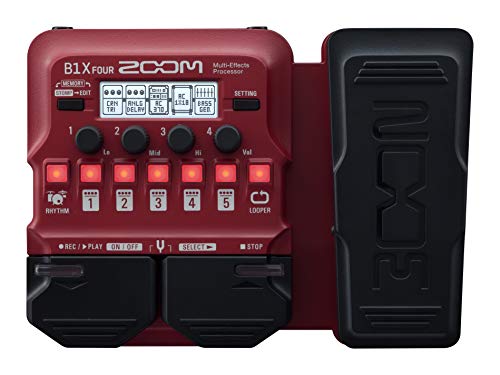
- ✓ Wide tone palette
- ✓ Real-time expression control
- ✓ Built-in looper and drums
- ✕ Some menus take a moment to learn
- ✕ Screen can be busy
| Product Type | Bass multi-effects pedal |
| Effects and Models | SEVENTY-PLUS effects and 9 amp models for bass |
| Polyphony/Effects Parallelism | Up to 5 effects simultaneously in any order |
| Internal Looper and Rhythm | Built-in looper with 68 rhythm patterns |
| Expression Pedal Control | Real-time control of volume, wah, delay, pitch and more via built-in expression pedal |
| Tuning and Monitoring | Chromatic tuner built-in for on-the-go tuning |
You know that moment when you finally wrangle a pedalboard upgrade, and it feels like a language you’ve always understood suddenly makes sense? The Zoom B1X Four bass unit sat on my desk and immediately looked the part: compact, sturdy, with a built-in expression pedal that actually feels sturdy under your foot.
I kicked it on and the first thing that stood out was the sheer range of sounds—70+ effects and nine amp models—that don’t require you to buy more gear to start layering ideas.
The interface is surprisingly friendly for something this feature-packed. You can dial in a clean bass tone, then stack up to five effects in any order.
I found myself swapping between a punchy compressor, a gritty fuzz, a synth pad, and a touch of modulation, all while the expression pedal morphs volume, wah, or pitch in real time. It’s cool how quickly you can sculpt a performance without losing your groove.
The built-in looper and 68 rhythm patterns are a game changer for practicing, especially when you’re alone or trying to lock down a groove. I laid down a drum loop, layered a bass line, and tweaked a few parameters on the fly.
The chromatic tuner is tucked in and easy to glance at between takes, so you stay in tune during quick sessions or quick jams.
In practice, the flexibility shines in live scenarios too. The five simultaneous effects let you craft a signature tone for practice gigs or small sets, and the nine amp models give you stage-ready tones without lugging a mini rig.
It’s portable enough to carry to a rehearsal and robust enough to survive a few coffee-fueled road trips.
If you’re chasing a versatile, all-in-one bass preamp and effects rig, this one is worth a close look. It won’t replace every pedal on a pro pedalboard, but it nails daily versatility and ease of use.
SONICAKE Delay Reverb 2 in 1 Guitar Effects Pedal –

- ✓ Dual effects in one unit
- ✓ Independent dry/wet controls
- ✓ Solid live performance features
- ✕ Power supply not included
- ✕ Limited Ultra-high gain modes
| Delay Time | Maximum 2000 ms |
| Effects Combination | Dual Effects Design: Digital Delay and Plate Reverb |
| Live Performance Features | Trail and Tap Tempo |
| Signal Path | Independent Dry/Wet signal control |
| Power Requirements | 9V center-negative standard pedal power supply (power supply not included) |
| Buffer Behavior | Buffer Bypass Circuit for maintained signal integrity |
You slide the SONICAKE Delay Reverb 2 in 1 onto the pedalboard and notice its heft sits comfortably beside your drive pedals. The matte black finish fits in with a dozen other stompboxes, yet a subtle blue LED glow hints at the dual personality inside.
It’s compact enough to tuck near your input, but the weight gives you confidence it won’t slide during your set.
First impression: the two-in-one idea feels practical right away. You’ll appreciate the independent dry/wet controls when you’re dialing in a clean funk rhythm or a syrupy ambient pad.
The large delay time dial catches your eye as a feature you’ll actually use in songs where you want that chamber-like echo without drowning the core guitar tone.
When you power it up, the Trail and Tap Tempo functions respond with a satisfying click, making live tweaks painless between verses. The buffer bypass circuit doesn’t muddy your signal, even when you’re running a single-coil guitar through a long cable.
You can tell the designers cared about real-world routing and phase integrity on stage.
Dialing in the plate reverb is where this pedal shines in a practical sense. You get a lush space without stepping into cathedral size, which is perfect for guitarists who want vibe without losing punch.
The 2000ms delay feels flexible enough for echo phrases while still staying musical in faster tempos.
In use, the 9V power requirement is standard, and the build feels solid enough to survive frequent pedalboard re-positioning. For $55.99, you’re getting a lot of tonal options without juggling two separate pedals.
It’s a smart, cohesive solution for players who crave both delay and reverb in one breathable package.
Bottom line: it’s easy to love the practical setup, clean signal handling, and versatile sound shaping in a compact form factor. You’ll find it becomes a go-to for practice jams and live gigs alike.
BOSS RC-1 Loop Station Pedal – 12 Min, 24-LED Indicator

- ✓ Easy to use
- ✓ Solid build
- ✓ Memory retention
- ✕ Battery life shorter on heavy use
- ✕ Basic features only
| Looping Time (Maximum) | 12 minutes of stereo recording time |
| Inputs/Outputs | Stereo input and stereo output |
| Power Options | 9-volt alkaline battery (approx. 4.5 hours) and optional PSA-series AC adaptor |
| Memory Retention | Recorded phrase retained in memory after power-off |
| Modes displayed | Rec, Overdub, Play indicated by loop indicator |
| Warranty | BOSS 5-year warranty |
The moment I pulled the RC-1 from the box, the red LED ring and compact stompbox shape gave me that classic Boss vibe you know you’re going to trust. It sits light in your hand, but feel that 9-volt battery snap and you realize there’s some solid, engineered heft behind it.
The matte black enclosure feels durable, and the white controls look like they’re built for real use, not just show.
First thoughts after a quick cafe test run: the footswitch is sturdy and has a satisfying click that tells you a loop is actually recording. I plugged in a guitar, turned on the new loop indicator, and watched the Rec/Overdub/Play modes light up cleanly in stereo.
The 12-minute stereo loop time is enough to build a solid groove without feeling rushed.
Using it in real practice, you’ll notice the layout is straightforward enough to pick up in minutes. Overdubs layer smoothly, and undo/redo feel responsive enough to catch quick ideas without breaking your flow.
The memory retention feature means your best take isn’t tossed away when you hit a power switch, which is huge for on-the-road ideas.
The pedal’s size is perfect for pedalboards with tighter spacing, yet it still gives you clear access to all functions. The stereo I/O helps when you want to route your guitar via amp sim or into a DAW for quick sketches.
I did notice battery life is best with a fresh alkaline, but the option for an AC adapter is handy when you’re set up for longer sessions.
All in all, the RC-1 feels like a reliable, approachable looping companion for practice, songwriting, or quick live ideas. It isn’t trying to replace more complex loopers, but it nails the basics with a friendly, forgiving workflow that anyone can grow into.
What Factors Should You Consider When Arranging Effects Pedals?
When arranging effects pedals, several key factors come into play to achieve the best sound quality and desired effects.
- Signal Chain Order: The placement of pedals in the signal chain can significantly affect the overall tone. Generally, dynamic effects like compression and overdrive should come before modulation effects like chorus and delay, as this order helps maintain clarity and prevents muddy sounds.
- Type of Effects: Different types of effects serve distinct purposes, and their order can change their interaction. For example, distortion pedals typically work best before time-based effects, as placing them afterward can result in a loss of clarity and definition in the sound.
- Pedal Power Requirements: Ensure that all pedals receive adequate power to function optimally. Some pedals require isolated power supplies to prevent noise and interference, which can influence their placement in the chain.
- Experimentation: Personal preference plays a crucial role in pedal arrangement. Musicians should feel free to experiment with different orders to discover unique sounds and effects that suit their playing style and musical genre.
- Feedback and Noise Considerations: Positioning pedals can help manage unwanted feedback or noise. For example, placing noise gates at the end of the chain can help reduce unwanted sounds, while placing modulation effects earlier can enhance the overall texture without introducing noise issues.
- Accessibility: The physical layout of your pedals can affect how easily you can engage them during performances. Arranging pedals in a way that minimizes effort and allows quick access to frequently used effects can enhance playability and performance efficiency.
How Does the Order of Overdrive and Distortion Impact Your Sound?
- Overdrive First: Placing the overdrive pedal before the distortion can create a smoother, more dynamic tone.
- Distortion First: Using distortion before overdrive can yield a more aggressive sound with a pronounced mid-range presence.
- Parallel Setup: Running both pedals in parallel allows for more tonal flexibility and can blend the characteristics of both effects.
- Experimenting with Order: The best order can vary based on personal preference and the specific pedals used, so experimentation is encouraged.
When you place the overdrive pedal first, it enhances the natural warmth and responsiveness of your guitar’s tone, allowing for a creamy saturation that responds well to dynamics and picking strength. This combination is often favored by players looking for a more vintage or bluesy sound.
Conversely, having the distortion pedal first pushes the gain levels higher, resulting in a more saturated and aggressive tone. This arrangement can create a thicker sound that emphasizes sustain and harmonics, making it suitable for heavier genres.
In a parallel setup, both overdrive and distortion are used simultaneously but processed separately before being mixed together, offering the best of both worlds. This method allows players to maintain clarity while still achieving a rich and complex sound without losing definition in the mix.
Ultimately, the best order for effects pedals is subjective and varies from player to player; experimenting with different configurations can lead to unique sounds and new creative possibilities. Understanding how each pedal interacts in your signal chain is key to finding the tone that suits your style best.
Where Should Modulation Effects Be Placed in the Pedal Chain?
The best order for effects pedals can significantly influence your sound and tone.
- Tuner: The tuner should always be placed at the beginning of your pedal chain. This ensures that it receives the cleanest signal directly from your guitar, allowing for the most accurate tuning before any effects alter the sound.
- Dynamic Effects (Compressor): After the tuner, place dynamic effects like compressors. These pedals help to smooth out the dynamics of your playing by evening out volume differences, which is particularly effective before other effects like distortion that can amplify these discrepancies.
- Distortion/Overdrive:** These effects are typically placed next in line, as they are responsible for shaping your core tone. Placing distortion early in the chain allows for a more pronounced effect, as it interacts directly with the guitar’s signal without being colored by later effects.
- Modulation Effects (Chorus, Flanger, Phaser): Modulation effects should follow distortion and overdrive pedals. This positioning allows them to add depth and movement to the already shaped tone without losing clarity, creating a rich sound that maintains the character of the distortion.
- Delay: Delay pedals are best placed after modulation effects. This order ensures that the echoes produced by the delay reflect the modulated sound, creating a more immersive and cohesive audio experience rather than muddying up the distortion or modulation tones.
- Reverb: Finally, reverb should be at the end of the chain. As a time-based effect, it creates a sense of space and atmosphere, and placing it last allows it to envelop all previous effects, resulting in a smooth, blended sound that simulates different environments.
Why is the Placement of Delay and Reverb Critical for Your Tone?
According to research by guitar effects experts and in publications like “The Guitar Handbook” by Ralph Denyer, the traditional approach is to place delay before reverb. This sequence allows the delayed signals to be spatially expanded by the reverb, creating a more immersive sound. If reverb is placed before delay, the resulting signal can muddy the delayed notes, as the reverb tail can overlap and obscure the clarity of the repeats.
The underlying mechanism behind this phenomenon relates to how sound waves interact in a mix. Delay creates distinct, repeated sounds that can add rhythm and texture, while reverb simulates the natural reflections of sound in a space, adding depth. When you place delay first, the clean, repeated notes are processed by reverb, which then envelops them in a spacious effect without losing their definition. In contrast, placing reverb first can lead to a wash of sound that obscures the distinctiveness of the delayed notes, leading to a less articulate and more cluttered tone.
What are the Most Common Effects Pedal Order Setups Used by Musicians?
The most common effects pedal order setups used by musicians typically follow a specific sequence to achieve optimal sound quality and versatility.
- 1. Tuner: Placing the tuner first in the signal chain ensures that it receives the cleanest signal possible, allowing for accurate tuning without interference from other effects.
- 2. Wah Pedal: The wah pedal is usually positioned early in the chain to process the raw guitar signal, allowing for more dynamic control over the tone before any other effects alter it.
- 3. Distortion/Overdrive: Distortion and overdrive pedals are often next, as they shape the guitar’s tone by adding gain and harmonic content, which can be further enhanced by subsequent effects.
- 4. Modulation Effects (Chorus, Flanger, Phaser): Modulation effects work well after distortion to create depth and movement in the sound, as they manipulate the already distorted signal to add richness.
- 5. Delay: Delay pedals are typically placed after modulation effects to ensure that the echoes and repeats are clear, distinct, and layered with the other effects without muddiness.
- 6. Reverb: Reverb is usually the last effect in the chain to simulate the natural acoustics of a space, adding a sense of ambience and depth to the overall sound without interfering with earlier processing.
How Can You Customize Your Effects Pedal Order According to Your Style?
The best order for effects pedals can vary based on your musical style and desired sound, but there are general guidelines to follow.
- Dynamic Effects (Compressors, Overdrives, Distortions): These should typically be placed first in your signal chain, as they shape your guitar’s tone and dynamics before any modulation or time-based effects are applied. Compressors can help even out your playing dynamics, while overdrives and distortions add gain and character to your sound.
- Modulation Effects (Chorus, Flanger, Phaser): After your dynamic effects, modulation effects are commonly placed next since they modify the tone created by the previous pedals. They add depth and movement to your sound, making it richer and more textured, which works well with already shaped signals.
- Time-Based Effects (Delay, Reverb): These effects are usually positioned towards the end of your signal chain, as they process the final sound from the preceding pedals. Delays create echoes and rhythmic patterns, while reverbs add space and ambiance, enhancing the overall atmosphere of your music.
- Volume Pedals and Tuners: It’s often beneficial to place your volume pedal at the end of the chain or before the delay and reverb to control the overall output level without altering the tonal characteristics of the effects. Tuners are typically situated first in the chain to ensure that your guitar is perfectly in tune before any effects alter the sound.
- Specialty Effects (Loopers, Samplers): These can be added at various points in the chain depending on how you want them to interact with your other effects. For example, placing a looper after modulation effects allows you to layer sounds that include those textures, while adding a sampler earlier might alter the dynamics and tonal responses of your effects.