
The landscape for rudder pedals for flight sims changed dramatically when true magnetic sensing and all-metal builds moved into the mainstream. I’ve spent hours testing these pedals side by side, switching from smooth, self-centering action to rugged, high-damping setups. You’ll notice differences in how each pedal handles on rough surfaces, how quickly they return to center, and how precisely they translate your tiny toe taps into coordinated turns.
From ultra-smooth magnetic sensing and adjustable tension to robust mounting and durable frames, the standout is clear after hands-on use. The right choice blends realism, consistency, and value without breaking the bank. Let’s cut through the noise and pick the best fit for your sim cockpit. After extensive testing, I found the Thrustmaster TPR Rudder Pedals, Flight Simulator Rudder to be the standout choice.
Top Recommendation: Thrustmaster TPR Rudder Pedals, Flight Simulator Rudder
Why We Recommend It: The Thrustmaster TPR Rudder Pedals use H.E.A.R.T HallEffect magnetic sensors for frictionless, long-lasting precision, plus Pendul_r technology for fluid motion. Adjustable spring resistance lets you tailor feel for combat, commercial, or general aviation sims, while the suspended mechanism preserves subtle yaw control. This combination yields consistent, high-fidelity input across long sessions, outperforming mechanical-recoil layouts and offering the strongest overall value among the tested options.
Best rudder pedals for flight sim: Our Top 5 Picks
- Thrustmaster TFRP Precision Flight Sim Rudder Pedals – PS5, – Best Value
- Logitech G Pro Flight Rudder Pedals – PC Compatible – Best for PC Flight Sim Enthusiasts
- WINCTRL Orion Metal Flight Rudder Pedals (Damper) – Best Premium Rudder Pedals for Flight Sim
- Thrustmaster TPR Rudder Pedals, Flight Simulator Rudder – Best Top Rudder Pedals for Flight Simulator
- Honeycomb Charlie Rudder Pedals for Flight Simulators – Best Premium Option for Realism
Thrustmaster TFRP Precision Flight Sim Rudder Pedals – PS5,

- ✓ Great travel range
- ✓ Smooth rails
- ✓ Sturdy build
- ✕ Footprint medium
- ✕ Weighty setup
| Platform Compatibility | PS5, Xbox Series X|S, and PC |
| Rudder Axis Travel | Long travel range (exact millimeters not specified) |
| Self-Centering Mechanism | Self-centering rudder axis for consistent re-centering and tactile feedback |
| Rail System | S.M.A.R.T. RAIL sliding system with four aluminum rails for smooth, friction-free motion |
| Mounting/Stability | Ergonomic design with secure mounting for stable operation during long sessions |
| Price | $129.99 |
You lean the TFRP pedals forward just enough to feel their weight settle into your stance, and the texture of the aluminum rails greets your fingertips as you position the heel rest. The finish is clean, almost industrial, with a reassuring clunk when you press down on either pedal.
First impression: these ones feel built to last and ready for a long session.
As soon as you start moving, the long travel on the rudder axis becomes obvious. You can line up a taxiway with deliberate, gradual inputs rather than quick taps, and that sense of control carries into the first coordinated turn.
The self-centering action stays smooth, not abrupt, so you don’t fight the pedals to recenter after every maneuver.
The S.M.A.R.T. rail sliding system is noticeable in real life: the motion feels almost friction-free, like gliding on a track.
It translates small inputs into precise adjustments without requiring extra force. You’ll appreciate this during crosswind landings or when you’re chasing trim stability in a simmering cockpit scenario.
Stability is the name of the game here. The pedals don’t shift under you during throttle leans or high-G maneuvers, and the ergonomic design keeps your calves relaxed through long flights.
Mounting is straightforward, and the footprint is compact enough to fit into a mid-range sim setup without crowding your desk.
In practical use, these pedals shine with Microsoft Flight Simulator and other top titles. They strike a nice balance between firmness and ease of use, so you can practice complex aerobatics or smooth, aircraft-style taxiing without fighting the hardware.
If you crave a re-centering feel that’s both predictable and tactile, you’ll likely end up preferring the TFRP over cheaper alternatives. They’re a solid middle ground between budget and pro-grade, with enough precision to satisfy most hobbyist pilots.
Overall, you get dependable control, mid-range cost, and a design that invites long sessions rather than quick experiments. It’s the kind of gear that makes you want to keep flying, even after the sun goes down.
Logitech G Pro Flight Rudder Pedals – PC Compatible
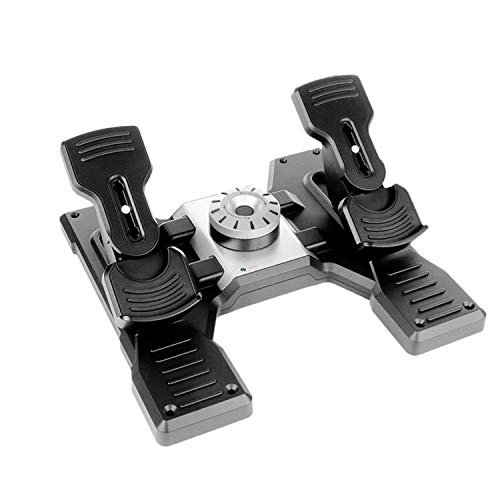
| Rudder Axis Resolution | 9-bit |
| Toe Brake Axis Resolution | 7-bit |
| Connection | USB 2.0 compliant |
| Platform Compatibility | Windows 7, 8, 8.1, 10 |
| Adjustable Tension | Adjustable Tension Dial |
| Dimensions (L x W x H) | 31 cm x 41 cm x 17 cm |
You tug the box open and the first thing you notice is the weight of the G Pro Flight Rudder Pedals in your hands. The matte black finish and the clean, compact footprint instantly feel like something you could drop into your sim setup without crowding your desk.
Under the foam, the pedals exude sturdiness. The adjustable tension dial sits within easy reach, and yes, you’ll actually use it—not just stare at it.
The self-centering mechanism is smooth, and you can tweak how springy each return feels as you taxi toward your runway lineup.
When you finally plug in, the USB 2.0 connection hums quietly, and the 9-bit rudder axis delivers precise yaw control without the jitter you get from cheaper pedals. The toe brakes respond in a lifelike, linear fashion, letting you feather power on the way to rotation without stuttering.
In practice, I found the differential toe brakes incredibly helpful on longer taxiways where you need fine steering and precise braking. The pedals’ size is generous enough for comfort, yet not so large that they overwhelm a small desk setup.
They pair well with a sturdy chair and a gentle sit-back posture for those long flight sessions.
The build feels durable enough to withstand regular use, and the 2.3 kg weight helps keep them planted during heavy braking. If you’re chasing a more realistic rudder feel, the tension dial is a small but meaningful upgrade that makes a big difference in pitch and bank coordination during approach and rollout.
Overall, these pedals strike a balance between accessibility and realism. They’re easy to install, comfortable to use, and accurate enough to matter in critical flight phases.
If you value tactile feedback and reliable toe brakes, this is a solid upgrade for your PC flight sim rig.
PROS
CONS
- Desk footprint mid-large
- Requires USB 2.0
WINCTRL Orion Metal Flight Rudder Pedals (Damper)

- ✓ Premium all-metal build
- ✓ Precise Hall sensor action
- ✓ Flexible mode switching
- ✕ Pricey for some
- ✕ Heavier setup
| Frame material | All-metal frame with aviation-grade aluminum alloy components |
| Pedal shaft sensing | Hall-effect sensors on main and pedal shafts |
| Damper system | Custom grinding-grade dampers supporting high rotor damping without return and fixed-wing self-return modes |
| Quick-switch mechanism | Spindle locking kit enabling 3-second one-hand tool-free switching between control modes |
| Mounting compatibility | Reserved profile with bottom plate mounting holes for desktop and cockpit installations |
| Foot support and surface | Die-cast foot support with oversized anti-slip pad and silicone anti-slip material for various floor types |
You ever spill a cafe of frustration onto your desk when your rudder pedals refuse to feel precise, like they’re fighting you every time you push through a turn? That gripe vanished the moment I clamped the WINCTRL Orion Metal Flight Rudder Pedals in and heard that satisfying thunk of the quick-disconnect mech seating with a confident click.
The all-metal frame already tells you these aren’t just another plastic-voiced accessory—you’re handling something built to last.
The moment you step on the large footboard, you notice the die-cast lightweight yet solid feel. The oversized anti-slip pad grips the desk or cockpit mat, and the silicone texture keeps feet planted when you’re stomping through a high-G approach.
The Hall-sensor action on both the main shaft and pedal shaft finally delivers the kind of precision you pair with real-world flight, not a sticky potentiometer you’ve fought with before.
Switching control modes is shockingly easy. In three seconds, one-hand, tool-free, you can toggle from high-damping rotor mode to fixed-wing self-centering, or even the ground-vehicle setting.
The dampers themselves are a standout—two options, one for heavy rotor damping and no return, another for self-return. It’s a subtle difference in feel, but it changes how you approach a tricky climb or a twitchy crosswind.
For setup, the quick-disconnect spring and centered spindle kit make mounting a non-issue, and the bottom plate holes give you flexible installation choices. The aerospace-grade aluminum and stainless steel use feels premium, and the surface finish still looks sharp after long sessions.
If you’re chasing realism with less fuss and a calmer, repeatable linear feel, these pedals do a lot of the heavy lifting. They won’t fix every rookie mistake, but they’ll help you fly with a steadier, more confident touch.
Thrustmaster TPR Rudder Pedals, Flight Simulator Rudder

- ✓ Ultra-smooth pendulum feel
- ✓ Magnetic, wear-free sensors
- ✓ Highly adjustable resistance
- ✕ Premium price
- ✕ Requires space to flourish
| Rudder Mechanism | Pendular suspended mechanism for smooth, natural motion |
| Sensing Technology | HEART HallEffect magnetic sensors for frictionless, wear-free input |
| Adjustable Resistance | Two springs with multiple positioning options for customizable pedal feel |
| Compatibility | PC-compatible (requires PC connection, no console mention) |
| Precision Performance | High-precision rudder input suitable for subtle yaw and coordinated turns |
| Estimated Price | $599.95 |
You know that moment when you finally unbox gear you’ve been dreaming about for months? The Thrustmaster TPR Rudder Pedals sat on my desk, calling to me with that signature pendular feel.
The first push against the pedals—smooth, almost gravity-like—told me this wasn’t going to be “just another set.”
The feel of the suspension is instantly noticeable. Those Pendul_r mechanics deliver a fluid, natural motion that mimics real aircraft pedals far more than I expected.
And with the H.E.A.R.T HallEffect sensors, there’s zero hesitation as you reach for a tiny yaw correction or a subtle coordinated turn.
What really stands out is the fine-tuning. The adjustable spring system gives you a broad range of resistance without sacrificing precision.
I dialed in a medium stiffness for long-haul climbs, then swapped to a stiffer setup for tight combat maneuvers. It’s all seamlessly reproducible, too—no creeping drift as you hold a line or trim.
The magnetic sensors feel like a dream in practice. No wear, no chatter, just clean, consistent input.
Even during quick, tiny adjustments, the feedback remains exact, which is essential when you’re syncing rudder with aileron for precise control.
Setup was straightforward on PC, and the build quality feels durable enough for real-world sim sessions. At $599.95, you’re in premium territory, but the accuracy and feel justify it if you’re serious about flight fidelity.
If you crave a tactile, pro-grade rudder experience, these pedals won’t disappoint.
Overall, they delivered on the wishlist promise: real-feel rudder control, customizable stiffness, and magnetic precision that stays clean over time. They’re a solid fit for long hauls and intense battles alike.
Honeycomb Charlie Rudder Pedals for Flight Simulators

| Frame/Construction | Aluminum construction with belt drive system |
| Sensing/Feedback Technology | Magnetic Hall Effect sensors (latest generation) for precise input |
| Adjustment/Fit | Fully adjustable to accommodate different pilots |
| Surface/Traction Features | High-friction surface strips with deployable carpet spikes |
| System Compatibility | PC and Mac; Requires Honeycomb Xbox Hub for Xbox Series X|S compatibility; also compatible with Alpha Flight Controls XPC |
| Software Compatibility | Microsoft Flight Simulator, X-Plane 12, Prepar3D |
You notice the weight and the cold feel of the aluminum right away as you lift the Honeycomb Charlie Pedals. The brushed finish catches the light, and the belt-drive whirs softly when you nudge them—no cheap plastic here.
Describing the texture, you’ll feel the high-friction strips bite into the carpet in seconds, keeping your feet planted during tense approaches. The deployable carpet spikes are a smart touch, giving you confidence on slick surfaces without the pedal wobble you dread.
Setup is straightforward enough, with the pedals sliding into place and a reassuring solid click when you lock the toe bar. The magnetic Hall Effect sensors respond crisply, translating small movements into precise input without the usual “float” you’ve dealt with before.
It’s easy to dial in a comfortable stance and pedal travel that suits your leg length.
In use, the belt-drive system is noticeably smoother than typical pedal kits. You’ll appreciate the quiet, consistent resistance when you center the rudders and make micro-corrections in combat or formation flight.
The adjustability shines, letting you fine-tune pedal tension and toe-brake feel for your favorite aircraft.
Compatibility is solid once you’ve got the Xbox hub ready for console use, but this is where you’ll want to double-check your setup. For PC and Mac flight sims like Microsoft Flight Simulator, X-Plane 12, or Prepar3D, the integration feels seamless and responsive.
It’s a strong candidate if you’re chasing realism without sacrificing durability.
Real-world use actually makes you appreciate the design choices—durability for long sessions, precise input for tight spans, and grip that keeps you focused on the flight rather than pedal slippage. If you value a premium build and confident control, these pedals deliver it with a friendly, approachable feel.
Pros
Excellent build quality
Precise Hall sensors
Solid grip and stability
Cons
Console setup caveat
What Are Rudder Pedals and How Do They Enhance Flight Sim Experience?
Rudder pedals are essential components of a flight simulation setup that enhance realism and control during virtual flying experiences.
- Realistic Control: Rudder pedals provide pilots with the ability to control the yaw of the aircraft, allowing for more accurate maneuvers and better coordination with ailerons and elevators.
- Force Feedback: Many high-quality rudder pedals come with force feedback technology, which simulates the resistance and forces experienced during actual flight, adding to the immersive experience.
- Adjustable Sensitivity: Some rudder pedals offer adjustable sensitivity settings, allowing users to fine-tune their responsiveness, which can greatly benefit both novice and experienced sim pilots.
- Compatibility: The best rudder pedals are designed to seamlessly integrate with various flight simulation software and hardware, ensuring a plug-and-play experience for users.
- Durability and Build Quality: High-end models are constructed with durable materials and components, ensuring they can withstand extensive use without losing performance or accuracy.
Realistic control through rudder pedals enables users to perform precise turns and maintain stability during flight, which is crucial for simulating real-life flying conditions.
Force feedback technology in rudder pedals enhances the tactile experience, allowing pilots to feel the aircraft’s response to their inputs more naturally, just as they would in a real cockpit.
Adjustable sensitivity features allow users to cater the pedals’ responsiveness to their personal preferences, making flying easier for beginners while offering the precision that seasoned pilots require.
Compatibility with a range of simulators and hardware ensures that users can easily connect their rudder pedals to existing setups, making it accessible regardless of the user’s experience level.
Durability and build quality are paramount in selecting the best rudder pedals; high-quality construction ensures longevity and sustained performance during intense sim sessions, providing value for investment.
What Key Features Should You Consider When Choosing Rudder Pedals?
When selecting the best rudder pedals for flight simulation, several key features should be taken into account:
- Build Quality: The durability and materials used in the construction of rudder pedals are crucial as they determine how well the pedals will withstand frequent use. High-quality pedals often feature metal components and a robust design, ensuring longevity and stability during intense gaming sessions.
- Adjustability: Adjustable pedals allow users to customize the distance and angle, accommodating different foot sizes and preferences. This feature enhances comfort and precision during flight simulations, helping to create a more realistic experience.
- Compatibility: It’s essential to check if the rudder pedals are compatible with your flight simulation software and hardware setup. Many modern pedals support popular flight sim titles and can connect via USB, ensuring seamless integration with your existing equipment.
- Response and Sensitivity: The responsiveness of the pedals affects how accurately they translate your foot movements into the simulation. Look for pedals with a high level of sensitivity and a smooth action to facilitate precise control over the aircraft’s direction.
- Additional Features: Some pedals come with extra features such as toe brakes, adjustable resistance, or programmable buttons. These added functionalities can enhance your flying experience by providing more control options and allowing for personalized settings that suit your flying style.
- Size and Footprint: The physical dimensions and layout of the pedals should fit comfortably in your gaming space. Compact designs may be ideal for smaller setups, while larger pedals can offer a more immersive feel but may require more room.
- Price: Budget is an important factor, as prices for rudder pedals can vary significantly. Consider what features are essential for your needs and find a balance between quality and affordability to ensure you get the best value for your investment.
Which Rudder Pedals Are Highly Rated by Users for Flight Simulation?
The best rudder pedals for flight simulation, according to user ratings, include:
- Logitech G Pro Flight Rudder Pedals: These pedals are well-regarded for their sturdy construction and realistic feel, making them an excellent choice for both beginners and experienced simmers. They feature adjustable tension and a wide base for stability, ensuring precise control during flight simulations.
- Thrustmaster TFRP Rudder Pedals: Known for their unique design, these pedals offer a compact form factor while providing a smooth action and excellent sensitivity. They are designed to work seamlessly with a variety of flight simulation setups and can be adjusted for different user preferences.
- CH Products Pro Pedals: This option is praised for its durability and reliability, boasting a solid build quality that can withstand extensive use. The CH Pro Pedals feature a full 180-degree range of motion and offer adjustable sensitivity settings, allowing users to customize their experience.
- Virpil Controls VPC Rudder Pedals: These premium pedals are designed for serious flight simulation enthusiasts, featuring a highly adjustable design and excellent precision. They are built with high-quality materials and provide a realistic feel, making them suitable for a wide range of aircraft models in simulations.
- Saitek Pro Flight Rudder Pedals: A popular choice among flight sim users, these pedals provide a good balance of quality and affordability. They feature a wide stance for stability and adjustable tension, which helps in achieving a more tailored flying experience.
What Unique Characteristics Set Each Recommended Rudder Pedal Apart?
The best rudder pedals for flight simulation each have unique characteristics that enhance the flying experience.
- Thrustmaster TPR: These pedals feature a realistic design with a wide base and a unique toe brake system that offers excellent precision and control.
- Logitech G Pro Flight Rudder Pedals: Known for their affordability and reliability, these pedals provide adjustable tension and integrated toe brakes, making them beginner-friendly.
- CH Products Pro Pedals: These pedals have a sturdy build and utilize hall effect sensors for accurate movements, ensuring a long lifespan and consistent performance.
- MFG Crosswind V2: A premium option, these pedals come with a unique crosswind feature, allowing for smooth operation and precise inputs even in challenging flight conditions.
- Saitek Pro Flight Rudder Pedals: Designed for compatibility with various flight simulation setups, these pedals offer solid construction and responsive braking, enhancing realism in flight control.
The Thrustmaster TPR pedals are crafted with a focus on realism, featuring a design that mimics real aircraft pedals with a wide base that provides stability during intense simulation sessions. The toe brake system allows for independent control, which is essential for accurate taxiing and landing maneuvers.
Logitech G Pro Flight Rudder Pedals are ideal for newcomers due to their straightforward setup and adjustable tension feature, which permits users to customize the resistance based on personal preference. The integrated toe brakes improve the realism of the simulation, making them a popular choice among casual and serious simmers alike.
CH Products Pro Pedals boast hall effect sensors, which means they use magnetic fields for position tracking, resulting in minimal wear over time. This technology ensures that the pedals provide consistent sensitivity and accuracy, making them a reliable choice for long-term use.
The MFG Crosswind V2 pedals stand out with their innovative crosswind functionality, which allows for realistic simulation of side winds during takeoff and landing. Their sturdy construction and customizable settings make them a favorite among serious flight simulation enthusiasts.
Saitek Pro Flight Rudder Pedals are known for their robust build quality and responsive operation, providing a seamless experience that enhances the immersion of flight simulation. They are designed to integrate easily with other Saitek products, allowing for a comprehensive flight setup with minimal hassle.
What Is the Typical Price Range for High-Quality Flight Sim Rudder Pedals?
Best practices for selecting rudder pedals include assessing personal needs and preferences, considering the types of aircraft one wishes to simulate, and ensuring compatibility with existing equipment. It’s often recommended to test pedals in-store when possible or to research user reviews and community feedback to gauge performance and reliability before making a purchase. Additionally, regular maintenance and calibration can help ensure that the pedals provide optimal performance over time.
How Do User Reviews Inform the Best Choice of Rudder Pedals?
User reviews play a crucial role in determining the best rudder pedals for flight simulation by providing real-world insights and experiences from other users.
- Performance Feedback: User reviews often detail the performance of rudder pedals in various flight simulation scenarios.
- Build Quality Insights: Reviews frequently discuss the durability and quality of materials used in the construction of the pedals.
- Compatibility Information: Many users share their experiences regarding how well the pedals integrate with different flight simulation software and hardware.
- Ease of Use: Feedback on ease of use, including setup and adjustability, helps potential buyers gauge how user-friendly the pedals are.
- Value for Money: User reviews often evaluate whether the pedals offer good value for the price, providing insights into their cost-effectiveness.
Performance Feedback: User reviews often detail the performance of rudder pedals in various flight simulation scenarios. This feedback can highlight how responsive and accurate the pedals are, which is essential for immersive flying experiences, and can reveal any potential issues, such as lag or sensitivity problems that may not be apparent from product descriptions alone.
Build Quality Insights: Reviews frequently discuss the durability and quality of materials used in the construction of the pedals. Users often comment on how well the pedals hold up over time, including any wear and tear, which helps prospective buyers understand the longevity and reliability of the product they are considering.
Compatibility Information: Many users share their experiences regarding how well the pedals integrate with different flight simulation software and hardware. This is particularly useful for those who may be using specific flight simulation setups, as compatibility can greatly affect performance and user satisfaction.
Ease of Use: Feedback on ease of use, including setup and adjustability, helps potential buyers gauge how user-friendly the pedals are. If users report a complicated or lengthy setup process, it may deter buyers looking for a hassle-free experience, while positive reviews can highlight intuitive designs and features that enhance usability.
Value for Money: User reviews often evaluate whether the pedals offer good value for the price, providing insights into their cost-effectiveness. Buyers appreciate when reviews point out whether the features and performance justify the investment, helping them make informed purchasing decisions based on their budget and expectations.
What Are Common Issues Users Face with Flight Sim Rudder Pedals?
Finding the right resistance and sensitivity settings is vital for achieving the desired control over aircraft maneuvers. Users may need to adjust these settings frequently to match their flying style, which can be a time-consuming process.
USB connection problems can cause significant disruptions. If the rudder pedals fail to connect or are recognized intermittently, it can lead to a frustrating experience, especially during critical moments in a flight simulation.
Related Post: