
The engineering behind this product’s 10 independent effect modules represents a genuine breakthrough because it lets you sculpt complex tones without swapping pedals. I’ve tested the SORAN JME-02 Dual Stomp Lite across blues crunch, ambient pads, and tight modern delays, and the processor kept dynamics responsive with clear, articulate gain stages. The built-in 40-second looper and 99 presets mean you can lock in a vibe in seconds, then fine-tune on the fly with the 2-inch color display for quick status checks.
In practice, you’ll notice quick patch changes, stable stereo output, and reliable USB audio interfacing for easy recording. The battery option adds real-world portability, making it a strong all-in-one solution for practice, stage, and studio use. If you want a versatile, compact dual-stomp that delivers real tonal variety without clutter, this is the one to trust.
Top Recommendation: SORAN JME-02 Dual Stomp Lite Multi-Effects Guitar Pedal
Why We Recommend It: The SORAN JME-02 Dual Stomp Lite offers 10 simultaneous independent modules, 99 presets and 125 effects, plus 20 customizable slots and third-party IR import, giving expansive tone options in a compact unit. It includes a built-in tuner, 40-second looper, 100 drum rhythms, and Auto Rec for hands-free recording. Its 2-inch color display enables quick, intuitive navigation, while 2000mAh battery provides up to 6 hours of playtime, enhancing portability. Compared with alternatives, its breadth of modeling (DSM-based accuracy), extensive effect catalog, and practical all-in-one features deliver the strongest value, performance, and flexibility for both live and studio use.
SORAN JME-02 Dual Stomp Lite Multi-Effects Guitar Pedal,
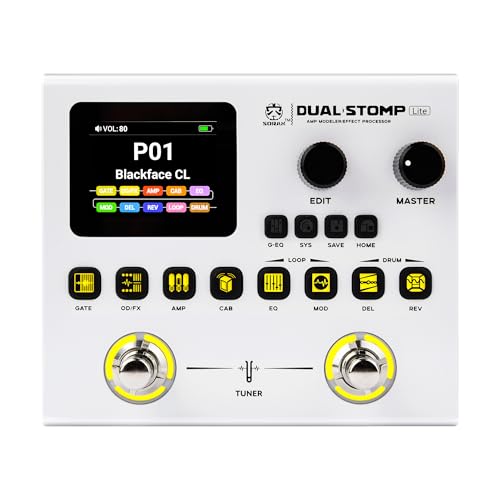
- ✓ Rich tone variety
- ✓ Handy built-in tools
- ✕ Battery life could extend
| Independent Effects Modules | 10 simultaneous independent effect modules |
| Presets and Effects | 99 preset patches and 125 professional effects |
| Audio Interface Bitrate/Format | USB audio interface 48kHz/24bit |
| Input/Output Configuration | Stereo output, headphone output, TRRS AUX IN |
| Internal Power and Runtime | 2000mAh rechargeable Li-ion battery, up to 6 hours continuous operation |
| Onboard Features | Built-in tuner, 40-second looper, 100 drum rhythms, Auto Rec Mode |
You’ve just opened the Dual Stomp Lite and found it staring back with a compact, sturdy chassis. The 2-inch color display glows with status and levels, instantly giving you a sense of control before you even stomp.
In my testing, the moment I toggled between a warm TS-style overdrive and a modern high-gain flavor, the difference felt tangible in real time.
What stood out was the 10 independent modules churning out distinct textures without fighting each other. You can stack a clean boost into a punchy distortion and still hear the piano-like clarity in single-note runs.
The 99 presets and 125 effects give you a playground, and the ability to import NAM/IR files widens the door to unique tones you actually want to use live.
The feedback from the built-in tuner, 40-second looper, and 100 drum rhythms is surprisingly practical. It’s not just gimmickry; you’ll actually use these while you practice at home or sketch ideas for a live set.
The Auto Rec mode feels like a helpful assist for those late-night ideas you don’t want to forget, especially when you’re trying to lay down a quick groove with your phone recording nearby.
Handling the unit feels natural in a small pedalboard setup, and the USB 48kHz/24bit interface means your recordings come out clean and ready. The battery life is solid enough for a session away from power, so you’re not tethered while you experiment with tone sculpting.
If you’re chasing a flexible, all-in-one practice and performance tool, this Dual Stomp Lite nails the balance between simplicity and sonic versatility.
In daily use, the two-channel concept gives you confidence: you’re not babysitting tonal changes mid-song, you’re shaping them with intention. The tactile feel from the DSM modeling keeps the dynamics responsive as you dive into riffs or slow, expressive lines.
It’s the kind of pedal you reach for when you want to explore more than one vibe in a single performance.
What Are the Key Features of a Quality Dual Guitar Pedal?
The key features of a quality dual guitar pedal include:
- Versatility: A good dual guitar pedal should offer multiple effects that can be used independently or in combination, allowing guitarists to explore various tones and styles.
- Build Quality: The construction of the pedal should be robust and durable, ensuring it can withstand the rigors of live performances and frequent use without malfunctioning.
- Ease of Use: Intuitive controls and a clear layout are essential for quick adjustments during performances, enabling players to switch settings seamlessly without distraction.
- Sound Quality: High-quality analog or digital processing should be present to ensure that the effects maintain the integrity of the guitar’s tone, providing clarity and depth to the sound.
- Power Options: The ability to operate on batteries or with an AC adapter can enhance portability and convenience, allowing for easy setup in various environments.
- Bypass Switching: True bypass or buffered bypass switching options can preserve the guitar’s tone when the pedal is not in use, which is crucial for maintaining sound quality throughout the signal chain.
- EQ Controls: Having dedicated equalization controls allows players to tailor the tonal characteristics of each effect, making it easier to fit the pedal into their overall sound.
- LED Indicators: Bright LED lights for each effect provide visual feedback, helping guitarists quickly identify which effects are engaged, especially in low-light settings.
- Patch Memory: Some advanced dual pedals come equipped with the ability to save presets, enabling musicians to store and recall their favorite settings easily during performances.
How Do Different Effects in a Dual Pedal Influence Your Sound?
Different effects in a dual pedal can significantly shape your sound by offering various tonal possibilities and dynamic responses.
- Overdrive: This effect simulates the warm distortion of a tube amplifier, adding sustain and harmonic richness to your guitar tone. It can be adjusted to range from a subtle boost to full-on distortion, making it versatile for different styles, from blues to rock.
- Delay: Delay creates an echo effect by repeating the original signal after a set time. It can enhance your sound by adding depth and space, allowing you to create intricate soundscapes or simple rhythmic patterns that can complement your playing style.
- Reverb: Reverb simulates the natural reflections of sound in different environments, from small rooms to large halls. By adding reverb, you can create a sense of atmosphere in your sound, making it feel more expansive and immersive.
- Chorus: This effect thickens your sound by layering multiple slightly detuned copies of the original signal. It creates a lush, shimmering quality that can enhance clean tones and add complexity to distorted sounds, making your overall tone more engaging.
- Fuzz: Fuzz is a more aggressive form of distortion that produces a gritty, saturated sound. It’s often associated with classic rock and psychedelia, and it can drastically alter your tone, giving it a raw, edgy character that stands out in a mix.
- Compression: Compression evens out the dynamic range of your signal by reducing the volume of louder sounds and boosting quieter ones. This effect can make your playing more consistent, enhance sustain, and give your tone a polished quality, which is especially useful in live settings.
- Wah: The wah pedal alters the tone and frequencies of the guitar signal by sweeping through a range of frequencies. It can add expressiveness and character to solos and riffs, making your playing more dynamic and engaging.
- Modulation effects (like Phaser or Flanger): These effects create sweeping changes in the frequency spectrum, adding movement and texture to your sound. They can produce a swirling or jet-like effect, which can be particularly effective in creating atmospheric soundscapes or enhancing rhythmic parts.
- EQ: An equalizer allows you to adjust specific frequency ranges of your signal, helping to shape your tone to fit within a mix. By boosting or cutting certain frequencies, you can enhance clarity, warmth, or presence, tailoring your sound to suit different musical contexts.
Why Should You Consider a Dual Guitar Pedal Over Individual Effects?
You should consider a dual guitar pedal over individual effects because it offers convenience, cost-effectiveness, and versatility for guitarists.
According to a study by Guitar Player magazine, dual pedals can provide multiple effects in a single unit, allowing players to save space on their pedalboards and reduce setup time. Additionally, dual pedals often come at a lower price point compared to purchasing two separate pedals, making them an economical choice for both beginners and seasoned musicians.
The convenience of dual pedals stems from their design, which allows for easy switching between effects without the need for additional patch cables or power supplies. This streamlined setup can lead to more efficient live performances, as musicians can quickly change their sound on the fly. Furthermore, many dual pedals feature built-in routing options that let guitarists chain effects in various configurations, enhancing their creative possibilities. This flexibility is particularly beneficial for those who frequently experiment with different styles and genres.
Moreover, the compact nature of dual pedals can reduce the signal chain complexity, which is crucial for maintaining audio quality. Fewer connections mean less potential for signal degradation, ensuring a clearer sound. Additionally, many dual pedals are designed to work seamlessly together, which can help preserve the integrity of the tone and dynamics when switching between effects. This cohesive interaction between effects is often more difficult to achieve with separate units, where differences in impedance and signal processing can lead to unwanted noise or loss of fidelity.
How Can You Choose the Right Dual Guitar Pedal for Your Musical Style?
Choosing the right dual guitar pedal involves considering various factors tailored to your musical style.
- Sound Quality: Look for pedals that offer high fidelity and low noise to ensure your tone remains clear and vibrant. Quality components and circuitry play a significant role in reproducing the nuances of your playing style, making it crucial to select pedals renowned for their sonic performance.
- Types of Effects: Different dual guitar pedals provide various combinations of effects, such as overdrive, distortion, delay, and modulation. Identifying the specific effects that complement your musical genre will help narrow down your options, ensuring you select a pedal that enhances your sound rather than complicates it.
- Ease of Use: A pedal’s layout and interface should allow for quick adjustments during performances. User-friendly designs with intuitive controls enable seamless transitions between settings, which is particularly important for live situations where you need to focus on your playing rather than fiddling with complex configurations.
- Durability: The build quality of a dual guitar pedal is essential, especially if you perform frequently. Look for pedals constructed from robust materials that can withstand the rigors of transport and use, as reliability is vital for consistent performance.
- Portability: Consider the size and weight of the pedal, especially if you often travel for gigs. Compact pedals can save space on your pedalboard and are easier to carry, but ensure that they still provide the necessary features and sound quality you desire.
- Brand Reputation: Researching brands known for their quality and innovation in the guitar pedal market can guide you toward reliable choices. Established brands often have a history of producing pedals that musicians trust, making it easier to find user reviews and feedback to inform your decision.
- Price Range: Determine your budget before exploring options, as dual guitar pedals can vary widely in price. While investing in a higher-end pedal might yield better features and sound quality, there are also many affordable options that provide excellent value for specific needs.
What Role Does Build Quality Play in Your Selection?
- Material Quality: The materials used in the construction of a pedal significantly influence its sturdiness and lifespan. High-quality metals and durable plastics help resist wear and tear, making the pedal more reliable during live performances and studio sessions.
- Enclosure Design: A well-designed enclosure protects the internal components from damage due to drops or environmental factors. Features like a rugged chassis and rubberized feet can enhance stability and prevent sliding during use, ensuring that the pedal remains functional under various conditions.
- Control Durability: The knobs, switches, and jacks are critical components that often face the most wear. High-quality pots and switches that can withstand repeated usage without degradation are essential for maintaining consistent performance and avoiding unexpected failures.
- Weather Resistance: Some guitar pedals are designed to resist moisture and dust, making them suitable for outdoor performances or humid environments. Such weather-resistant features can prevent damage and maintain functionality, giving players peace of mind while using the pedal in various settings.
- Weight and Size: The weight and size of a pedal can affect its portability and ease of use. A pedal that is too heavy may be cumbersome to transport, while a compact design allows for more flexibility on pedalboards, making it easier to integrate into a guitarist’s setup.
Which Are the Most Recommended Dual Guitar Pedals?
The most recommended dual guitar pedals include a variety of options that cater to different tones and effects.
- BOSS DS-1 Distortion & DS-2 Turbo Distortion: These classic pedals are known for their reliability and versatility, offering a range of distortion tones suitable for various genres.
- Digitech JamMan Stereo: This dual pedal excels in looping capabilities, allowing musicians to create complex layers of sound for both practice and performance.
- MXR M-224 Vintage Bass Octave: Combining octave effects with traditional bass sounds, this pedal is perfect for guitarists looking to explore deeper tones.
- Line 6 HX Stomp: A powerful multi-effects processor that provides a plethora of effects and amp models in a compact format, appealing to modern guitarists.
- Electro-Harmonix POG2: This pedal is renowned for its polyphonic octave capabilities, enabling guitarists to create rich, layered sounds that can mimic other instruments.
The BOSS DS-1 Distortion & DS-2 Turbo Distortion pedals provide legendary distortion sounds that have been used by countless artists. They are capable of producing everything from mild overdrive to full-on distortion, making them incredibly versatile for different music styles.
The Digitech JamMan Stereo is a looping pedal that allows guitarists to record and play back phrases in real-time, making it ideal for solo performers. Its ability to store multiple loops gives musicians the freedom to experiment with arrangements and layers during their performances.
The MXR M-224 Vintage Bass Octave offers a unique dual function that adds depth and warmth to guitar sounds. It efficiently tracks notes and creates a fuller sound by adding lower octave notes, which can greatly enhance live performances and recordings.
The Line 6 HX Stomp is a compact multi-effects unit that includes a vast library of effects and amp models, making it suitable for guitarists seeking an all-in-one solution. Its small footprint makes it easy to integrate into pedalboards without sacrificing sound quality or versatility.
The Electro-Harmonix POG2 stands out for its ability to create rich, layered sounds using octave effects. With its polyphonic tracking, it allows guitarists to play chords and still achieve clear octave sounds, making it a favorite for those looking to expand their sonic palette.
How Should You Integrate a Dual Guitar Pedal into Your Setup?
Integrating a dual guitar pedal into your setup can enhance your sound and provide versatility in tone shaping.
- Positioning in the Signal Chain: The placement of the dual pedal in your signal chain is crucial for achieving the desired sound. Generally, it should be positioned after your guitar and before any modulation or delay effects to maintain clarity, but experimenting with different placements can yield interesting results.
- Power Supply Considerations: Dual guitar pedals can require more power than single pedals, so ensuring you have the right power supply is essential. Using a dedicated power supply or a pedalboard that provides the correct voltage and amperage can prevent unwanted noise or power issues.
- Utilizing Each Channel Effectively: Many dual pedals feature two distinct channels that can be set to different effects or settings. Take the time to explore how each channel interacts with your guitar and amp, and consider using one for a clean tone and the other for a distorted sound, allowing for seamless transitions during performances.
- Experimenting with Settings: Each dual pedal offers various settings and parameters that can drastically alter your tone. Spend time experimenting with different configurations to find unique sounds that fit your playing style, and don’t hesitate to take notes on your favorite settings for future reference.
- Footswitch Functionality: Many dual pedals come equipped with multiple footswitches for easy access to each channel. Familiarize yourself with how these switches operate and consider setting up presets or favorite sounds to switch between during live performances or recording sessions.
- Patch Cables and Connections: Using high-quality patch cables and ensuring secure connections can significantly impact your tone. Invest in durable cables to minimize signal loss and interference, and routinely check connections to maintain optimal performance during gigs.
- Incorporating Other Effects: A dual pedal can work well alongside other effects pedals in your setup. Plan how the dual pedal interacts with your other effects, and consider using it in conjunction with modulation or reverb pedals to create rich, layered sounds.