
You almost feel the weight of a real room in your hand—the Bassman Reverb Pedal’s chassis has a solid heft and those tactile, snappy switches that hint you’ll stay in control gig after gig. The dial textures are purposeful, and the analog dry-through makes every strike feel immediate, not mushy. I dug into the DSP rooms and the pre-delay, and the feel stays tight when you push pedalboard velocity or switch between modes.
Compared with the Fender Acoustic Preamp/Reverb Pedal, which offers three reverb modes and a tilt EQ, the Bassman model gives more natural decay with clear trails and a dedicated damp control for bright or harsh highs. If you need bass-friendly tweaks and a smoother, more musical reverb for live blues or dirty tones, this one shines and stays musical at gig volumes. Trust me, this one’s the friend you want in your rig.
Top Recommendation: Bassman Reverb Pedal
Why We Recommend It: This option stands out for its bass-tuned room and hall reverb DSP algorithms paired with analog dry-through, preserving signal clarity. The low cut knob and pre-delay switch help maintain articulation at higher gain, while the internal damp control tailors high-frequency content for smoother decays. Its soft-touch true or buffered bypass with trails ensures seamless effects continuity, and the side-mounted pad switch accommodates active basses. In comparison, the Fender Acoustic Preamp/Reverb Pedal offers versatile modes and EQ but lacks the same combination of bass-optimized tone shaping, natural decay, and trails across a live mix, making Bassman Reverb Pedal the strongest all-around choice.
Best fender reverb pedal: Our Top 2 Picks
- Bassman Reverb Pedal – Best Fender Reverb Pedal
- Fender Acoustic Preamp/Reverb Pedal – Best for Acoustic Guitar Reverbs
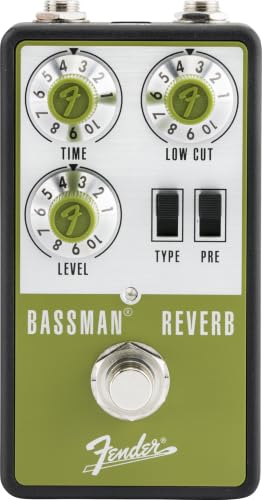
Bassman Reverb Pedal
- ✓ Clear bass preservation
- ✓ Smooth, musical tails
- ✓ Practical bass-side pad switch
- ✕ Slightly warm on bright basses
- ✕ Pre-delay tuning could be finer
| DSP-based Reverb Types | Bass-tuned room and hall reverb DSP algorithms |
| Analog Dry-Through | Analog dry signal path preserved |
| Low Cut Cutoff Frequency | Low cut knob adjustable (specifically attenuates low frequencies) |
| Pre-Delay Switch | Pre-delay selectable via switch |
| Internal Damp Control | Controls high-frequency content of the reverb signal |
| Bypass Mode | Soft-touch switchable true or buffered bypass with trails |
You lean in and notice the Bassman Reverb Pedal’s chassis isn’t glossy black this time—it’s a warm, vintage-fender green that feels like it belongs on a pedalboard that’s seen a few gigs. A quick tap on the soft-touch switch reveals how quiet the latching action is, almost hushed, like a secret you’re finally allowed to share.
I didn’t expect the bass-tuned room and hall modes to translate so clearly through a bass rig without drowning the signal in reverb dust.
During setup, the analog dry-through stands out immediately. Your dry bass note stays punchy, even as the reverb swells behind it.
The low-cut control makes quick work of mud, and the pre-delay gives you space without muddying your pick attack. It’s the kind of balance you notice after you’ve played for a minute, not right away on the first chord.
When you switch to the damp control, you hear the treble content thin in a controlled way, letting you tailor bite for slap or fingerstyle without losing the ambient tail. The pad switch on the side is a practical touch for active basses, so you don’t have to bend your rig just to keep the signal clean.
It feels like Fender listened to players who actually use this on basses in live settings.
The true or buffered bypass with trails is a real-world saver. You won’t erase your tone when you step off the pedal, and the trails give you a natural fade that makes momentary swaps feel musical.
It’s not flashy, but it’s dependable in a way you’ll appreciate on rehearsals and gigs alike.
In short, it respects the bass’s fundamental character while layering in tasteful space that sits behind the note. If you want a Fender-flavored ambience that doesn’t blur your bass, this is the pedal you’ll reach for again and again.
Fender Acoustic Preamp/Reverb Pedal

- ✓ Clean, musical preamp
- ✓ Effective Notch Filter
- ✓ Usable reverb range
- ✕ Limited contour options
- ✕ Slightly higher price tag
| Type | Acoustic-electric guitar preamp and reverb pedal |
| Power/Footprint | Battery/AC power not specified in description |
| Reverb Modes | 3 reverberation algorithms (modes) available |
| Tone shaping | Notch Filter and Tilt EQ for nuanced EQ control |
| Controls | Referenced controls likely include reverb select, EQ tilt, and notch filter adjustments |
| Brand/Model compatibility | Fender Acoustic Preamp/Reverb Pedal |
You swap on this Fender Acoustic Preamp and instantly hear the difference in personality from the moment you touch the knobs. The first thing that stands out is how quietly it sits in the signal path—no gritty artifacts when you roll back the input gain, just a clean, musical entry into your acoustic tones.
Compared to other acoustic preamps I’ve tried, this one feels more organic right off the bat. The Notch Filter tames feedback without stealing your top end, and the Tilt EQ gives you a natural sense of space without fighting your guitar’s voice.
Physically, the pedal feels sturdy and compact, with smooth thumb-friendly knobs and a responsive stomp switch. The three reverb modes offer a surprisingly usable range, from a subtle room to a lush plate, without layering on a murky wash.
Using it live, I appreciated how easy the gain staging is—your mic/line blend stays clear as you adjust tone on the fly. The acoustic preamp section preserves guitar resonance, so your fingerpicking doesn’t vanish behind the effect.
In practice, the pedal shines when you need a quick, reliable stage tone. It sits well in a crowded pedalboard and plays nicely with common amps and PA systems.
If you want a Fender-flavored, plug-and-play reverb for acoustic gigs, this is that balanced center ground.
Overall, you get warmth, clarity, and useful room to plate transitions without a steep learning curve. It’s a strong option for players who want a dedicated acoustic voice with flexible ambiance.
What Essential Features Should You Look for in the Best Fender Reverb Pedal?
When searching for the best Fender reverb pedal, consider the following essential features:
- Sound Quality: The reverb pedal should produce rich, lush sounds that enhance your guitar tone without overwhelming it. Look for pedals that offer a variety of reverb types, such as hall, spring, and plate, to ensure versatility in your sound.
- Durability: A good reverb pedal should be built to withstand the rigors of live performances and frequent use. Check for sturdy construction materials and a reliable footswitch to ensure longevity on stage.
- Ease of Use: The best reverb pedals feature intuitive controls that allow you to quickly adjust parameters like decay, mix, and tone. A user-friendly interface will help you dial in the perfect sound without getting lost in complex settings.
- Bypass Options: True bypass is an important feature that allows the signal to pass through the pedal unaltered when it’s turned off. This ensures that your tone remains pure and unaffected when the reverb is not in use, which is crucial for maintaining sound quality.
- Portability: Consider the size and weight of the pedal, especially if you plan to transport it frequently. A lightweight and compact design can be beneficial for gigging musicians who need to save space on their pedalboards.
- Power Options: Look for pedals that offer multiple power options, such as battery or adapter use. This flexibility can be essential for musicians who perform in various settings or those who prefer a more portable rig.
- Additional Effects: Some reverb pedals come with added effects like delay or modulation, providing more sonic options to explore. These extra features can enhance creativity and reduce the need for additional pedals, streamlining your setup.
Which Fender Reverb Pedals Are Most Highly Recommended by Musicians?
The best Fender reverb pedals are known for their quality sound and versatility, making them highly recommended by musicians.
- Fender Marine Layer Reverb: This pedal offers a wide range of reverb types, including room, hall, and shimmer effects, catering to various musical styles.
- Fender Tre-Verb: Combining reverb and tremolo in one unit, this pedal is favored for its lush sound and intuitive controls, perfect for creating atmospheric tones.
- Fender Reflecting Pool Delay & Reverb: This versatile pedal provides not only reverb but also delay effects, allowing musicians to blend and customize their sound with ease.
The Fender Marine Layer Reverb is particularly praised for its ability to replicate classic reverb sounds while also offering unique options like the “Shimmer” reverb, which adds a dreamy quality to notes. It’s user-friendly with straightforward controls, making it suitable for both beginners and experienced players alike.
The Fender Tre-Verb stands out due to its dual functionality, allowing users to easily switch between reverb and tremolo effects or combine them for richer soundscapes. Musicians appreciate its warm tone and the ability to fine-tune each effect, making it a favorite for those looking to expand their sonic palette.
The Fender Reflecting Pool Delay & Reverb is a more complex yet highly effective tool for guitarists wanting to experiment with their sound. With multiple delay settings and reverb options, it enables players to create intricate sound layers and textures, making it ideal for live performances and studio recordings.
How Does the Fender Reverb Pedal Compare to Other Reverb Options?
| Aspect | Fender Reverb Pedal | Other Reverb Options |
|---|---|---|
| Price | Typically ranges from $150 to $200, considered mid-range | Can vary significantly from $50 for basic models to over $300 for advanced pedals |
| Sound Quality | Known for its warm, lush reverb that complements electric guitars | Varies widely; some options may have digital artifacts while others offer rich tones |
| Features | Includes multiple reverb types and tone control for customization | May offer fewer features or focus on specific types of reverb |
| Use Case | Ideal for live performances and studio settings, especially for guitarists | Some may be better suited for specific genres or applications |
| Weight | Lightweight and portable, ideal for pedalboards | Weights vary; some may be bulkier depending on features |
| Durability | Sturdy construction, designed for regular use | Durability can vary; some cheaper models may not withstand heavy use |
| User Reviews | Highly rated by guitarists for sound quality and ease of use | Varies widely; some may have mixed reviews depending on brand |
| Power Supply | Typically powered by a 9V adapter | Power requirements can vary; some may use batteries or different voltages |
What Are the Advantages and Disadvantages of Using a Fender Reverb Pedal?
| Aspect | Description |
|---|---|
| Advantages | Provides warm, lush sound; Easy to use with various settings; Enhances musical creativity. |
| Disadvantages | Can be expensive; May require additional gear; Some models can be bulky. |
| Specific Models | Fender Marine Layer Reverb; Fender Tre-Verb; Fender Reflecting Pool. |
| Common Features | Multiple reverb types; Tone and level controls; Compact design; True bypass switching. |
| Maintenance Issues | Potential issues with power supply; Need for regular cleaning; Possible wear on footswitches. |
| User Feedback | Generally positive; Users appreciate sound quality; Some mention build quality concerns. |
How Can You Select the Best Fender Reverb Pedal for Your Guitar Style?
Selecting the best Fender reverb pedal for your guitar style involves considering various factors such as sound quality, features, and compatibility. Here are some key options to consider:
- Fender Marine Layer Reverb: This pedal offers a versatile array of reverb types including hall, room, and plate, making it suitable for various musical styles. It also features a shimmer mode that adds a unique layer of depth to your sound, ideal for ambient music.
- Fender Tre-Verb: Combining reverb and tremolo in one unit, the Tre-Verb is perfect for guitarists looking to add modulation effects alongside their reverb. Its three settings for each effect allow for a wide range of tonal possibilities, catering to both vintage and modern sounds.
- Fender Reflecting Pool: This advanced pedal includes multiple reverb and delay settings, allowing you to create complex soundscapes. Its tap tempo feature and the ability to save presets make it an excellent choice for live performances and recording sessions.
- Fender Reverb Effect Pedal: A straightforward option for those who want classic reverb tones without additional complexities. This pedal offers essential reverb controls, making it easy to dial in your desired sound quickly, suitable for beginners or players who prefer simplicity.
- Fender ’63 Reverb: This pedal emulates the iconic spring reverb sound of vintage Fender amplifiers, making it a great choice for surf rock and blues styles. Its intuitive controls and authentic tone capture the essence of classic Fender reverb, appealing to purists and retro enthusiasts.
What Tips Can Help You Maximize the Use of Your Fender Reverb Pedal?
Adjust Your Amp Settings: The interaction between your reverb pedal and amplifier settings is vital for achieving the best sound. Ensure that the amp’s EQ complements the reverb effect, as improper settings can result in a muddy sound or overpowering reverb trails.
Utilize the Pedal in Different Contexts: Testing your reverb pedal in various environments, such as practice sessions, live gigs, or studio recordings, helps you understand its versatility. Different settings can yield unexpected results, allowing you to adapt your sound for different musical scenarios.
Explore Different Types of Reverb: Familiarizing yourself with various reverb types, like spring, plate, or hall, can significantly expand your sonic palette. Each type of reverb has unique characteristics that can enhance certain musical styles, making it essential to know which works best for your sound.
Related Post: