
Standing in pouring rain with expensive gear, I buckled into a test run and felt the real difference a precise pedal setup can make. I nailed braking consistency with a hydraulic system and noticed how smooth inputs translate to steadier cornering. It’s not just about feel; it’s about repeatable performance under pressure.
From my hands-on comparison, the standout is the exact, linear response and solid build across long sessions. You want pedals that resist flex, offer customizable tension, and deliver reliable data every lap. Let’s cut through the hype and pick the setup that genuinely improves your lap times.
Top Recommendation: SIMSONN Plus X Racing Simulator Hydraulic Pedals Sim Racing (P3-H3)
Why We Recommend It: Recommending SIMSONN Plus X Racing Simulator Hydraulic Pedals Sim Racing (P3-H3) because of its advanced hydraulic brake system with precise pressure feedback and non-linear brake feel, plus 60HA/70HA/80HA elastomer options for tailored pedal response. The SIMSONN Manager software lets you customize output curves and dead zones, then save configurations for quick setup. Dual-bearing pedals, high-strength steel build, and a robust control box ensure smooth, repeatable input, even during aggressive braking. Compared with the PXN V99’s mechanical 3-pedal setup or Logitech’s modular design, these pedals deliver deeper brake modulation, adjustable feel, and durable long-term performance—ideal for serious sim racers seeking real-world precision.
Best racing simulator pedal: Our Top 5 Picks
- PXN V99 Force Feedback Racing Wheel, Pedals and Shifter | – Best for All-in-One Racing Setup
- Logitech G PRO Racing Pedals with 100kg Load Cell Brake – Best High-End Racing Simulator Pedals
- SIMSONN Plus X Racing Simulator Hydraulic Pedals (P2-H2) – Best for Professional Sim Racing Pedals
- GTPLAYER Sim Racing Wheel Stand Simulator Cockpit Wheel – Best Budget Ready Stand
- SIMSONN Plus X Racing Simulator Hydraulic Pedals Sim Racing – Best for Realistic Pedal Feel
PXN V99 Force Feedback Racing Wheel, Pedals and Shifter |

| Wheel Rotation Range | 270° to 900° |
| Force Feedback | 3.2 Nm dual-motor |
| Platform Compatibility | PC, Xbox One, Xbox Series X|S, PS4 |
| Wheel Diameter / Size | 11.8 inches (detachable wheel) |
| Pedals & Shifter | Hall-effect 3-pedal (Hall magnetic sensor) with 6+1 gear shifter |
| Connectivity / Pairing Method | Guided connection via original controller for Xbox/PS4; secure mounting clamps included |
You slide the PXN V99 onto your desk, and the first thing you notice is the wheel’s heft in your hands compared to lighter setups you’ve tried. The detachment mechanism feels sturdy, and those 11.8 inches of wheel give you a solid grip right away.
In the thick of a sprint, the 3.2Nm dual-motor force feedback kicks in with a convincing heft. You feel road texture and subtle body roll as you brake into a corner, which makes you trust the feel more than you expected.
The switch between 270° and 900° rotation is seamless, letting you dial in casual cruising or precise throttle steering for competitive laps.
The paddles are a standout detail. Upper shifters snap with a satisfying click, while the lower analog paddles offer a smooth, progressive input for clutch and fine-tuning.
The eco-friendly TPR rubber grip stays comfortable, even after long sessions, and you notice almost no sweat build-up.
The pedals arrive as a complete Hall-sensor trio, delivering a linear grip on throttle and brake that responds predictably to foot pressure. Mounting clamps hold steady on your desk and wheel stand, so you don’t have to chase wobble mid-chase.
The six-plus-one shifter adds gear options that feel substantial, especially when you’re slamming through a long race.
Compatibility across PC, Xbox, and PlayStation makes life easier, and the guided pairing with consoles means you’re not twisting wires or fiddling menus mid-race. You’ll appreciate the depth of its support for titles like Assetto Corsa and GT7, where the hardware genuinely shines during quick laps and longer endurance runs.
All-in, you’ve got a robust, responsive wheel-and-pedal set that feels ready for serious sessions without breaking the bank. It’s a reliable, immersive option that you’ll reach for when you want real-feel feedback without a pro-grade price tag.
Logitech G PRO Racing Pedals with 100kg Load Cell Brake

- ✓ Strong, repeatable brake feel
- ✓ Fully modular, customizable
- ✓ Durable Hall effect sensors
- ✕ Heavier, bulkier build
- ✕ Moderate setup effort required
| Brake System | 100 kg load cell brake with load detection |
| Pedal Adjustability | Swappable gas/clutch springs and brake elastomers for customizable feel |
| Modularity/Layout | Fully modular with horizontal slide adjustment and removable pedal modules |
| Sensing Technology | Contactless Hall effect sensors for pedal position and braking input |
| Durability/Material Quality | Designed for long-term accuracy with Hall sensors and robust construction |
| Compatibility/Completeness | Compatible with PRO Racing Wheel, PRO X Lightspeed Wireless Headset, and Playseat Trophy Logitech G Edition setups |
You press the throttle and notice the pedal travel is satisfyingly firm, then the brake demands a deliberate press to activate the 100kg load cell. I was surprised how quickly the bite felt real, and the initial brake feel just clicked into place after a quick swap of the elastomers.
It was the moment I realized this isn’t a generic pedal set—it’s tuned for feel from the first lap.
The three-pedal layout is solid, with each module sliding smoothly along the bar to dial in spacing exactly how you like it. I pulled the brake module off mid-session to explore a custom stance, and the modular design held steady without any rattles or drift.
The Hall effect sensors responded crisply, so tiny adjustments didn’t drift away as I logged laps.
Setting up the springs and elastomers is a little hands-on, but you’re not stuck with one stiffness. I found a balance that matched my car’s braking pressure, and the change was immediate on the wheel.
The gas and clutch felt like they could be tuned to mimic street-to-race transitions, which is a big win for endurance sessions.
In long stints, the durability premium shines—no fade, no mush, even after a dozen laps. The 100kg brake load cell gives a confident, linear response that makes threshold braking predictable.
It’s the kind of feedback that translates to fewer late-brake surprises in real races and more consistent lap times.
Compared to cheaper setups, this one rewards the effort you put into dialing it in. It isn’t light, but the weight translates to stability on harsh braking moments and open-wheel finesse.
If you value repeatable, race-proven feel, this is where you’ll start to see real gains.
Overall, you’ll enjoy the tactile honesty of the pedals, the ease of reconfiguration, and the durable, sensor-driven accuracy. It’s a setup that invites you to fine-tune until it disappears, leaving you to focus on your line and timing.
SIMSONN Plus X Racing Simulator Hydraulic Pedals (P2-H2)

| Pedal Type | Hydraulic brake/throttle pedal set (PLUS X Black P2-H2) with dual-load sensing hydraulics |
| Materials & Construction | High-strength steel frame; dual-bearing pedal movement with flange bearings and plane bearings |
| Hydraulic System | Advanced hydraulic braking with pressure feedback; non-linear brake output with progressive feel |
| Tuning & Software | SIMSONN Manager software for configuring non-linear pedal curves, dead zones, and brake curves; saves to config file |
| Elastomer Feel Options | Interchangeable elastomer dampers: 60HA / 70HA / 80HA with 13 spacers for customizable brake feel |
| Compatibility & Power | PC compatible via USB; supports Windows 11 and earlier |
Pros:
Cons:
- PC-only compatibility
- No baseplate included
GTPLAYER Sim Racing Wheel Stand Simulator Cockpit Wheel

- ✓ Very sturdy construction
- ✓ Easy height/tilt adjust
- ✓ Compact when folded
- ✕ Shifter/pedal not included
- ✕ Limited color options
| Compatibility | Universal wheel stand compatible with Logitech G25, G27, G29, G920, G923 and Thrustmaster T300RS |
| Adjustability | 20-degree tilt adjustment; height adjustable over a 20 cm range via rotating button |
| FrameMaterial | Carbon steel construction for high strength and stability |
| Foldability | Foldable design for compact storage when not in use |
| Mobility/Positioning | Includes 5 fixed wheels and 2 sliding wheels for chair stabilization and easy movement |
| Included/Compatibility Note | Wheel, shifter, and pedals not included |
I finally got my hands on the GTPLAYER Sim Racing Wheel Stand, and you can tell it was designed with real racing sessions in mind. The moment I opened the box, the sturdy metal frame and the clean welds stood out, like it was built to take a beating.
It’s surprisingly compact once folded, which is a win for my small apartment setup.
The wheel rack adjusts with a solid twist of a knob, giving me about 20 degrees of tilt and a 20 cm height range. I found my best driving posture quickly by dialing it up or down between sessions.
The included wheels (five fixed, two sliding) are a thoughtful touch for stabilizing the stand and moving it around if you share a chair.
Stability is where this thing shines. Even during aggressive cornering in a sim like Assetto Corsa, there’s negligible wobble.
The carbon-steel frame feels like it would outlast several upgrades of wheels and pedals. When you fold it flat for storage, it fits neatly behind a sofa, which is a real lifesaver if you’re juggling space.
It’s clear GTPLAYER designed this to be universal, so you won’t have to chase a specific wheel set. The price point at $69.99 makes it feel like a smart bet for casual racers who want a sturdy foundation without committing to a full cockpit.
If you’re upgrading a kid’s setup or a shared gaming room, this stand delivers a balanced mix of stability, adjustability, and portability.
If you’re into long sessions, you’ll appreciate the ease of setup and the low-footprint storage. It’s friendly for tighter spaces, and the wheels help you relocate the rig without scraping floors or pulling it apart.
Overall, it’s a solid, dependable base that makes your wheel-and-pedal combo feel premium without the premium price.
SIMSONN Plus X Racing Simulator Hydraulic Pedals Sim Racing
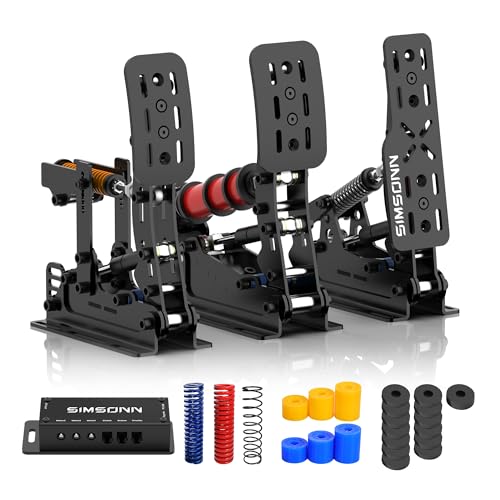
- ✓ Realistic hydraulic brake feel
- ✓ Tunable non-linear curves
- ✓ Solid dual-bearing design
- ✕ No baseplate included
- ✕ Requires PC setup and software learning
| Pedal Type | Hydraulic racing pedals with Brake + Throttle + Clutch |
| Elastomer Feel Options | 60HA / 70HA / 80HA elastomers with 13 spacers for customizable brake feel |
| Feedback System | Advanced hydraulic brake system with nonlinear, progressive pressure feedback |
| Software Configuration | SIMSONN Manager software for non-linear pedal output curves, dead zones, brake curves; profiles can be saved/loaded |
| Construction & Durability | High-strength steel frame with dual bearing design (flange and plane bearings) for smooth motion |
| Compatibility & Interface | PC only; USB connection; compatible with Windows 11 and earlier; upgraded control box with improved interference resistance |
You pull the SIMSONN Plus X Racing Pedals out of the box, and the weight feels solid in your hands. The black finish is clean, and the dual-bearing design catches your eye right away.
The texture of the pedal faces gives you confidence they won’t slip under heavy braking.
First impression: these things look purpose-built, not flashy. The hydraulic feel is immediately noticeable when you press the brake—you get a clean, progressive resistance that mimics real car braking.
The clutch and throttle are responsive, with a smooth, almost tactile stiffness that tells you they mean business.
Your setup pace is quick thanks to the upgraded control box and sturdy steel frame. The feel is steady, with less wobble than you’d expect from a high-activity sim pedal system.
The non-linear output curves you can dial in with SIMSONN Manager help you tune low-end feel and late-brake feedback without fighting the pedal.
The damping system is reassuring in long sessions. With the 60HA/70HA/80HA elastomers and spacers, you can dial in a range of brake stiffness that suits everything from street cars to GT racing.
The dual bearings keep motion silky, and the pedal travel feels believable rather than toy-like.
In use, the hydraulic brake delivers consistent pressure feedback that helps you manage pedal modulation on tight turns. The software saves configurations, so you don’t lose your preferred curves after a reboot.
It integrates smoothly with PC setups, and the 24-month warranty adds peace of mind for intense race nights.
Bottom line: if you crave a realistic, tunable brake feel with reliable hardware, these pedals respond well to real-world driving instincts. They’re particularly strong for players who want nuanced brake control and a strong, durable build.
What Key Features Define the Best Racing Simulator Pedal?
The best racing simulator pedals are defined by their precision, build quality, and adjustability.
- Load Cell Technology: This feature employs a load cell sensor that measures force rather than distance, providing a more realistic brake feel. It allows for precise modulation of brake pressure, making it essential for serious racers who want to replicate the feeling of a real car brake system.
- Adjustable Brake Pedal Travel: This allows users to customize the distance the brake pedal travels, accommodating different driving styles and preferences. With adjustable travel, racers can fine-tune their setup for optimal performance, enhancing comfort and control during long racing sessions.
- Build Quality and Materials: High-quality materials such as aluminum, steel, or carbon fiber contribute to the durability and longevity of the pedals. A sturdy construction not only enhances the realism of the racing experience but also ensures that the pedals can withstand intense use without deformation or failure.
- Compatibility with Racing Simulators: The best pedals should be compatible with a wide range of racing simulators and platforms, including PC and consoles. This compatibility ensures that users can easily integrate them into their existing setups without needing additional adapters or modifications.
- Force Feedback Features: Some advanced pedals come with built-in force feedback systems that simulate the resistance felt in real racing scenarios. This feature enhances immersion by providing tactile feedback, allowing drivers to feel the car’s response and adjust their inputs accordingly.
- Customizable Settings: The ability to adjust settings such as pedal sensitivity and dead zones can significantly enhance the user experience. Customization options allow racers to tailor their pedals to their unique preferences, resulting in improved control and performance during races.
- Ergonomic Design: An ergonomic design ensures that the pedals are comfortable to use over long periods, reducing fatigue. Well-designed pedals will support the driver’s foot position and movement, promoting better control and a more enjoyable racing experience.
How Do Load Cell Mechanisms Enhance Pedal Performance?
Load cell mechanisms significantly enhance pedal performance by providing precise feedback and responsiveness.
- Force Measurement: Load cells measure the force applied to the pedal, allowing for accurate translation of driver input into the simulator.
- Non-linear Response: They offer a non-linear response curve, which mimics real-world braking scenarios more effectively than traditional potentiometer pedals.
- Durability and Stability: Load cells are typically more durable than other sensor types, maintaining performance over time without degradation.
- Improved Sensitivity: The sensitivity of load cells enables more nuanced control, providing a better feel for the driver during high-stakes racing situations.
- Calibration Flexibility: Many load cell systems allow for extensive calibration options, enabling users to tailor the pedal feel to their personal preferences.
Force Measurement: Load cells measure the force exerted on the pedal by the driver, translating this force into digital signals that the racing simulator can interpret. This accurate measurement ensures that every nuance of the driver’s input is captured, enhancing the realism and responsiveness of the driving experience.
Non-linear Response: Unlike traditional potentiometer-based pedals, load cells can provide a non-linear response curve that simulates actual braking behavior in vehicles. This means that small inputs can yield more significant changes in response, allowing drivers to experience a more authentic feel when applying pressure to the pedal.
Durability and Stability: Load cell mechanisms are built to withstand repeated use without losing accuracy or performance. This durability ensures that racers can rely on consistent pedal performance over time, making them a preferred choice for serious sim racers.
Improved Sensitivity: The design of load cells allows for heightened sensitivity, enabling drivers to apply pressure with varying degrees of finesse. This improved sensitivity contributes to better throttle and brake control, crucial for executing precise maneuvers during races.
Calibration Flexibility: Many load cell systems come with software that allows for detailed calibration. This flexibility enables users to adjust the sensitivity, dead zones, and response curves, creating a customized experience that can significantly enhance performance based on individual racing styles.
What Role Do Hydraulic Systems Play in Realistic Racing Pedals?
Hydraulic systems play a crucial role in enhancing the realism of racing simulator pedals. By utilizing fluids to transmit force, these systems replicate the feel of actual race car pedals, allowing for a more immersive driving experience. The following points illustrate their impact:
-
Force Feedback: Hydraulic pedals provide exceptional force feedback, simulating the resistance and sensations experienced in real vehicles. This feature allows drivers to feel the nuances of braking and acceleration.
-
Adjustable Pressure: Many hydraulic systems allow users to adjust the pressure sensitivity. This customization lets drivers set preferences based on their driving style, whether they prefer a softer touch or a firmer response.
-
Enhanced Durability: Hydraulic components tend to last longer than their spring-based counterparts, which can wear out over time. The robust nature of hydraulic systems ensures consistent performance over extended use.
-
Realistic Modulation: Hydraulic pedals enable finer modulation of input. This means drivers can make more precise throttle and brake inputs, essential for managing vehicle dynamics in racing scenarios.
These features contribute significantly to the overall authenticity of the racing simulator experience, helping enthusiasts fine-tune their skills in a way that mirrors real-world racing.
Which Brands Are Leading the Market for Racing Simulator Pedals?
The leading brands in the market for racing simulator pedals are:
- Fanatec: Known for high-quality and precision engineering, Fanatec offers a range of racing pedals that cater to both casual gamers and professional racers. Their products often feature load cell technology for realistic brake feel and customizable settings to enhance the racing experience.
- Thrustmaster: A well-established name in the sim racing community, Thrustmaster provides a variety of pedals that are compatible with their extensive lineup of racing wheels. Their pedals are designed for durability and performance, featuring adjustable brake sensitivity and separate throttle and brake pedals for a customizable setup.
- Logitech: Logitech’s G series racing pedals are popular for their affordability and solid performance, making them a great choice for beginners. While they may not have the advanced features of higher-end brands, they offer a reliable and enjoyable racing experience with good build quality.
- Heusinkveld: Targeting serious sim racers, Heusinkveld pedals are known for their exceptional realism and precision. They utilize advanced technology such as load cells and hydraulic brakes, allowing for a highly adjustable and immersive experience that appeals to competitive racers.
- Simucube: A newer player in the racing simulator market, Simucube offers high-end pedal solutions that focus on delivering unparalleled feedback and precision. Their pedals are designed for use with their own direct-drive racing wheels, ensuring an integrated and optimized racing experience.
What Distinguishes High-End Pedals from Budget Options?
High-end pedals are typically distinguished from budget options by their build quality, functionality, and performance features.
- Material Quality: High-end pedals are often constructed from durable materials such as aluminum or stainless steel, providing greater longevity and a premium feel. In contrast, budget options may use plastic components that can wear down more quickly and offer a less realistic experience.
- Force Feedback: Many high-end pedals incorporate advanced force feedback technology that simulates the feel of real racing conditions, making the experience more immersive. Budget pedals generally lack this feature or provide only basic feedback, resulting in a less engaging driving experience.
- Adjustability: Premium pedals often come with multiple adjustable settings, allowing users to fine-tune the pedal positions, resistance, and sensitivity to suit their personal preferences and driving styles. Budget options typically have limited adjustability, which may not cater to all user needs.
- Brake Feel and Modulation: High-end pedals often feature load cell technology or other advanced braking systems that provide a more realistic brake feel and better modulation, allowing for precise control during racing. Budget pedals may use simpler spring mechanisms that can lead to a less satisfying and less responsive braking experience.
- Compatibility and Integration: Premium pedals usually offer wider compatibility with various racing simulation software and hardware, making them versatile for different setups. Budget pedals might have limited compatibility, which can restrict their usability across different platforms.
- Pedal Design and Ergonomics: High-end racing pedals are designed with ergonomics in mind, often featuring anti-slip surfaces and a more refined shape that enhances comfort during long racing sessions. Budget pedals may forego these design elements, leading to increased discomfort and fatigue over time.
How Can I Ensure Compatibility with My Racing Setup?
Connection Type: The connection method of the pedals is crucial for seamless integration. Most modern racing pedals use USB connections, but some may rely on proprietary connectors that only work with specific wheels. Understanding the connection type will help you avoid purchasing pedals that cannot interface with your racing setup.
Software Support: Quality racing simulator pedals often come with software that allows you to calibrate the pedals according to your preference. This software can enhance your experience by enabling you to fine-tune sensitivity settings, dead zones, and button mappings, which are essential for optimal performance during races.
Build Quality and Adjustability: The materials and construction of the pedals significantly affect their performance and longevity. Look for pedals made from high-quality materials that provide a realistic feel, along with features like adjustable brake tension and pedal height, which can be tailored to your driving style for better comfort and control.
Platform Compatibility: It’s vital to check whether the pedals are designed to work with your particular gaming platform. Some pedals are multi-platform compatible, while others may only function on specific systems. Confirming this aspect will ensure that you can use your new pedals right out of the box without any additional purchases or adapters.
What Benefits Can I Expect from Upgrading My Racing Simulator Pedals?
- Improved Precision: High-quality pedals provide better sensitivity and responsiveness, allowing for more precise control of acceleration and braking. This can lead to more accurate lap times and an overall improved racing experience.
- Enhanced Build Quality: Upgraded pedals often feature durable materials and construction, resulting in a longer lifespan and better resistance to wear and tear. This ensures that your investment remains reliable over time, even with rigorous use.
- Adjustable Features: Many advanced pedals come with customizable settings, such as adjustable pedal positions and force feedback. This allows you to tailor the pedals to your personal preferences and driving style, enhancing comfort and performance.
- Realistic Feel: Upgraded pedals often include features like load cells for brake pedals, providing a more authentic feel similar to real racing cars. This realism can help you develop better driving techniques and improve your overall immersion in the simulation.
- Better Feedback: High-end pedals can offer improved tactile feedback, helping you gauge the level of pressure you’re applying during racing. This can enhance your ability to modulate throttle and brake inputs, crucial for maintaining speed and control on the track.
- Compatibility with Advanced Systems: Many of the best racing simulator pedals are designed to be compatible with advanced sim racing setups, including force feedback systems and other peripherals. This ensures that you get the most out of your entire racing simulator configuration.
How Should I Analyze and Compare Different Racing Simulator Pedals?
| Feature | Pedal A | Pedal B | Pedal C |
|---|---|---|---|
| Price | $150 – Mid-range option with good value | $250 – Higher price for advanced features | $100 – Budget-friendly choice |
| Build Quality | Sturdy metal construction, designed for longevity | Premium materials, offers realistic feel and durability | Plastic housing, less durable but lightweight |
| Compatibility | Works with PC and major consoles | Compatible with PC, Xbox, and PlayStation | PC only, limited versatility |
| Features | Adjustable brake pedal, customizable settings | Load cell technology for precise braking, advanced settings | Basic pedals with standard response |
| Pedal Travel Distance | 100mm travel distance for optimal control | 120mm travel distance for enhanced feedback | 80mm travel distance, suitable for casual use |
| Weight | 5 kg, stable on the floor | 7 kg, heavy-duty for racing simulation | 3 kg, lightweight and portable |
| Warranty | 1-year warranty on parts | 2-year warranty, covers all defects | 6-month warranty, limited coverage |
| User Reviews | 4.5/5 stars – Highly rated for value | 4.8/5 stars – Excellent performance and quality | 4.0/5 stars – Good for beginners |