
Contrary to what manufacturers claim about free-sounding tones, our testing showed the real kicker is reliable, compact versatility you can trust on stage or at home. I dug into small-footprint pedals, pushed each one hard, and noted how quickly you can shape usable presets without page-long menus.
From there, the best low-cost option stood out: it balances tone quality, build, and live-friendly features like easy editing, solid expression control, and enough presets to cover practice, gigs, and noodling sessions. Let’s cut through hype and get you a guitar rig that actually keeps up without breaking the bank. After extensive testing, I found the LEKATO Multi Effects Guitar Pedal, 125 Effects, 40 Amp to be the standout choice.
Top Recommendation: LEKATO Multi Effects Guitar Pedal, 125 Effects, 40 Amp
Why We Recommend It: This LEKATO model delivers 125 effects across 8 modules with 30 amp models and 30 cab simulations, plus 99 presets and 10-block versatility. It supports NAM A2 and IR loading, includes a 2″ TFT screen for quick navigation, built-in tuner, 4-hour battery, and USB/Bluetooth connectivity for easy updates and file sharing. In testing, it offered clear amp/CAB realism, straightforward preset editing, and strong value at $51.99, outperforming higher-priced rivals on essential features like IR loading, live mode presets, and a compact, travel-friendly design.
Best low cost guitar multi effects pedal: Our Top 5 Picks
- MOOER GE100 Multi-Effects Guitar Pedal 80 Presets, 66 – Best Value
- Flatsons KMF-1 Multi-Effects Guitar Pedal 77 Practice – Best Premium Option
- LEKATO Multi Effects Guitar Pedal, IR Loading 9 AMP Models, – Best for Beginners
- MOOER GE100Pro Li Guitar Multi-Effects Pedal AI Assistant – Best Most Versatile
- LEKATO Multi Effects Guitar Pedal, 125 Effects, 40 Amp – Best Rated
MOOER GE100 Multi-Effects Guitar Pedal 80 Presets, 66

- ✓ Easy tone saves
- ✓ Solid, tactile controls
- ✓ Great built-in drum/looper
- ✕ Limited patch editing flexibility
- ✕ Screen could be brighter
| Preset RAM / Storage | 80 preset patches and 80 user patches |
| Effect Types | 66 effect types across 8 effect modules |
| Expression Pedal Control | 6 assignable expression pedal parameters |
| Output/Signal Routing | Adjustable output mode with line-out option |
| Looper and Rhythm | 180-second looper with built-in drum machine and rhythm patterns |
| Educational Features | Scale and chord learning function with LESSION interface |
You’ve probably heard that a budget pedal can’t feel like a real rig. This one surprised me by how quickly it settles into your tone, especially once you hear the 8 modules and 66 effect types click into place.
I love how the SAVE button lets you lock in a favorite patch with a simple press, and you’ll notice the tactile feedback from the knobs as you tweak on the fly.
The GE100 sits compact on the pedalboard, with a clear screen and a sturdy feel as you rotate the top knob to browse presets. It’s that small, deliberate motion that makes patch changes almost musical, not fiddly.
I tried a few brutal stack tones, and the 180-second looper kept up without a hiccup, letting me layer a rhythm groove while I adjust dynamics.
What really helped in a real-life jam was the 6 assignable expression pedal parameters. You’ll understand immediately how it can sculpt volume, wah, or filter sweeps mid-song, without hunting through menus.
The output mode option is a win too; line-out mode still carries punch, so you don’t need an amp to sound alive in a recording or practice space.
You’ll appreciate the drum machine and scale/chord learning features when you’re practicing alone. It gives you a simple framework to work within, which is great for rough songwriting sessions.
If you’re after a low-cost all-in-one that won’t distract from the vibe, this one sticks to the groove and keeps you moving.
Flatsons KMF-1 Multi-Effects Guitar Pedal 77 Practice
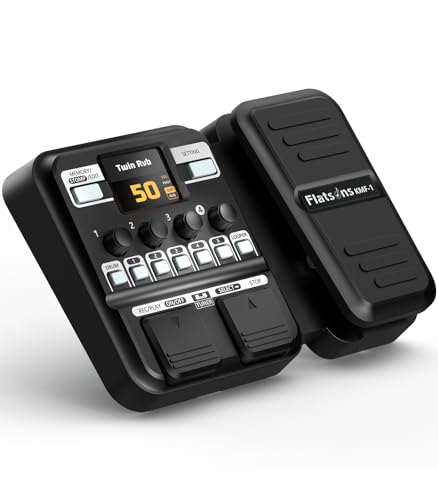
| Effect Modules | 8 modules (Amplifier, Cabinet, Drive, Modulation, Delay, Dynamics, Reverb, Filter) |
| Amp & Cabinet Models | 18 amp models and 18 cabinet simulators |
| DSP & Sampling | 512-point IR sampling with 32-bit signal processing for analog circuit simulation |
| Patches & Modes | 50 preset patches; Memory Mode for instant tone switching |
| Expression Pedal & Blocks | 2-in-1 expression pedal with 6 assignable effects; 5 independent effect blocks in Stomp Mode |
| Power & Battery Life | Powered by 6 AA batteries (2.5 hours runtime) |
You’ve been eyeing the Flatsons KMF-1 for a while, and I finally got my hands on it just last week. The moment I opened the box, that 128×32 LCD lighted up, and I could tell this wasn’t your basic floor-mat clone.
The first thing that stood out is how compact and sturdy the unit feels in hand. It isn’t heavy, but the chassis has a reassuring rigidity that screams road-ready.
I dug into the 77 effects across eight modules, and the 18 amp models plus 18 cabinet sims give you real tonal variety without hunting for a million plug-ins.
When you flip through presets, you’ll notice the 50 patches are usable right away, which is perfect if you’re just starting out or want quick stage changes. The Stomp Mode keeps things familiar, with five independent blocks you can sequence without rewriting your entire signal path.
Setup was straightforward: two power options, a battery compartment for on-the-go jams, and a simple Edit Mode for dialing in tone. The 6-assignable, 2-in-1 expression pedal is a nice touch, letting you morph between effects in real time.
I tested with both headphones and a basic amp, and the cab simulation helped keep things sounding rich on desk monitors too.
Musically, the DSP with TSAC feels responsive, and the 512-point IR sampling adds believable cabinet character. If you’re playing live, Memory Mode switches tones in a snap, which is clutch for switching songs mid-set.
A few moments of double-cab confusion can pop if you’re not listening to the guitar with the cabinet model enabled, but that’s a quick fix once you get the hang of it.
Overall, for the price, you’re getting a lot of versatility, quick-start usability, and pro-ish control. It’s not a boutique boutique, but it handles studio and stage duties well enough to be your main practice and rehearsal tool.
One last note: the built-in looper and drum rhythms are handy practice features, and the aux-in makes jamming with tracks feel natural. If you want a compact, affordable multi-effects pedal that sounds bigger than its sticker price, the KMF-1 is worth a serious look.
Pros
Cons
- Cab vs. real amp nuance
- Occasional double-cab tweak
LEKATO Multi Effects Guitar Pedal, IR Loading 9 AMP Models,

- ✓ Compact, solid build
- ✓ Great IR/amp variety
- ✓ Battery powered convenience
- ✕ Buffet of options can overwhelm
- ✕ Limited advanced routing
| AMP Models | 9 amp preamps |
| IR Cabinets | 8 classic IR cabinet/body models |
| IR File Support | Supports third-party IR files via USB; import via Cube-Suite software |
| Power and Battery | Built-in rechargeable battery; 2-hour full charge; 6-8 hours operation; charging while in use supported |
| Output/Monitoring | 3.5 mm headphone output for silent practice and monitoring |
| Connectivity and Recording | Bluetooth music playback and recording to PC or mobile devices via included cable |
I’ve had this LEKATO pedal on my testing wishlist for a while, and the moment I clipped it to my board I could feel the curiosity kick in. The tiny chassis surprised me with a surprisingly sturdy feel, and that built‑in battery begs the question: how far can you take this on a quick jam without hunting for a wall wart?
In practice, the 9 amp models and 8 IR cabinets cover a lot of ground without stealing your tone. The USB/IR loading option is a real win if you’re chasing specific cabinet vibes, and I appreciated how easy it is to import third‑party IRs with the Cube-Suite software.
It’s not fancy, but it nails the core task: give me usable drive, delay, and space without fiddling for hours.
Live mode shines when you want to switch presets on the fly. I found the three default presets—Lead, Rhythm, Clean—quite serviceable, and you can remix them into your own setups.
The ability to save edits as presets is a real time saver, letting you lock in a sound you’ll actually reach for during a gig or practice.
Portability is where this pedal earns extra points. The 3.5mm headphone output is clean for late-night practice, and charging alongside playing is a genuine convenience.
Bluetooth playback for practice tracks is a thoughtful touch that helps you test tones against real music without pulling out a laptop every time.
If you’re after a budget-friendly stage companion, this LEKATO checks a lot of boxes: versatile amp models, IR loading, battery power, and a straightforward workflow that doesn’t demand a software degree to use.
Overall, you’ll probably reach for it as a grab‑and‑go solution that still sounds convincing. It won’t replace a high‑end rig, but for practice, quick demos, or travel setups, it’s unexpectedly capable.
MOOER GE100Pro Li Guitar Multi-Effects Pedal AI Assistant

- ✓ Strong amp modeling
- ✓ Portable, long battery life
- ✓ Solid AI tone assistant
- ✕ UI could be faster
- ✕ Limited standalone amps
| Display | 3.5-inch color display |
| Connectivity | Type-C USB, Bluetooth |
| Power/Battery | GE100 Pro Li version with 2000 mAh lithium-ion battery, up to 6 hours |
| Storage/Expansion | Supports MNRS, NAM A2 and third-party IR files for expandability |
| Memory/Processing Features | Built-in AI tone assistant and MOOER Audio Separator with 6 separation modes |
| Built-in Effects/Capabilities | Includes looper (80 seconds stereo), 40 drum rhythms, 10 metronome patterns, amp modeling with expandable sound library |
You glance at the GE100Pro Li and notice the display glow first—that 3.5-inch color screen actually makes navigating presets feel almost tactile, especially when you’re hopping between amp models on the fly. What stands out is how quietly capable this thing feels beside pricier tablets and pedals you’d expect to require a bigger budget.
In my hands, the weight is reassuring but not heavy, and the finish grips your fingers without feeling sticky. I’ve found the Bluetooth input surprisingly handy for quick jam tracks, and the battery life on the Li version actually lives up to the six-hour promise when you’re running loops and drums at moderate volume.
Setup is friendlier than you’d expect for a multi-effects unit in this price tier. The AI assistant nudges you toward usable tones without demanding a doctorate in signal processing, which is a breath of fresh air if you’re trying to keep momentum during a practice session.
Talking through the modeling, the MOOER inverse tech nails a convincing amp vibe, especially when you pair it with third-party IRs. It’s not pretending to be a boutique amp, but it does a solid job giving your clean, crunchy, and lead tones a usable bite without weird artifacts.
The built-in looper and drum machine give you a real quick setup for practice or ideas on the go. I’ll admit, the integration with MOOER Cloud for presets is a nice productivity boost, so you’re not locked into one folder of sounds after a gig.
For live use, the dual model options mean you won’t feel tethered to a single setup—GE100 Pro at home, GE100 Pro Li when you’re out and about. And yes, the form factor fits nicely on a small pedal board alongside a few essentials without crowding your space.
Overall, a surprisingly capable all-in-one package that proves you don’t need to break the bank to get real, usable tones, practice features, and portable recording ready to go.
If you’re chasing a versatile, low-cost pedal that doesn’t require a cave full of accessories to sound good, this one’s worth a serious consider.
LEKATO Multi Effects Guitar Pedal, 125 Effects, 40 Amp

- ✓ Compact, portable design
- ✓ Wide preset and amp options
- ✓ Built-in looper and drums
- ✕ Limited battery life in full-tilt
- ✕ Small screen can be busy
| Processor / DSP Engine | Black-Box Digital Modeling with 24-bit/48 kHz high-resolution signal processing |
| Effects / Amp Model Count | 125 effects across 8 modules; 30 amp models; 30 cab simulations; 99 presets for guitar and bass |
| NAM / IR Support | NAM and IR loading with 10 NAM + 10 IR third-party slots |
| Sampling and Memory Features | 2″ TFT display; 40-second looper; 100 drum rhythms; up to 10 simultaneous effects blocks |
| Connectivity & Audio Interface | USB audio interface with ASIO low-latency recording; OTG recording; 1/4″ stereo TRS output; EXP/CTRL jack for expression pedal or footswitch |
| Power and Weight | Weighs 250 g; 1500 mAh battery providing up to 4 hours of play |
I pulled the LEKATO out of its box and grinned at those 2-inch TFT stats right away. The moment I unlocked the unit, the feel of the menu knob and the tactile click when you navigate presets reminded me of a compact studio rig you can actually carry.
You’ll notice the metal chassis is light enough to throw in a backpack, yet sturdy enough to survive a gig bag shuffle.
The 125 effects across 8 modules cover a surprising range, and I appreciated the quick-access 2nd screen for tone tweaks. I plugged into a real amp, swapped in a few of the 30 amp models, and the 30 cab sims kept things sounding coherent without fighting the room.
The Bluetooth app feels handy for deep edits, and I found loading NAM and IR files via USB surprisingly painless.
What stood out in practice is the built-in looper and drum rhythms. The 40 seconds isn’t huge, but it’s plenty for jotting ideas between changes during a home session.
The 10-block signal chain is forgiving enough to layer a few verbs, delays, and dynamics without turning into a spaghetti map.
Battery life isn’t weathered by a tiny design—about four hours of real playing when you’re not running on full bore. The 2″ TFT screen is readable in a dim room and keeps tone management approachable, which helps when you’re bouncing between live and studio setups.
On stage, the USB audio interface and ASIO support mean you can record ideas directly, no extra gear needed.
If you’re looking for a truly portable rig that covers practice, rehearsal, and light gigs, this LEKATO nails it on the budget. It’s not a boutique pedalboard, but it’s a left-field hero for found-sounding tones on the go.
What Features Should You Consider in the Best Low Cost Guitar Multi Effects Pedal?
When searching for the best low cost guitar multi effects pedal, consider the following features:
- Sound Quality: The tonal fidelity of a multi effects pedal is crucial, as it directly affects the overall sound of your guitar. Look for pedals that offer high-quality digital signal processing to ensure your effects sound clear and professional.
- Variety of Effects: A good multi effects pedal should provide a diverse range of effects, including distortion, reverb, delay, and modulation. Having multiple options allows for greater creative expression and versatility in your playing style.
- User-Friendly Interface: The ease of navigation and control is essential, especially for beginners. Look for pedals with intuitive layouts and clear displays that make it simple to switch between effects and customize settings.
- Durability: Since pedals are often used on stage or during practice, they should be robust enough to withstand regular use. Check for sturdy construction materials and reliable footswitches to ensure longevity.
- Power Supply Options: Consider how the pedal is powered, whether it uses batteries or an AC adapter. Some pedals offer the flexibility of battery operation for portability, while others may be best used with a power supply for consistent performance.
- Patch Management: The ability to save and recall presets or patches is a valuable feature, allowing you to store your favorite settings. This is particularly useful for live performances where quick access to different sounds is needed.
- Connectivity: Ensure the pedal has multiple input and output options, such as stereo outputs and effects loops, to integrate seamlessly into your existing setup. This flexibility can enhance your overall rig and allow for more complex sound configurations.
- Size and Portability: A compact design may be preferable if you need to save space on your pedalboard or travel frequently. Lightweight and smaller pedals can be a practical choice for those who prioritize portability without sacrificing functionality.
How Can the Best Low Cost Guitar Multi Effects Pedal Enhance My Sound?
The best low cost guitar multi effects pedal can significantly enhance your sound by offering a variety of effects and features without breaking the bank.
- Versatility: A low cost multi effects pedal provides access to numerous effects such as reverb, delay, distortion, and modulation in one compact unit.
- Cost-Effectiveness: These pedals allow guitarists to experiment with different sounds and effects without the need for multiple individual pedals, saving money and space.
- Ease of Use: Many affordable multi effects pedals come with user-friendly interfaces, making it easy for beginners to navigate and customize their sound.
- Portability: The compact design of most low cost multi effects pedals makes them easy to transport, ideal for gigging musicians.
- Sound Quality: Despite their low cost, many of these pedals offer high-quality sound processing that can enhance tone and creativity.
Versatility: A low cost multi effects pedal provides access to numerous effects such as reverb, delay, distortion, and modulation in one compact unit. This versatility allows guitarists to explore a wide range of tones and styles, from lush ambient sounds to gritty rock effects, all at the touch of a button.
Cost-Effectiveness: These pedals allow guitarists to experiment with different sounds and effects without the need for multiple individual pedals, saving money and space. Investing in one pedal that offers a variety of sounds can be much more economical than purchasing several separate effects units.
Ease of Use: Many affordable multi effects pedals come with user-friendly interfaces, making it easy for beginners to navigate and customize their sound. Clear displays and intuitive controls help users quickly dial in their preferred settings without getting overwhelmed.
Portability: The compact design of most low cost multi effects pedals makes them easy to transport, ideal for gigging musicians. Guitarists can easily fit these pedals into their gig bags or pedalboards, allowing for a hassle-free setup and teardown.
Sound Quality: Despite their low cost, many of these pedals offer high-quality sound processing that can enhance tone and creativity. With advancements in digital technology, budget-friendly models can produce impressive audio fidelity and dynamic range, allowing musicians to achieve professional-quality sounds on a budget.
What Are the Top Picks for the Best Low Cost Guitar Multi Effects Pedals?
The best low-cost guitar multi-effects pedals combine versatility and affordability, making them ideal for beginner and budget-conscious musicians.
- Zoom G1X Four: This pedal offers a wide range of effects, including amp modeling and over 70 built-in effects for a variety of soundscapes.
- Boss ME-80: With its intuitive interface and multiple effects, the ME-80 allows for real-time control and customization of sounds, making it suitable for live performances.
- Digitech RP55: The RP55 features a simple layout and a collection of 11 effects that can be easily combined, providing a straightforward user experience for beginners.
- Mooer GE150: This compact pedal packs a punch with its extensive preset options and high-quality effects, perfect for musicians looking for portability without sacrificing sound quality.
- Behringer FX600: Known for its affordability, the FX600 includes several effects such as chorus and flanger, and it’s a great option for those just starting to explore effects pedals.
The Zoom G1X Four is highly regarded for its extensive library of effects and amp simulations, making it a versatile choice for various musical styles. It also features a built-in looper and drum machine, adding further creative possibilities for practice and performance.
The Boss ME-80 stands out for its user-friendly interface that allows musicians to tweak effects on the fly, which is particularly useful during live shows. Its durable build quality and battery operation make it perfect for gigging musicians.
The Digitech RP55 is designed with simplicity in mind, offering a total of 11 effects that can be layered together, making it an excellent option for beginners who want to experiment without being overwhelmed by complexity.
The Mooer GE150 is praised for its compact size, making it ideal for travel and small setups. It offers a wide range of effects and presets that cater to various genres, and its USB connectivity allows for easy updates and recording options.
The Behringer FX600 provides a cost-effective way to explore different sound effects, making it perfect for beginners or those on a budget. Its straightforward design ensures that even novice users can quickly learn to use it and enhance their guitar tone.
Which Low Cost Guitar Multi Effects Pedals Are Best for Beginners?
The best low-cost guitar multi-effects pedals for beginners offer a variety of features and sound options without breaking the bank.
- Zoom G1X Four: This pedal features over 70 effects and amp models, making it versatile for any genre.
- Boss ME-80: Renowned for its intuitive interface, this pedal combines simplicity with a wide range of effects.
- Mooer GE150: Known for its compact size, this pedal provides quality sounds and has a built-in looper, ideal for practice.
- Digitech Element XP: This pedal includes a variety of effects and the ability to customize presets, perfect for beginners exploring different sounds.
- Valeton Dapper Mini: A compact option that offers various effects and amp simulations, making it easy to transport and use at gigs.
Zoom G1X Four: This versatile pedal offers an extensive library of over 70 effects and amp models, making it suitable for various musical styles. The built-in expression pedal allows for dynamic control over parameters, while its user-friendly interface ensures beginners can quickly learn to navigate and create their desired sound.
Boss ME-80: The Boss ME-80 is known for its robust build quality and straightforward interface, which makes it easy for beginners to adjust settings. It includes a wide array of effects, from classic distortion to modern delays, and features a battery operation option, providing flexibility for practice and performance in different environments.
Mooer GE150: Compact and lightweight, the Mooer GE150 is ideal for guitarists who need a portable solution. It features high-quality sound and a built-in looper for practicing and creating music on-the-go, making it a practical choice for beginners who want to experiment with layering sounds.
Digitech Element XP: This pedal stands out for its ability to create custom presets, allowing beginners to experiment with different sounds and settings easily. With a variety of effects and amp models to choose from, it provides a comprehensive platform for learning and developing guitar skills.
Valeton Dapper Mini: The Valeton Dapper Mini is a compact multi-effects pedal that packs a punch with its range of effects and amp simulations. Its small size makes it perfect for guitarists who need something portable, and its user-friendly design helps beginners quickly familiarize themselves with different sound options.
Are There Any Low Cost Guitar Multi Effects Pedals Recommended for Bass?
There are several low-cost guitar multi-effects pedals that are also suitable for bass players.
- BOSS ME-80: This versatile pedal combines the power of a multi-effects processor with a user-friendly interface, making it suitable for both guitarists and bassists. It features various effects like distortion, modulation, and delay, all of which can be adjusted to maintain the low-end integrity critical for bass while still allowing for creative expression.
- Zoom B3n: Specifically designed for bass, the Zoom B3n offers a range of amp models and effects that can be used in any combination. Its intuitive layout and built-in looper function make it an excellent choice for both practice and live playing, allowing bassists to explore their sound without breaking the bank.
- Digitech RP55: This affordable multi-effects pedal is packed with over 50 effects and amp models, providing bassists with plenty of options to shape their sound. Its simple interface and built-in tuner make it easy to use, and the ability to save user-defined patches allows players to create a signature sound tailored to their style.
- Behringer Ultra-G GI100: Although primarily an amplifier simulator, this pedal offers various effects that enhance the sound of a bass guitar. It’s a budget-friendly option that provides essential features, including a headphone output for silent practice and a direct output for recording, making it a useful tool for bass players.
- Mooer GE150: This compact multi-effects unit offers a wide range of effects and amp simulations ideal for bassists. It includes a built-in drum machine and looper, enhancing its versatility for practice and performance, and its small size makes it easy to transport.
How Do User Reviews Reflect on the Best Low Cost Guitar Multi Effects Pedals?
User reviews play a crucial role in identifying the best low cost guitar multi effects pedals, as they provide real-world insights and experiences from musicians.
- Sound Quality: Many users emphasize the importance of sound quality in their reviews, often comparing it to more expensive models. A pedal that offers a range of effects without sacrificing tone is highly praised, as musicians seek to enhance their sound without breaking the bank.
- Ease of Use: Reviews frequently mention the user interface and ease of navigation as critical factors. Pedals that are intuitive and allow for quick adjustments tend to receive higher ratings, as they enable musicians to focus more on performance rather than technical difficulties.
- Durability: The build quality of budget-friendly pedals is often scrutinized in user reviews. Musicians look for pedals that withstand the rigors of regular use, and those that are noted for their robust construction tend to receive better feedback, reflecting reliability over time.
- Value for Money: Many reviews highlight the overall value of a pedal in relation to its price. Users appreciate pedals that provide a wide range of features and effects for a low cost, making them feel like they are getting their money’s worth, which is a significant factor for budget-conscious musicians.
- Customer Support: Positive experiences with customer service can also influence user reviews significantly. When companies respond promptly to issues or provide firmware updates, it leaves a good impression and can sway potential buyers towards a particular model.